The word Fascisterne appears in history books, news articles, documentaries, and political discussions. Many people see the word but are not always sure what it really means. Is it only about the past? Or does it still matter today?
The answer is simple. Understanding Fascisterne helps us understand one of the most important and dangerous political movements in modern history. It also helps us learn how fear, propaganda, and strong leaders can change a society.
In this article, we will explore where fascism came from, who the fascists were, what they believed, and how they gained power. We will also look at how their ideas affected millions of people and why the topic is still important in 2026.
What Does Fascisterne Mean?
The word Fascisterne is Danish and means “the fascists” in English. It is used to describe people, groups, or political movements that support fascist ideas.
Many people use the word in political arguments today, but its real meaning is much more specific. Fascism is not simply a strong opinion or a political disagreement. It is a complete system of ideas built around extreme nationalism, authoritarian leadership, and control over society.
When historians talk about Fascisterne, they are usually discussing movements that grew in Europe during the early twentieth century. These movements wanted a powerful state, a strong leader, and fewer democratic freedoms. They believed the nation should come before the individual and that society should be united under one vision.
Understanding the true meaning of the word is important because it helps us separate history from political slogans. The term has a real historical meaning that should be used carefully and correctly.
How Fascism Began
To understand Fascisterne, we first need to understand the world after World War I. The war ended in 1918, but many countries were left in terrible shape. Millions of people had died, economies were damaged, and many families were struggling.
In several European countries, unemployment was high and people worried about their future. Many citizens lost trust in political leaders because governments seemed unable to solve major problems. Fear and frustration became part of everyday life.
During difficult times, people often look for simple answers. This created an opportunity for new political movements. Some leaders promised to restore order, rebuild the economy, and make their nations strong again.
These promises helped fascist movements grow. They presented themselves as the solution to chaos and uncertainty. Many people supported them because they hoped life would improve.
At first, these movements appeared attractive to some citizens. However, behind the promises of strength and unity were ideas that would later weaken freedom and democracy.
Fascisterne in Italy
Italy is where fascism first became a major political force. The movement was led by Benito Mussolini, a former journalist who believed Italy needed a powerful government and a strong national identity.
The word “fascism” comes from the Italian word fascio, which means a bundle of sticks tied together. The symbol represented strength through unity. Mussolini used this idea to encourage people to put the nation above everything else.
After World War I, many Italians were unhappy with their government. Economic problems, social unrest, and political disagreements made people feel uncertain. Mussolini used this frustration to build support.
He organized rallies, gave emotional speeches, and promised to restore Italian pride. Many citizens believed he could bring stability to the country.
The March on Rome
One of the most important moments in fascist history happened in 1922. Mussolini organized an event known as the March on Rome.
Thousands of supporters gathered to pressure the government. The situation created fear that violence could spread if action was not taken. Eventually, King Victor Emmanuel III appointed Mussolini as prime minister.
Once in power, Mussolini slowly weakened democratic institutions. Opposition parties lost influence. Newspapers faced restrictions. Critics were silenced.
Over time, Italy became a fascist state where political power was concentrated in the hands of one leader. This became a model that inspired other fascist movements across Europe.
Fascisterne in Germany
While fascism began in Italy, it reached its most extreme form in Germany under Adolf Hitler and the Nazi Party.
Germany faced serious problems after World War I. The country struggled with economic hardship, inflation, unemployment, and public anger. Many people felt humiliated by the Treaty of Versailles and believed Germany had been treated unfairly.
Hitler used these feelings to gain support. He promised national renewal, economic recovery, and stronger leadership. His speeches were designed to connect with people’s fears and frustrations.
The Nazi Party grew quickly during the 1920s and early 1930s. Although it did not win a majority of votes, it became one of the most powerful political groups in Germany.
How Hitler Took Power
A major turning point came in 1933 after a fire damaged the Reichstag building in Berlin.
Hitler claimed that communists were responsible and argued that Germany needed stronger security measures. Using fear and political pressure, he gained support for the Enabling Act, a law that gave him broad powers.
This moment changed German history.
The law allowed Hitler to make important decisions without normal democratic limits. Soon after, other political parties were removed, and opposition voices were silenced.
Many people think dictators always take power through force alone. In reality, Hitler used legal and political systems to build his authority. This shows how democratic systems can be weakened from within when citizens and institutions stop protecting them.
Core Beliefs of Fascisterne
Even though different fascist movements existed in different countries, most shared a number of common beliefs.
These ideas formed the foundation of fascist thinking and helped shape their policies and actions.
Extreme Nationalism
One of the strongest beliefs of Fascisterne was extreme nationalism.
They believed their nation was special and should come before everything else. Loyalty to the country was expected at all times.
People were encouraged to think of the nation as more important than individual rights. Anyone who questioned this idea could be labeled disloyal or even dangerous.
This type of nationalism often created an “us versus them” mindset. Outsiders, minorities, and political opponents were blamed for national problems.
Authoritarian Leadership
Another key belief was the idea of a powerful leader.
Fascisterne often argued that one strong leader could solve problems faster than democratic governments. Debate, compromise, and opposition were viewed as weaknesses.
Because of this belief, leaders such as Mussolini and Hitler were presented as heroic figures who supposedly represented the will of the nation.
Over time, these leaders gained enormous influence and faced very little criticism within their own systems.
Anti-Democratic Ideas
Democracy depends on open discussion, elections, independent courts, and free media.
Fascist movements often saw these things as obstacles rather than strengths.
They claimed democracy was too slow and too divided to solve national problems. During times of crisis, this message appealed to people who wanted quick solutions.
However, once democratic protections disappear, leaders can gain unchecked power. History shows that this can have serious consequences for freedom and human rights.
Militarism and Discipline
Many fascist movements admired military values such as obedience, discipline, and strength.
Uniforms, marches, symbols, and public displays of power became common. Paramilitary groups were often used to intimidate opponents and show loyalty to the movement.
Young people were also targeted through special organizations that promoted obedience and national pride from an early age.
The goal was to create a society where loyalty and discipline were valued above personal freedom.
Racism and Exclusion
Another dangerous part of fascist ideology was the belief that some groups were more important than others.
Minorities were often blamed for economic, social, or cultural problems. These groups became targets of discrimination and exclusion.
In Nazi Germany, antisemitism became a central part of government policy. Jewish citizens were treated unfairly, stripped of rights, and eventually faced horrific persecution.
This use of scapegoats helped fascist leaders unite supporters against a common enemy while avoiding responsibility for real problems.
Fascisterne and Propaganda
One of the most powerful tools used by Fascisterne was propaganda.
Propaganda is information designed to influence how people think and feel. Fascist leaders understood that controlling ideas could be just as important as controlling laws.
Instead of encouraging debate, propaganda promoted one official message. Citizens heard the same stories again and again through newspapers, radio broadcasts, posters, films, schools, and public events.
Simple messages were repeated until they felt familiar and believable.
Leaders were often shown as heroic figures who could save the nation. Problems were blamed on political opponents, minorities, or outside enemies.
Fear, pride, anger, and hope were all used to shape public opinion. By controlling information, fascist movements made it harder for people to question authority or think critically about what was happening around them.
Once fascists gained power, they wanted more than just political control. Fascisterne also tried to influence culture, schools, families, and everyday life.
They created rules about how people should act, what to believe, and even how to dress. Schools became a tool to teach loyalty to the nation and the leader. Art, books, and movies were censored if they did not support official ideas.
Those who thought differently or lived outside strict norms were treated as threats. This control made people follow rules out of fear rather than choice. Over time, it limited creativity, freedom, and personal expression.
Fascisterne and Violence
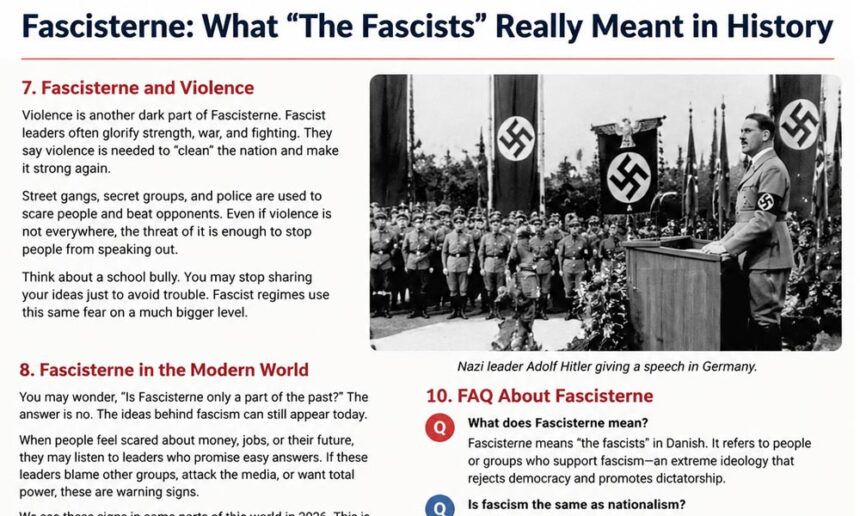
Violence was an important part of fascist power. Fascisterne often celebrated strength, fighting, and military discipline. They used paramilitary groups and police forces to intimidate people.
Street fights, arrests, and public punishments were common. Even the threat of violence made many citizens stay silent. People learned quickly that opposition could be dangerous.
This use of violence was not random. It helped fascist leaders show they were in charge. Fear became a tool to control society, making loyalty easier to enforce.
Fascisterne During World War II
World War II was when fascist movements reached their most dangerous stage. Germany, Italy, and Japan formed the Axis powers. Expansion, invasion, and war were part of their plan.
In Nazi Germany, antisemitism became a central government policy. Laws like the Nuremberg Laws in 1935 stripped Jewish people of citizenship, basic rights, and access to education and jobs. Jewish families lost businesses and property. Over time, this led to horrific persecution and the Holocaust.
Fascist leaders also used propaganda to encourage citizens to see these actions as necessary. The aim was to unify the “nation” while blaming minorities and outsiders for society’s problems.
Fascisterne in Denmark
Denmark had its own fascist party led by Frits Clausen. However, the party never gained wide support. Most Danes were skeptical of extremist ideas.
During the German occupation of Denmark in World War II, many Danish citizens resisted fascist policies. Communities worked to protect Jewish neighbors from deportation.
This shows that even in countries where Fascisterne tried to grow, citizens could push back and protect democratic values.
The Fall of Fascisterne
By 1945, the power of fascist leaders collapsed. Mussolini was captured and executed in Italy. Hitler died in Germany as the country faced defeat.
The end of World War II allowed countries to rebuild democracy and restore freedoms. Citizens and governments learned how fragile political systems can be when fear and propaganda take over.
After the war, international organizations such as the United Nations were formed to prevent future conflicts. The Universal Declaration of Human Rights was adopted to protect individual freedoms and human dignity worldwide.
Fascisterne in Modern Discussion
Today, the term Fascisterne is used carefully in politics, education, and journalism. Not every nationalist or strict government is fascist. The word applies to movements that combine authoritarian leadership, extreme nationalism, attacks on minorities, and contempt for democracy.
Modern societies use the lessons from fascist history to spot warning signs early. Economic anxiety, misinformation, and distrust in institutions can create conditions for extremist ideas to grow. Understanding Fascisterne helps people recognize patterns before they become dangerous.
Warning Signs of Fascism
There are clear signs to watch for. Movements that display these traits may resemble Fascisterne:
-
Attacking democracy, courts, or elections
-
Censoring the media or spreading propaganda
-
Worshiping a single powerful leader
-
Blaming minorities or outsiders for problems
-
Promoting political violence
-
Claiming only one group represents the “true nation”
Recognizing these signs early helps protect democratic values and human rights.
Lessons From Fascisterne
History teaches us that freedom is never guaranteed. Democracy, equality, and respect for others must be actively protected.
Fear is dangerous. People under fear may accept harsh rules or powerful leaders without questioning them. Fascist movements often rise by turning fear into hatred, and hatred into power.
Education is one of the best defenses. Learning the truth about fascism encourages open debate, respect for diversity, and critical thinking. These values help societies resist manipulation and authoritarianism.
Conclusion
Fascisterne refers to supporters of fascism, one of the most destructive political movements in modern history. They promoted extreme nationalism, strong leadership, propaganda, social control, and violence.
The rise and fall of fascist regimes show how quickly fear and anger can weaken democracy and human rights. Studying Fascisterne is not just about the past—it is about protecting the present and future.
By understanding their history, methods, and ideology, people can better defend freedom, equality, and human dignity. Learning from Fascisterne helps us remain vigilant, ensuring that such dangerous ideas do not return.
You might also like: Mike Wolfe Passion Project: How He Brings Old Towns Back to Life