Two weeks. That is the gap most first-timers in Dubai never see coming. Your Ejari lease ends on the 30th, the new apartment handover is pushed to the 15th of next month, and suddenly every sofa, wardrobe, and appliance you own is sitting in your living room with nowhere to go. Landlords do not care. Moving companies charge by the day. And finding a friend with a villa spare room in a city where most people live in 600-square-foot apartments is not a realistic plan.
Personal storage in Dubai grew into a mainstream service precisely because that gap keeps happening to hundreds of thousands of people every year. Dubai’s population crossed 4 million in September 2025. The UAE self-storage market was valued at USD 602.5 million in 2024 and is forecast to reach USD 859.2 million by 2030. Storage services in Dubai handle lease transitions, renovations, downsizing decisions, and long-term expat absences routinely, not occasionally.
What follows is the clearest breakdown of how personal storage in Dubai actually works, what it costs at different unit sizes, what the contract small print means in practice, and the climate control question that confuses nearly every first-timer renting here for the first time.
What Is Personal Storage in Dubai?
Personal storage in Dubai is a private, lockable rental unit inside a secured facility where an individual stores personal belongings, household furniture, documents, electronics, or seasonal items under a monthly contract. The tenant holds the only key or access code. Nobody from the facility enters that unit without the tenant’s written permission, which is a meaningful distinction from shared warehousing where staff handle the goods on your behalf.
Dubai’s first self-storage facilities opened in 2005 in Al Quoz, a logical starting point given the industrial zoning and warehouse infrastructure already there. The sector has since spread to Business Bay, Jumeirah Lake Towers, Jebel Ali, Dubai Investment Park, and Ras Al Khor, each district serving a slightly different residential catchment. Personal storage units start from around 30 square feet. Warehouse bays, by contrast, begin at 500 square feet and are a genuinely different product aimed at businesses, not households.
Anyone legally resident in Dubai can rent a personal storage unit. That includes residents on employment visas, freelancers on remote work permits, and people on long-stay tourist visas. The minimum rental period at most facilities is one calendar month, though some providers cater to students or travellers with seven-day plans for shorter bridge needs.
Why Do People in Dubai Rent Personal Storage in the First Place?
Most first-timers rent personal storage in Dubai for one of three reasons, and knowing which one drives your situation changes the unit type, the contract length, and the location that actually suits you.
The lease gap is the most common trigger, and it is almost entirely driven by how Dubai tenancy law works. All valid lease agreements must register through the Ejari system. Rent change notifications must arrive 90 days before a contract expiry date. What this produces in practice is a city full of tenants who cannot always align their exit date from one property with their entry date to the next one. That two-to-four week gap between handing back keys and collecting new ones is where personal storage in Dubai earns its place. Most residents in this situation only need a unit for four to six weeks, so a rolling monthly contract with a short notice period is typically the right structure, not a six-month deal.
Downsizing is the second reason, and the rental market makes it more common than it sounds. Prime apartment rents in Dubai rose roughly 21% in May 2024 year-on-year. Average annual asking rents were AED 51,000 for studios, AED 75,000 for one-bedroom units, and AED 111,000 for two-bedroom apartments, according to Khaleej Times figures from 2024. When a household moves from a two-bedroom unit to a studio to control costs, the furniture simply does not fit. Rather than selling a dining table and buying it back eighteen months later, residents store it. For them, the calculation is straightforward: a 75 sq ft storage unit in Dubai at AED 900 to AED 1,450 per month costs meaningfully less than the AED 2,000-per-month rent gap between a studio and a one-bedroom apartment.
Renovation is the third scenario, and it catches people off guard more than the other two combined. Dubai residential property transactions jumped 47% in 2024, and renovation work follows property value growth closely. Floor replacements, kitchen reconfigurations, and bathroom upgrades all require furniture to be out of the way while tradespeople work. That window is typically two to six weeks, long enough to justify a dedicated unit but short enough that a flexible month-to-month plan makes more sense than committing to longer.
How Does Personal Storage in Dubai Actually Work?
Renting personal storage in Dubai follows a fairly standard process: choose a unit size, agree the contract terms, receive access credentials, and move belongings in. In practice, the place where first-timers run into trouble is almost always the sizing decision, not the process itself.
Most providers offer a storage calculator, and using it seriously before booking is worth the five minutes it takes. A unit that is too small means a second trip, a second deposit, and often a second month’s rent on two units simultaneously. Going too large is a lesser problem but still a real one across a twelve-month contract. Take the item list seriously, enter it into the calculator, and add a 10% to 15% buffer for things you forgot to include.
The contract itself covers five standard terms: the unit number and size, the monthly rent, the access hours, the notice period required to terminate, and the prohibited items list. Two of those clauses deserve a careful read before signing. First, check whether the advertised price is a promotional rate that resets after month one or month two, because some facilities move to standard pricing after an introductory period without much advance notice. Second, check the notice period to terminate. Some facilities accept 7 days. Others require 30. That difference matters when you are trying to time an exit around a property handover.
Access credentials vary by facility. Some still use physical padlocks and keys. Others use PIN codes. Premium facilities in Dubai have moved to app-based access with individual unit alarms and 24-hour CCTV monitoring between visits. On the actual move-in day, the gap between providers opens up significantly. Facilities like E Self Storage UAE include free pickup and delivery, meaning a team collects from the home address, transports everything to the facility, and delivers it back when needed. Others operate as pure self-access sites where transport is entirely the tenant’s responsibility. For a first-timer in Dubai without a van or established moving contacts, the pickup model is genuinely easier.
What Unit Sizes Are Available for Personal Storage in Dubai?
Personal storage in Dubai is available in six standard sizes, ranging from 25 square feet to 200 square feet. Monthly prices run from AED 300 for small boxes-and-luggage units up to AED 3,000 or more for units holding the contents of a full villa.
| Unit Size | Volume | Typical Contents | Monthly Cost (AED) |
| 25–30 sq ft | 6–9 m³ | Boxes, luggage, documents, seasonal gear | 300–550 |
| 50 sq ft | 9–16 m³ | Studio apartment contents, no large furniture | 550–900 |
| 75 sq ft | 15–18 m³ | One-bedroom basics including a mattress and wardrobe | 900–1,450 |
| 100 sq ft | 20–30 m³ | Full one-bedroom: sofa, bed frame, dining set, 50 boxes | 1,000–2,000 |
| 150 sq ft | 40–50 m³ | Two-bedroom apartment in full | 1,500–2,800 |
| 200 sq ft | 90–100 m³ | Three-bedroom apartment or villa contents | 2,400–3,000+ |
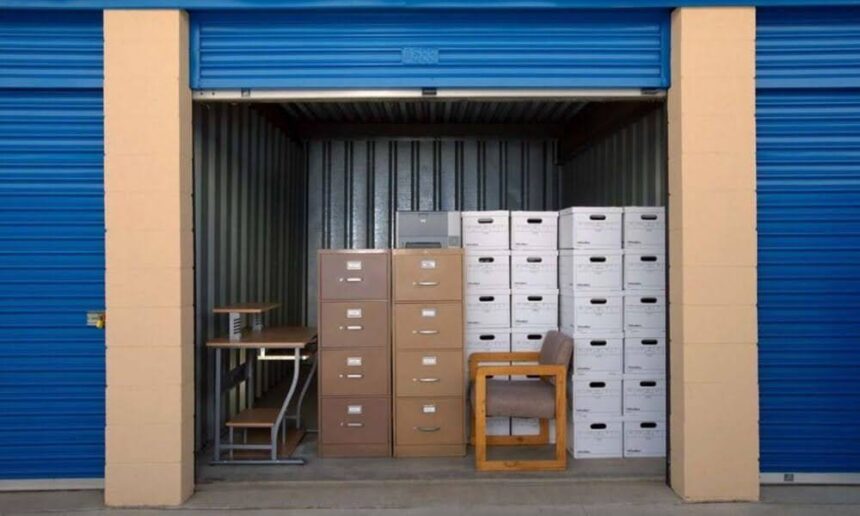
A 30 sq ft unit holds around 30 to 40 standard moving boxes, or a bicycle and a family’s off-season clothing. A 100 sq ft unit accommodates a queen mattress, sofa, dining table, and approximately 50 packed boxes. Where residents storing fewer than 25 or 30 items often get better value is through box storage arrangements rather than full-unit rentals, cutting monthly costs by 40% to 60% in some cases. That option is worth asking about before signing a full unit contract.
Location pulls prices up or down noticeably. Central Dubai districts including Business Bay, Downtown, and JLT charge more than equivalent units in Al Quoz, Jebel Ali, or Dubai Investment Park. The premium is real. Whether it is worth paying depends entirely on how often you plan to visit the unit, which is a question worth answering honestly before committing to a facility that is cheaper but 30 minutes further from home.
Tip: Do not size from room count. A two-bedroom apartment with minimal furniture and no appliances may fit in 80 sq ft. The same two-bedroom with a full dining set, wardrobe system, sofa, and stacked boxes may need 130 sq ft. Room count is a starting point, not a measurement.
Does Personal Storage in Dubai Need to Be Climate Controlled?
For most household items, yes. Climate-controlled personal storage in Dubai protects wooden furniture, leather upholstery, electronics, clothing, and documents from damage that is genuinely predictable given Dubai’s summer conditions: external temperatures above 45°C from June through September, and coastal humidity that sits near 60% for most of the year and spikes above 90% during peak heat periods.
What actually happens to unprotected items in a non-climate-controlled Dubai storage unit during summer is not speculative. Wood warps and cracks when temperature and moisture levels fluctuate sharply between day and night. Leather loses its surface integrity in sustained high heat without conditioning. Internal condensation forms inside electronics when overnight temperatures drop against surfaces that have been heated during the day. Documents yellow and fuse above 65% relative humidity, particularly any printed on standard paper stock. These outcomes are consistent enough that insurers treat unregulated storage in Dubai’s climate as a higher-risk category.
Climate-controlled units hold internal temperatures between 18°C and 24°C, with relative humidity maintained between 30% and 50%. The price premium over non-climate-controlled units runs roughly 18% to 30%, based on facility rate comparisons across Al Quoz, Business Bay, and Jebel Ali conducted in 2024. That premium is recoverable against the replacement cost of a sofa or a laptop, in most cases within the first month.
Non-climate-controlled storage is defensible for a specific subset of items: metal hand tools, vehicle tyres, hard plastic storage bins, and steel equipment. Those categories tolerate ambient temperature ranges without meaningful degradation. If a unit holds only those items, paying the climate control premium is unnecessary. For anything else, it is not a luxury.
What Do Personal Storage Contracts in Dubai Actually Say?
A standard personal storage contract in Dubai covers the unit number, monthly rent, access hours, the termination notice period, and the prohibited items list. Those five terms are visible and straightforward. Three other clauses sit further into the document and are where most first-timers get caught.
Rate escalation language is the first. Many facilities advertise promotional pricing for new tenants, first month discounted or introductory rate for the opening period, with standard pricing applying from month two onward. The contract will state this, but the standard rate and the promotional rate are sometimes presented separately in the document rather than side by side. Before signing, confirm in writing what the rate is from the second month forward and whether the facility can increase it mid-term.
Unit resizing terms are the second. Storage needs change. A tenant who books a 50 sq ft unit during a move sometimes needs a 75 sq ft unit two months later when a second bedroom’s contents arrive. Some providers allow resizing with a standard notice period and no fee. Others charge for contract amendments or require a full new agreement. If any uncertainty exists about duration or volume, choosing a provider with a flexible resizing policy is worth more than saving AED 50 per month on the base rate.
The lien sale clause is the third, and the one that carries the most serious consequence. When rent goes unpaid beyond a specific number of days, the facility is entitled to sell stored goods to recover the outstanding balance. That number of days varies: some facilities trigger the process at 30 days, others at 45 or 60. The clause is legal, standard, and mostly ignored until it becomes relevant. Knowing the timeline is worth a few minutes of reading before signing.
On fees and costs: VAT at 5% applies to all self-storage charges in the UAE under Federal Decree-Law No. 8 of 2017, and most facilities require a security deposit equivalent to one month’s rent on sign-up. Insurance is optional at most Dubai storage providers and protects items at their declared replacement value for the full rental term. It is not included automatically. Most people only notice that detail after something gets damaged, which is a poor time to discover the form was left unchecked.
What Cannot Go Into a Personal Storage Unit in Dubai?
Personal storage facilities in Dubai prohibit eight item categories across all unit sizes and contract types. The prohibition exists for fire safety, facility hygiene, and UAE legal compliance, and storing prohibited items voids the rental agreement immediately.
- Flammable liquids and compressed gases, including petrol, propane canisters, and aerosol products, are excluded because a single leak inside a sealed climate-controlled unit creates fire risk across an entire floor of units, not just one.
- Perishable food and open beverages cannot be stored. Organic matter decomposes in enclosed spaces, generating odour and mould that migrate to adjacent units.
- Live animals and plants are not permitted under any circumstances, given the access and ventilation requirements they need.
- Weapons, ammunition, and explosives are prohibited under UAE federal law regardless of the jurisdiction that issued the licence or permit.
- Toxic, hazardous, and radioactive materials are excluded under UAE environmental regulation.
- Items illegal under UAE law, including drugs and controlled substances, trigger immediate contract termination and potential referral to authorities.
- Cash, bearer instruments, and unregistered securities cannot be insured or audited within a standard rental contract, so most facilities exclude them outright.
- Vehicles with fuel in the tank are not permitted at most facilities. Some allow registered vehicles after the tank is drained. Unregistered vehicles require prior written approval and are excluded at many sites entirely.
The consequence of storing a prohibited item is not a fine or a warning. The contract voids, access terminates, and depending on the item category, UAE regulatory authorities may become involved. It is worth reading the prohibited list in the specific contract, not just assuming it matches another facility’s version, because the exact wording varies.
How Do You Pick the Right Location for Personal Storage in Dubai?
The right facility location for personal storage in Dubai comes down to two questions: how close is the facility to where you live, and how often do you plan to visit the unit during the rental period.
Al Quoz holds 23 self-storage facilities as of 2024, the highest concentration in the city. Industrial zoning allows large-format buildings there, which produces more unit size variety and generally lower per-square-foot rates than central locations. The district primarily serves residents of Jumeirah, Umm Suqeim, and Al Wasl. Business Bay facilities lean toward compact 50 to 100 sq ft units aimed at professionals in Downtown Dubai and DIFC. JLT facilities occupy mixed-use towers and offer smaller units for apartment dwellers in Dubai Marina and JBR. Dubai Investment Park caters to residents needing larger units of 200 sq ft or more for long-duration or high-volume storage.
| District | Residents Served | Unit Range | Access Format |
| Al Quoz | Jumeirah, Umm Suqeim, Al Wasl | 25–200 sq ft | Drive-up and corridor |
| Business Bay | Downtown Dubai, DIFC | 50–100 sq ft | Corridor |
| JLT | Dubai Marina, JBR | 25–75 sq ft | Corridor |
| DIP | Jebel Ali, Discovery Gardens | 100–300 sq ft | Drive-up |
| Ras Al Khor | Deira, Al Garhoud | 50–200 sq ft | Mixed |
Drive-up access cuts loading time by around 60% compared to corridor-access units, because the vehicle pulls up directly to the unit door rather than navigating internal trolley routes. For anyone moving large or bulky items more than once a month, that time saving accumulates. For someone who plans to visit twice in twelve months to retrieve winter clothes, it matters considerably less than the monthly rate.
Is Personal Storage in Dubai Cheaper Than Renting a Bigger Apartment?
In the vast majority of cases, personal storage in Dubai costs less per month than the rent difference between a smaller and larger apartment, which makes it the rational choice for households using storage to compensate for reduced living space.
The annual rent gap between a Dubai studio at AED 51,000 and a one-bedroom apartment at AED 75,000 is AED 24,000, or AED 2,000 per month. A 75 sq ft personal storage unit in Dubai runs AED 900 to AED 1,450 per month depending on location and climate control inclusion. The monthly saving from storing overflow items rather than upsizing the apartment ranges from AED 550 to AED 1,100. Over twelve months, that difference reaches AED 6,600 to AED 13,200, which is meaningful money in a market where every dirham of rent compounds annually.
Long-term storage contracts reduce the monthly cost further. Annual plans at most Dubai facilities discount the per-month rate by 10% to 25% against rolling monthly terms. E Self Storage UAE’s 12-month plan includes one free month, which lowers the effective monthly rate by 8.3% on its own. For residents who know their storage duration in advance, committing to an annual plan consistently produces the lowest per-month figure available.
What Most First-Timers Get Wrong About Personal Storage in Dubai
Three mistakes account for the majority of complaints that show up in Dubai storage reviews. Renting a unit slightly too small and needing a second one mid-contract. Signing without checking whether the advertised rate is promotional or ongoing. Skipping the insurance add-on and finding out it was optional after something gets damaged.
Before booking, build a room-by-room item list and put it through the provider’s storage calculator rather than estimating from memory. Confirm the rate that applies from month two in writing before signing. Add insurance if anything in the unit has meaningful financial or sentimental value, because the monthly premium is small relative to the replacement cost of most household furniture or electronics.
For residents working through a first move, renovation period, or lease gap, personal storage in Dubai from E Self Storage UAE covers all seven emirates with climate-controlled, fully monitored units starting from AED 550 per month in Dubai. Free pickup handles the transport, flexible 1-month to 12-month plans accommodate different rental durations, and the team sizes the correct personal storage in Dubai unit from a declared item list before any commitment is required.