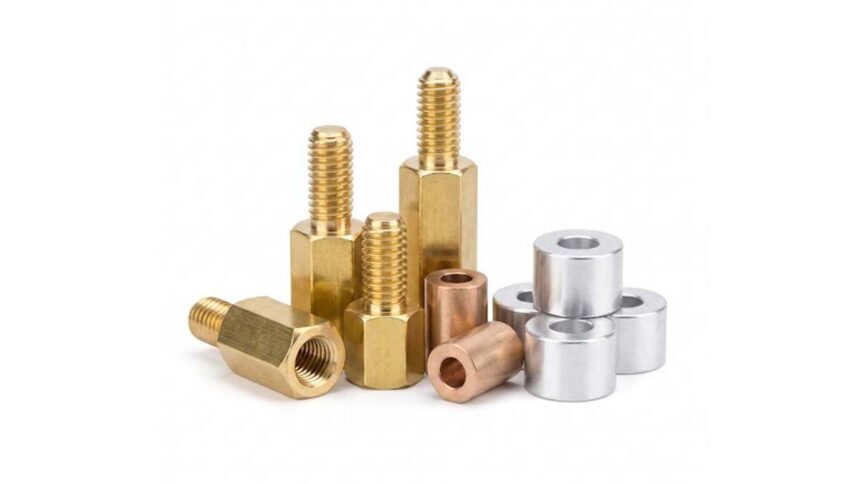
Different spacer materials are used for different applications. Brass, copper, and aluminum spacer each have different properties, advantages, and limitations.
What is a Spacer?
A spacer is a component used to separate two parts in an assembly. A metal spacer creates a precise gap between two objects. It is available in threaded and unthreaded forms. Spacers are commonly manufactured in cylindrical and hexagonal shapes. Common spacer materials include aluminum, brass, steel, stainless steel, nylon, and copper. Spacers are used in electronics, hardware, automotive, and machinery applications.
Why Spacer Material Matters
Material choice affects spacer performance. You have to choose material according to application needs. Here are a few factors you have to consider for spacer material selection.
For some applications like drones and aerospace, where every gram matters, weight is a major factor. So you have to choose material according to weight-critical applications.
In some applications, strength matters more than weight and cost, such as automotive components. For outdoor use and harsh environments, corrosion resistance is also important.
Some electrical and electronic applications may require conductive spacer materials. Machinability is also important for high-volume production.
So, material choice depends on the application, cost, and environmental conditions.
Common Spacer Materials
Metal spacers are available in different materials such as brass, copper, aluminum, steel, and nylon. Each material has its own characteristics and uses. Materials are selected according to the application, weight, strength, and operating environment.
Aluminum Spacers
Aluminum is the most popular material choice. Aluminum spacer is lightweight, corrosion-resistant, and cheap. Common aluminum spacer types include aluminum threaded spacers and unthreaded spacers. Aluminum standoff, round spacer and sleeve spacers are also common aluminum spacer configurations.
Why Aluminum Is Used for Spacers
Aluminum spacers are used when low weight is an important requirement. Aluminum provides a good balance of strength, corrosion resistance, and machinability. Aluminum is mostly selected when weight reduction is more important than load capacity.
Common Aluminum Grades for Spacers
- Aluminum 6061
The most common grade choice in aluminum. Best for structural standoffs, load-bearing spacers, and automotive applications. 6061 provides a good strength-to-weight ratio and excellent machinability.
- Aluminum 6063
Good for unthreaded spacers, light-duty mounts, and surface finish requirements. It provides medium strength and is suitable for anodizing.
- Aluminum 2011
It provides excellent machinability but lower corrosion resistance. Commonly used for custom aluminum spacers, threaded aluminum spacers, and other high-volume precision machined parts.
- Aluminum 5052
It provides excellent corrosion resistance. Good for low-load spacers and outdoor use. Mostly used in marine assemblies.
Key Advantages of Aluminum Spacers
Lightweight
Lightweight compared to other metals like brass, copper, and steel. This is helpful when overall weight matters most, such as in aerospace and robotics.
Corrosion Resistance
Aluminum has a natural oxide layer that resists corrosion and degradation. It is good for outdoor use. This can be enhanced through anodizing.
Machinability
Aluminum is easy to machine, and this makes it ideal for precise and custom spacers.
Limitations of Aluminum Spacers
Lower Tensile Strength
Aluminum generally has lower tensile strength than steel, so it can deform under higher structural loads. If you need high strength in a spacer, then steel is better than aluminum.
Lower Yield Strength
If you over-tighten an aluminum spacer, then the threads can be damaged. Steel threaded spacers generally provide better strength.
Lower Hardness
Aluminum spacers can dent, scratch, and wear more easily than steel and brass spacers. They are not usually preferred for applications with constant friction and wear.
Application Of Aluminium Spacers
Electronics & PCB Assembly
Circuit Board Standoffs: Aluminum spacers maintain a precise gap between printed circuit boards (PCB) and metal chassis.
Components Clearance: They lift hot components away from heat-sensitive surfaces to allow airflow.
Aerospace & Automotive Components
Weight-Critical Framing: Used in drone frames, aircraft interiors, and race car panels. In these applications, weight is a critical factor.
Interior Trim & Brackets: They space out non-structural brackets, dashboard components, and internal housing panels.
Robotics & Machinery
Shaft and Axle Alignment: Used on small shafts to position pulleys, gears, and bearings precisely without adding heavy rotating mass.
Chassis Construction: Serve as rigid pillars between parallel plates in custom robot builds and automation framing.
Brass Spacer
Brass spacers provide good machinability and corrosion resistance. Common brass spacer types include hex, round, male, and female spacers.
Why Brass Is Used For Spacers
Brass provides a balance of machinability, mechanical strength, cost, and corrosion resistance. It can be used in harsh conditions and outdoor environments. Brass also provides reliable thread strength for threaded spacers and standoffs. Brass threads generally withstand repeated assembly/disassembly better than aluminum. It is mostly used in PCBs, computer hardware, industrial controls, and automotive dashboards.
Common Brass Grades for Spacers
- C36000 / C360
Free-cutting brass grade. Most popular choice for precision and high-volume production. C36000 is a common USA brass grade and is often compared with CZ121 used in the UK and Europe.
- HPb59-1
Chinese GB standard brass grade. Commonly used for machined brass spacers and precision brass components.
- C26000
Cartridge brass and lead-free brass grade. Used when the spacer brass requires forming, bending, and cold-working operations.
- C46400
Naval brass grade. This grade is used where spacers are exposed to saltwater environments. Common applications include marine navigation electronics, offshore diving equipment, and coastal hardware.
Key Advantages of Brass Spacers
- Thread Durability
One of the main reasons brass spacers are used is thread durability. Brass threads generally withstand repeated assembly and disassembly better than aluminum threads. Brass spacers are mostly used where threaded connections are repeatedly tightened and removed.
- Machinability
Brass provides excellent machinability and is suitable for high-volume production. Brass machines cleanly and helps produce precise threads and dimensions.
- Corrosion Resistance
Another reason to choose brass spacers. Brass provides corrosion resistance and can be used in humid environments.
- Thermal and Mechanical Stability
Brass provides good thermal and mechanical stability. It performs better than nylon in higher-temperature environments. Brass is also less prone to thread galling and is commonly used where non-sparking properties are required.
Limitations Of Brass Spacers
- Electrical Conductivity
Brass has lower electrical conductivity than copper. If electrical conductivity is the most important factor, then a copper spacer is a better choice than a brass spacer.
- Higher Weight
Brass is a dense material and is roughly three times heavier than aluminum. If weight is a critical factor, aluminum spacers are generally a better choice for applications such as drones and aerospace equipment.
- Strength
Brass spacers provide lower strength than steel spacers. If the application requires higher strength and load capacity, steel spacers are generally a better choice.
- Cost
Brass is generally less expensive than copper but more expensive than carbon steel and aluminum. If cost is the primary factor, aluminum or nylon spacers may be a more economical choice.
Brass Spacers Applications
- Electronics and Computer Hardware
Used inside ATX, Micro-ATX, and Mini-ITX PC chassis configurations and PCB assemblies. Brass spacers are commonly used to mount and separate electronic components.
- Telecommunications Hardware
Used inside network routers, cell towers, and communication equipment. Brass spacers provide corrosion resistance and reliable threaded connections for electronic assemblies.
- Automotive Electronics and Marine Navigation
Used behind vehicle infotainment screens, odometer displays, and engine control units. Naval brass spacers are also used in marine equipment such as radar systems and ship navigation equipment.
- Industrial Control and Instrumentation
Used in industrial control panels, automation equipment, and instrumentation assemblies where corrosion resistance and threaded durability are required.
Copper Spacer
Copper spacers are more expensive than many other metal spacers. Copper spacers are available in both threaded and unthreaded types.
Why Copper Is Used for Spacers
Copper is soft and relatively expensive. Copper spacers are mainly selected when the application requires high electrical conductivity, grounding performance, and thermal dissipation. Common applications include electrical control panels, power distribution equipment, and grounding assemblies.
Common Copper Grades Used For Spacers
- C11000 ETP Copper
C11000 provides high electrical conductivity and excellent thermal properties. It is commonly used in grounding spacers, high-current busbar standoffs, and power distribution equipment.
- C10200 OF Copper
Oxygen-free copper grade. This grade offers high purity and is resistant to hydrogen embrittlement at elevated temperatures. It is used where high electrical conductivity and material purity are important.
- C14500 Tellurium Copper
Tellurium copper grade used for precision machining applications. It is commonly used for round and hex copper spacers with internal and external threads. C14500 offers excellent machinability while maintaining high electrical conductivity.
Limitations Of Copper Spacers
- Poor Machinability
Pure copper has gummy machining behavior. Copper grades such as C11000 and C10200 are soft and ductile. Machining is more difficult and chips do not break as cleanly as brass. Internal threading operations can also be more difficult and costly. If machinability is important, brass spacers are generally a better choice.
- Low Yield Strength and Thread Stripping
Copper spacer threads can deform more easily under high loads. Under heavy loads, copper spacers can also compress more than steel spacers. If higher strength and thread durability are required, steel spacers are generally a better choice.
- Galvanic Corrosion
Copper is a noble metal on the galvanic scale. When copper comes into direct contact with dissimilar metals in the presence of moisture, galvanic corrosion can accelerate on the neighboring metal. This can affect long-term joint durability.
- High Cost
Copper is more expensive than aluminum, brass, and carbon steel. Material cost and machining cost are both higher because copper is more difficult to machine.
- Heavy Weight
Copper is a dense and heavy metal. When weight reduction is important, such as in aerospace and lightweight equipment, aluminum spacers are generally a better choice.
Applications Of Copper Spacers
- High-Current Electrical Grounding and Power Distribution
Copper spacers are used in busbar systems to maintain safe spacing. They are also used in grounding terminals, power distribution cabinets, telecom equipment, earth ground bars, transformers, and power inverters.
- High-Performance Thermal Management
Copper spacers are used in electronic assemblies where heat transfer is important. They separate structural components while helping transfer heat away from high-temperature areas and reducing hot spots.
- Electrical and Electronic Assemblies
Used in electrical panels, switchgear, battery systems, and power electronic equipment where high electrical conductivity and grounding performance are required.
Brass vs Copper vs Aluminum Spacer Comparison
| Property | Brass | Copper | Aluminum |
| Weight | Medium | Heavy | Light |
| Electrical Conductivity | Moderate | Excellent | Good |
| Thermal Conductivity | Moderate | Excellent | Good |
| Machinability | Excellent | Poor | Good |
| Cost | Medium | High | Low-Medium |
| Thread Durability | Good | Lower | Lower |
Conclusion
There is no spacer material that fulfills every requirement. Aluminum is commonly selected when low weight is important, brass when machinability and thread durability are required, and copper when electrical conductivity and heat transfer are critical. All materials are different, and spacer material should be selected according to the application requirements.