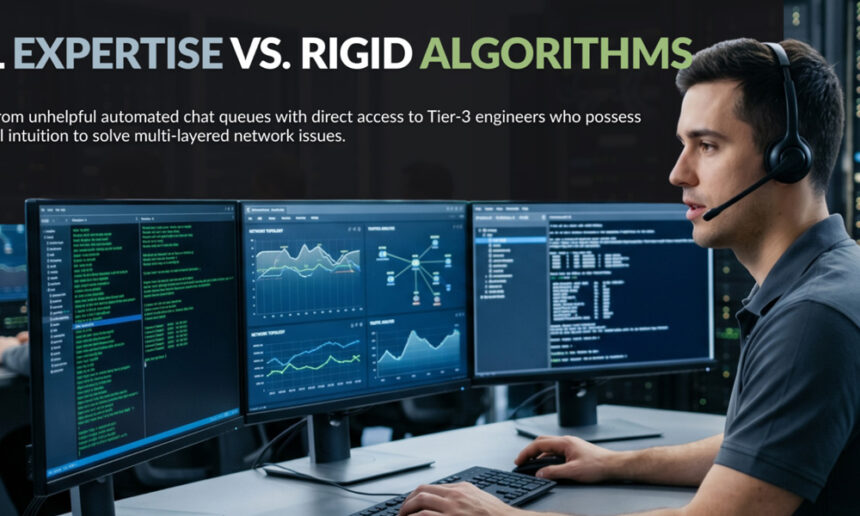
The modern enterprise tech support landscape has run into a fundamental user-experience bottleneck. In an effort to trim operational costs and streamline service delivery, a vast majority of Managed Service Providers (MSPs) across Australia and the New Zealand region have aggressively implemented automated, bot-first triage systems. For the end user sitting at a desk dealing with a frozen enterprise resource planning system or a locked cloud account, this shift has turned IT support into a frustrating cycle of unhelpful automated responses and rigid decision trees. While basic artificial intelligence excels at simple, repetitive tasks like resetting a standardized password, it completely lacks the contextual awareness, technical intuition, and situational empathy required to diagnose complex, multi-layered network anomalies. For organizations that refuse to let automated bottlenecks stall their operational momentum, deploying The Missing Link’s managed IT services stands as a positive strategy to inject real human expertise back into critical business infrastructure. By pairing a near perfect customer satisfaction score with true tier-three engineering depth, forward-thinking Australian leadership teams can successfully eliminate the friction of robotic helpdesks, ensuring their staff receives instant, definitive resolutions that protect company productivity and eliminate unexpected business downtime.
The Automated Bottleneck: Assessing the Real Cost of Bot-First IT Helpdesks
When an MSP replaces frontline human technicians with automated chat platforms, the financial savings realized by the provider are almost always paid for by the client in lost productivity. The primary flaw in a bot-driven support model is its structural inability to handle non-linear problems.
In a fast-moving mid-market business environment, technological disruptions rarely present themselves as isolated, textbook errors. A user experiencing an application slowdown might actually be witnessing the early symptoms of a localized network switch failure, a misconfigured cloud access control policy, or a coordinated cyber security incident. A chatbot is fundamentally programmed to match keywords to static knowledge-base articles, meaning it will continually offer superficial fixes for deep-seated infrastructure issues. This mismatch forces your employees to waste valuable billable hours arguing with an algorithm, escalating their frustration and leaving your operational systems vulnerable while waiting for a real human engineer to finally step into the conversation.
The Psychology of Support: Why Empathy and Context Matter in a Crisis
When a core business system goes offline, the primary requirement of an operations director or managing director is not just a technical fix; it is clear, transparent communication and reassurance. A major system failure creates an environment of intense professional pressure, especially when client deliverables, regulatory compliance timelines, or revenue pipelines are actively on the line.
A chatbot cannot understand the operational context or urgency of a business crisis. It cannot recognize that a specific user submitting a ticket is the chief financial officer attempting to process an end-of-month payroll run, or that a warehouse supervisor’s logging issue is halting an entire logistics fleet. Human engineers, by contrast, possess the capacity for situational empathy. They understand the broader operational and commercial impact of technical disruptions. When a real expert takes ownership of an issue, they don’t just execute technical commands; they actively manage the human element, providing clear timelines, managing expectations, and restoring operational confidence alongside the underlying technology stack.
Analyzing the Real Value of an Industry-Leading CSAT Score
In the managed services sector, Customer Satisfaction (CSAT) scores are frequently referenced in marketing materials, yet their operational significance is rarely deconstructed. A CSAT score represents the direct, unfiltered feedback of end users immediately following the resolution of a technical issue.
While the wider IT industry struggles with mediocre satisfaction metrics driven by sluggish response times and unresolved tickets, maintaining an industry-leading, near one hundred percent CSAT score requires an absolute cultural alignment toward human-centric support. This elite level of performance indicates that every tier of the helpdesk framework is structured to resolve problems thoroughly on the first point of contact. For mid-market executives, a consistently high CSAT score serves as a reliable leading indicator of staff performance, operational stability, and low turnover rates, proving that employees are being supported by an outsourced team that operates as a natural, highly responsive extension of their own internal corporate culture.
The Strategic Danger of “Ticket Churn” and Reactive Engineering
Many traditional MSPs manage their internal support queues using metrics that actively incentivize poor long-term outcomes for their clients. Technicians are evaluated on ticket closing speed rather than permanent resolution quality, leading to a phenomenon known as ticket churn.
Under a reactive, churn-driven framework, a technician will quickly patch a recurring software conflict just to clear the issue from their active queue. Because the underlying root cause is never identified or remediated, the issue inevitably returns a few days later, triggering another ticket and dragging down staff efficiency once again. Human-led managed services eliminate this repetitive cycle through continuous root-cause analysis. When senior engineers notice a pattern of similar alerts across your network ecosystem, they proactively step out of the daily ticket queue to investigate the architectural source of the failure. By redesigning configurations or deploying permanent software updates, they permanently eliminate the systemic flaw, driving down total ticket volume and allowing your staff to work without constant technical disruptions.
Managing Financial Predictability and Avoiding “Bill Shock”
For chief financial officers and managing directors, one of the most frustrating aspects of managing a technology vendor is the unpredictable nature of monthly invoicing. Many low-cost MSPs win contracts by offering an attractive, bare-minimum baseline fee, only to attach heavy out-of-scope surcharges for critical escalations, after-hours emergency support, or strategic infrastructure consulting.
| Operational IT Metric | Automated Bot-First IT Model | High-Touch Human-Led IT Model |
| First-Contact Resolution | Low (Limited to basic script matches) | High (Driven by multi-tier engineering depth) |
| Communication Quality | Rigid, generic automated responses | Empathetic, context-aware human updates |
| Root-Cause Remediation | None (Fixes symptoms via articles) | Continuous (Permanently eliminates flaws) |
| Monthly Invoicing Structure | Unpredictable due to out-of-scope fees | Flat, all-inclusive monthly architecture |
| Strategic Business Alignment | Isolated from client corporate goals | Active partnership focusing on mid-market growth |
By transitioning to an all-inclusive, human-led operational model, businesses completely eradicate the risk of unexpected bill shock. Because the support framework encompasses advanced monitoring, continuous optimization, and unrestricted access to engineering professionals within a predictable flat monthly rate, technology costs transform into a transparent, easily budgeted operational expenditure. Financial resources can be allocated confidently toward core expansion initiatives, free from the threat of emergency technology bills.
Image from Pexels
Shifting Internal IT Teams from Daily Firefighting to Strategic Growth
When an organization lacks a reliable, elite-tier outsourced managed services partner, their internal IT personnel are inevitably swallowed up by the daily demands of basic user support. Highly skilled internal developers and network administrators find their weeks consumed by password resets, hardware setups, and minor software troubleshooting.
This misallocation of internal talent represents a massive strategic opportunity cost for a growing mid-market business. Your internal technology team possesses a deep, specialized understanding of your proprietary workflows, customer journeys, and core business products. They should be focused on executing high-value digital transformation projects, such as integrating advanced data analytics, optimizing customer-facing applications, or automating supply chain workflows. By offloading the entire burden of daily infrastructure management and user support to a high-touch, real-people helpdesk, you liberate your internal technical leaders, allowing them to shift from a state of constant, exhausted firefighting into a proactive engine of corporate growth.
Navigating Complex ANZ Regulatory Compliance with Human Governance
The regulatory environment across Australia and New Zealand has become increasingly demanding, with strict expectations surrounding data privacy, corporate governance, and information security. Mid-market companies are now held to performance standards that were once reserved exclusively for multi-national banking institutions and government agencies.
Achieving and maintaining compliance with complex frameworks like the ACSC Essential Eight or evolving regional privacy laws is an objective that a automated chat platform cannot assist with. Compliance is a living operational practice that requires human oversight, continuous system testing, and meticulous documentation. An expert managed services partner provides the human governance necessary to navigate this landscape. Senior engineers design and validate immutable backup strategies, implement multi-factor authentication protocols, and execute regular vulnerability scans, generating the verifiable audit trails required by corporate insurers and regulatory bodies to prove your organization’s digital resilience.
Eliminating the Operational Onboarding Friction
The decision to change managed IT providers is frequently delayed because business leaders dread the perceived chaos of the transition process. There is a common fear that the outgoing provider will withhold critical access keys, that documentation will be lost, and that system downtime during the cutover will disrupt client operations.
A human-led approach mitigates this risk through a meticulously planned, highly structured onboarding framework. Long before any active systems are migrated, a dedicated transition team is assigned to your account to conduct a comprehensive discovery phase. This phase involves mapping your entire network topology, auditing hardware assets, and creating a centralized, secure documentation matrix. Because real engineers manage every stage of this transition, potential compatibility issues are identified and resolved prior to the active cutover date, guaranteeing a smooth, seamless handoff that occurs completely transparently to your staff and external customers.
Conclusion: Securing the True Competitive Advantage
In a corporate world increasingly dominated by generic automation and detached robotic interfaces, prioritizing real human expertise is no longer just an operational preference; it has become a powerful competitive advantage. Technology is the lifeblood of modern commerce, but technology is ultimately designed, implemented, and utilized by people.
By moving away from the frustrating limitations of bot-first MSP structures and embracing an elite, high-touch managed services framework, Australian and New Zealand mid-market leaders can confidently secure their operational foundation. This strategic shift protects your staff from productivity-killing technical friction, ensures complete financial predictability, and aligns your technology stack with your long-term commercial goals. Trust in a partnership built on real-world engineering depth, build an environment where your team feels genuinely supported, and establish a foundation of operational clarity that allows your business to scale, innovate, and lead with absolute confidence.
____________________________________________________________________________
Steven Lagrimas is a freelance writer specializing in STEM, business, health, politics, and the social sciences. His work explores the intersection of society, governance, innovation, and emerging global trends shaping communities and industries today.