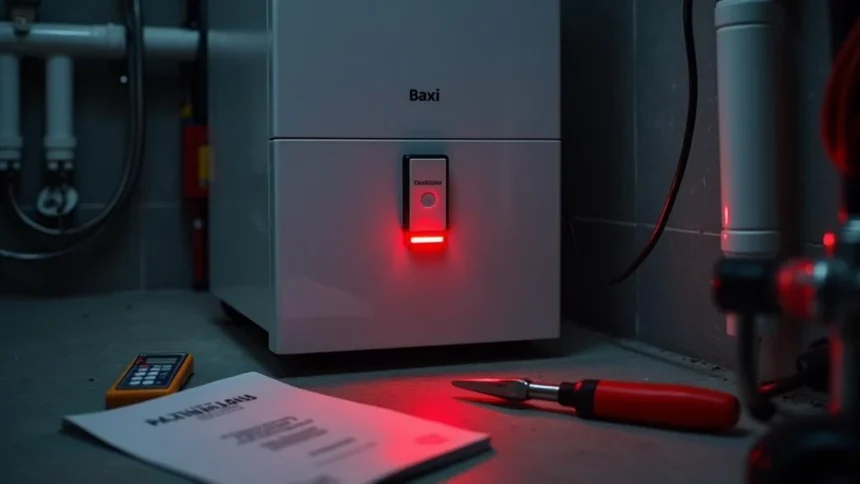
Before touching anything inside the casing, an engineer checks whether the boiler is even getting gas, since a surprising number of E1 lockouts come down to something as simple as a meter that’s tripped or a supply valve left half closed. Only once gas supply is confirmed do they move on to the ignition electrode, the gas valve, and the flue, working through each one in a set order rather than guessing. That order matters, because it stops you paying for a part replacement when the real fault was something free to fix.
Engineers check gas supply first, then the ignition electrode, gas valve, flue, and finally the printed circuit board, in that order. This sequence rules out the cheapest and most common causes before moving on to anything that requires a replacement part, which keeps the diagnosis quick and avoids unnecessary repairs.
What Does E1 Mean on a Baxi Boiler
E1 is the fault code Baxi boilers display when the burner fails to ignite after several attempts, known as an ignition lockout. The boiler tries to light the burner a set number of times, and if it doesn’t detect a flame within that window, it locks out and shows E1 rather than continuing to try and risking a build-up of unburned gas. It’s a safety feature, not a sign the boiler is damaged beyond repair.
Why Gas Supply Gets Checked First
It sounds almost too obvious, but a huge share of ignition lockouts trace back to gas simply not reaching the boiler. A prepayment meter that’s run out, a supply valve that got nudged shut during other work, or even another gas appliance in the house tripping the whole supply can all produce identical symptoms to a genuine ignition fault. Checking this first takes two minutes and rules out the easiest explanation before anything gets taken apart.
Once gas supply is confirmed as normal, attention shifts to the ignition system itself. This is where most Baxi E1 fault cases actually originate, since the electrode responsible for sparking the burner wears down over years of use and eventually stops producing a strong enough spark to light the gas reliably.
For a full walkthrough covering this and four other frequent breakdowns, read our guide: how to fix e1 error on baxi boiler
1. How the Ignition Electrode Works
The ignition electrode sits right next to the burner and produces the spark that lights the gas. Over time it accumulates soot and carbon, and the gap between the electrode tip and the burner can widen slightly through normal wear, both of which weaken the spark until it’s no longer reliable. An engineer will remove it, inspect it under good light, and either clean it back to bare metal or replace it outright if it’s pitted or cracked.
Signs the Electrode Is the Problem
A boiler that tries to ignite, makes a clicking sound, but doesn’t catch, is showing classic electrode symptoms. If this has been happening intermittently for a few weeks before locking out completely, the electrode was likely degrading gradually rather than failing all at once.
2. Checking the Gas Valve
If the gas supply is fine and the electrode sparks correctly but the burner still won’t light, attention moves to the gas valve itself. This valve controls exactly how much gas reaches the burner and when, and if it’s stuck partially closed or has a wiring fault, insufficient gas gets through to sustain a flame even with a good spark present. Testing this requires specific meters and should only be done by a Gas Safe registered engineer.
3. Flue and Air Intake Blockages
Modern condensing boilers need a clear flue to draw in air and expel exhaust gases correctly, and if that flue terminal outside is blocked by a bird’s nest, ice, or debris, the boiler’s safety systems can prevent ignition entirely as a precaution. This is more common after storms or during winter and is checked visually as part of a thorough inspection, since it’s an easy fix once spotted.
4. Printed Circuit Board Faults
If everything above tests correctly and the boiler still won’t ignite, the fault sits with the printed circuit board, the component that controls timing and sequencing for the whole ignition process. PCB faults are less common but do happen, particularly on older units, and usually mean a board replacement rather than a repair, since these components aren’t typically serviceable on-site.
Diagnostic Order Engineers Follow
Working through checks in the right order saves time and avoids replacing parts that were never faulty. Here’s the sequence most engineers follow on an E1 lockout.
- Confirm gas supply is reaching the boiler and the meter hasn’t tripped.
- Inspect the ignition electrode for wear, carbon build-up, or incorrect gap.
- Test the gas valve for correct operation and gas flow.
- Check the flue and air intake terminal for blockages.
- Test the printed circuit board if every earlier step checks out fine.
What Engineers Check First at a Glance
This table summarises the inspection order and what each check is actually looking for.
| What’s Checked | What It Reveals | Typical Fix |
| Gas supply and meter | Whether gas is reaching the boiler at all | Reset meter, check other gas appliances |
| Ignition electrode | Whether a spark is being generated to light the burner | Clean or replace electrode |
| Gas valve | Whether gas is actually flowing through to the burner | Valve replacement |
| Flue and air intake | Whether a blockage is preventing safe combustion | Clear blockage, check terminal |
| PCB and wiring | Whether the control board is sending the right signals | Rewire connection or replace PCB |
Frequently Asked Questions
1. What does E1 mean on a Baxi boiler?
E1 is Baxi’s fault code for ignition lockout, meaning the boiler tried to light the burner but didn’t detect a flame within its allowed attempts. It’s a built-in safety response rather than a sign of serious damage.
2. Can I fix an E1 error myself?
Checking gas supply and resetting the boiler once is safe for most homeowners. Anything involving the ignition electrode, gas valve, or PCB needs a Gas Safe registered engineer, since these involve gas components and internal wiring.
3. Why does my Baxi boiler keep locking out with E1?
Repeated E1 lockouts usually point to a worn ignition electrode or a gas valve fault rather than a one-off issue. If resetting the boiler only buys a few hours before it locks out again, the underlying component needs inspecting.
4. Is E1 the same as a boiler completely breaking down?
No. E1 is a lockout triggered by a safety mechanism, and in most cases the fix is a straightforward part replacement or clean rather than a full boiler replacement.
5. How do I reset a Baxi boiler after an E1 fault?
Press and hold the reset button for a few seconds until the display changes. If E1 reappears within a few attempts, stop resetting and get the ignition system checked rather than continuing to reset repeatedly.
6. Can weather cause a Baxi E1 fault?
Yes. Ice or debris blocking the external flue terminal during cold or stormy weather can prevent safe ignition and trigger an E1 code, even though nothing inside the boiler itself is faulty.
7. How long does it take to fix an E1 ignition fault?
Most E1 faults are resolved within a single engineer visit, since diagnosis follows a clear order and the most common causes, like a worn electrode, are quick to replace.
8. Does an E1 fault mean my boiler needs replacing?
Rarely. E1 is almost always caused by a single component, such as the electrode or gas valve, and replacing that part typically restores normal operation without needing a new boiler.
Final Thoughts
An E1 lockout looks alarming on the display, but for most Baxi boiler owners it comes down to one of a handful of well-understood causes, checked in a logical order rather than guessed at. Working through gas supply, ignition electrode, gas valve, flue, and finally the PCB catches the fault quickly and avoids paying for parts that were never the problem. If your boiler keeps throwing E1 and resetting isn’t holding, 0800 Homefix can send a Gas Safe engineer to run through these checks properly and get the ignition working reliably again.