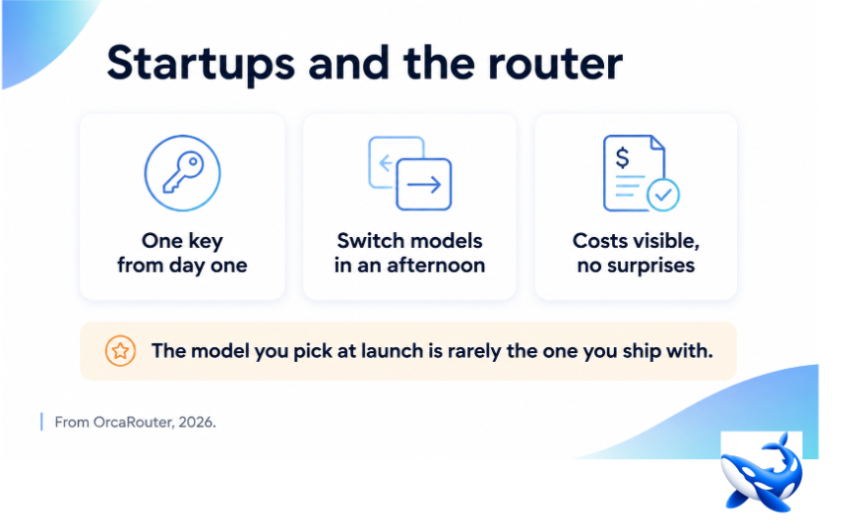
Startups are where the model-choice mistake is most expensive, because they have the least slack. The model a startup picks at launch is rarely the one it ships with — better models appear, prices change, the product’s task mix shifts. An AI router is how a startup keeps that choice cheap. OrcaRouter is one platform built around this pattern.
The three reasons it matters early
One key from day one. A startup building on one model with one vendor key has nothing to migrate later; it has to build the multi-model path eventually, and starting on a router means that path is configuration, not a project.
Switch models in an afternoon. When a better or cheaper model ships, the startup that can add it to the pool and route to it in an afternoon wins the comparison; the startup that has to re-integrate loses weeks.
Costs visible, no surprises. A startup’s runway is its budget. Per-call cost visibility from the start means no surprise invoice, and routing cheap-first on tolerant work stretches the runway.
The argument against waiting
“Add a router later” sounds reasonable and is expensive. The integration is the cheap part; the accumulated code that assumes one model — the prompts, the error handling, the per-vendor logic — is what makes the later switch costly. A router adopted on day one means the code never assumed a single model in the first place.
The one thing a startup should not defer
If a startup adopts nothing else from this article, the one thing not to defer is the cheap-first rule on tolerant work. For a team with a runway, cost visibility is survival, and the cheap-first rule is where the savings live. The other router benefits — one key, model switching — compound over time and matter as you grow. But the cost rule matters from the first month, because it is the difference between a bill you can predict and a bill that surprises you. Set it early, keep it simple, and let the router do the bookkeeping while your team builds the product.
The hedge against the pivot
Startups change what they build, and the model needs change with it. A router is the hedge that makes those pivots cheap: the application talks to a layer, so when the product shifts from text summarising to agentic workflows, the pool and the rules absorb it without a rewrite. That flexibility is disproportionately valuable to a small team, because a startup cannot afford a multi-week re-integration in the middle of a pivot. The router is not just a cost-saver for startups — it is the thing that keeps the application decoupled from whichever model the moment happens to call for.
A note on runway and scope
For a startup, the router’s value is best understood through the lens of runway and scope. Runway is budget; scope is attention. The cheap-first rule protects runway by making sure the tolerant majority of calls — extraction, classification, formatting — never pays frontier prices. At startup volumes the absolute saving is modest; the habit it builds is not. Setting the cost rule early means cost discipline is the default, not a retrofit that arrives with an unpleasant first invoice.
Scope is the subtler win. A small team has the least slack for integration work, and the multi-model path is where integration work hides. A startup that routes from day one never builds the assumption of a single model into its code, so when the product pivots — and startups pivot — the model layer changes with the product instead of blocking it. The agentic shift, the multimodal shift, the “we need a cheaper model for this new workload” shift: all of them are configuration changes on a router and integration projects without one.
There is an argument for deferring infrastructure at a startup, and it is usually right for the things a startup should defer. The router is not one of them, because it is not a bet on scale — it is a bet on optionality, and a small team’s scarcest resource is exactly the optionality it can afford to protect. One key from day one, cheap-first from the first call, and a pool that grows as the product does: that is a small team keeping its options open at almost no cost.
The takeaway
Startups should use an AI router from day one because the model they pick at launch is rarely the one they ship with. One key from the start, model switching in an afternoon, and costs visible before they become surprises — all three matter most when runway is short and the model landscape is moving. The routing layer is not an enterprise add-on; it is how a small team keeps its options open while the frontier keeps moving.
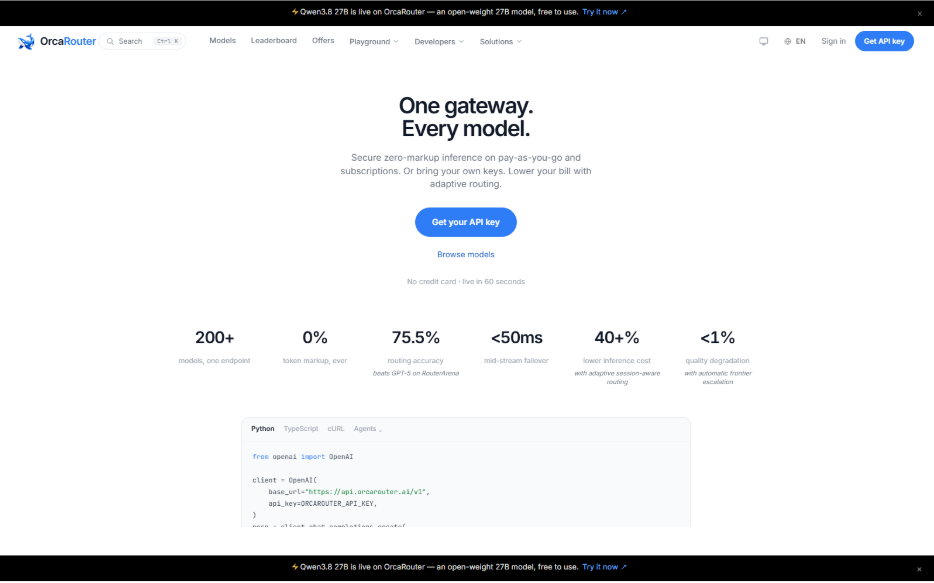 Sourcing note: this article describes the AI-router category and OrcaRouter’s implementation. The single-key, cheap-first and day-one-adoption claims reflect OrcaRouter’s own published descriptions, checked August 2026.