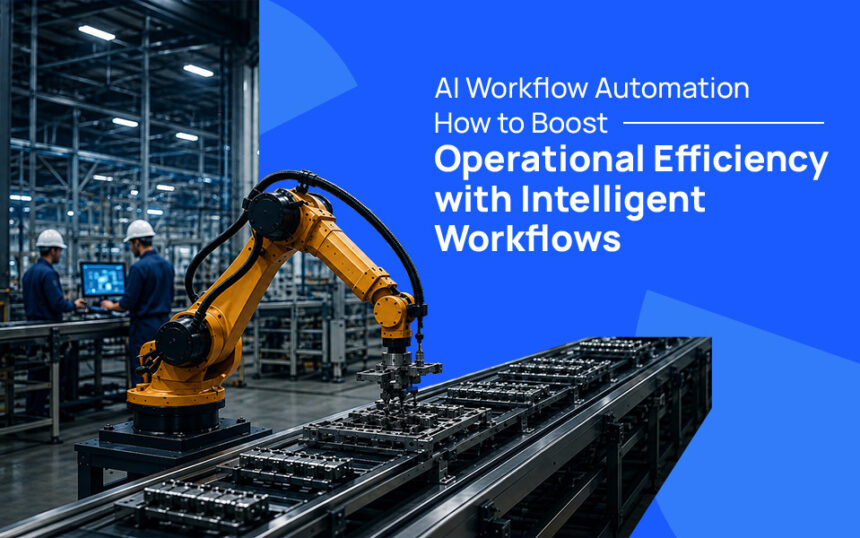
Manufacturing processes require continuous repetitive work daily, and it doesn’t end here. The operation requires approval, purchasing requests, and monitoring inventory to make final decisions. Based on which team responds to maintenance alerts and business systems updates. For Tier-2 manufacturers operating with lean teams, managing these workflows manually can consume valuable time and slow down decision-making.
This is where AI workflow automation can make a difference. With the integration of Enterprise AI, Manufacturers can automate repetitive tasks and enable systems to interpret data, recognize patterns, suggest actions, and assist staff in making more complex decisions within current business workflows.
What Is The Process Of AI Workflow Automation?
AI workflow automation employs AI to support or automate tasks across linked workflows and analyze business data. AI-powered workflows can adapt to shifting data and business conditions, unlike traditional automation, which typically adheres to set rules.
For example, when inventory drops below a predetermined threshold, traditional automation might generate a purchase request. Before suggesting the best procurement course of action, an AI-powered workflow can take into account current inventory, production schedules, supplier lead times, past consumption, and future demand.
Because automation carries out tasks while AI adds intelligence to them, AI and automation are complementary technologies.
Why Tier-2 Manufacturers Need Intelligent Workflows
With comparatively small teams, Tier-2 manufacturers frequently oversee numerous production lines, suppliers, plants, machinery, and business systems. Additionally, ERP, MES, inventory, procurement, CRM, and production systems may share operational data.
This creates several challenges:
- Manual data entry and repetitive tasks
- Delayed approvals and follow-ups
- Fragmented operational information
- Slow response to production issues
- Limited visibility across departments
- Dependency on employees for routine decisions
These workflows can be connected by AI automation, which also lessens the need for manual coordination.
Where AI Workflow Automation Can Improve Operations
AI for Operations
AI can monitor operational conditions, identify bottlenecks, analyze production data, and make recommendations to operations teams. Managers can now spend more time acting on operational insights and less time creating reports.
Predictive Maintenance
To find potential equipment problems, AI can examine machine performance, sensor readings, maintenance records, and production conditions. The system can produce alerts, make maintenance requests, or direct problems to the right team when it is linked to workflow automation.
Procurement and Inventory
Purchase orders, material requirements, supplier performance, and inventory levels can all be tracked by AI. Potential shortages can be detected by an intelligent workflow, which can also suggest procurement actions and direct approvals in accordance with predetermined business rules.
Quality Management
Workflows driven by AI can assist in identifying quality anomalies, categorizing inspection problems, and directing issues to the appropriate teams. This may facilitate quicker inquiry and remedial action.
From Automation to Agentic Workflows
Agentic workflows, in which AI agents can comprehend a goal, obtain relevant data, plan several steps, and coordinate actions across linked systems, are the next evolution.
For example, an AI agent might check inventory, examine open purchase orders, assess approved suppliers, calculate lead times, and prepare a recommendation for procurement approval if it detects a possible shortage of raw materials.
This is more than just autonomous AI carrying out a single task. The objective is to develop linked workflows in which AI can assist business processes while adhering to established guidelines, permissions, and governance controls.
AI Automation Needs a Strong Foundation
Adding an AI tool to an already-existing process is not enough for successful AI workflow automation. Reliable data, system integration, security, governance, and well-defined workflows are essential for manufacturers.
ERP, MES, IoT platforms, procurement software, and inventory systems are examples of enterprise systems that must supply the data needed by AI applications. Reliable intelligent workflows may be produced by combining data engineering, AI agents, RAG, workflow orchestration, and enterprise integrations.
The practical strategy for Tier-2 manufacturers is to begin with a single high-impact workflow, assess its business impact, and then progressively extend AI automation throughout all operations.
Enterprise AI Is Next Step for Tier 2 Manufacturer
The goal of AI is to enhance the workflows manufacturers currently rely on with intelligence, building a more effective and scalable foundation for the next phase of industrial operations.
Manufacturing is progressing from basic rule-based automation to intelligent, networked operations thanks to AI workflow automation. Manufacturers can minimize repetitive tasks, enhance decision-making, and react more quickly to changing operational conditions by integrating Iconflux’s Enterprise AI into their current workflows.