Outsourcing cold calling is a significant operational decision. The wrong choice wastes budget and burns through your contact list. The right choice puts qualified meetings on your calendar within weeks without the time and cost of building an internal team.
So, you need to choose the right one now, otherwise the wrong one can rob you. Don’t waste your time with the wrong one. Check and hire the best cold calling company right now.
What Does It Mean to Outsource Cold Calling?
Outsourcing cold calling means hiring a specialist third-party company to run your outbound phone prospecting on your behalf. The outsourcing company provides the SDRs, the methodology, dialing technology, and reporting infrastructure. You supply the target market, the value proposition, and access to your calendar.
The outsourcing company calls prospects, qualifies them against your ICP, and books meetings directly into your sales team’s schedule. Your closers handle everything from the first meeting forward. The outsourcing partner owns the top of the funnel.
Pros and Cons of Outsourcing Cold Calling
Most vendors present outsourcing as an obvious choice. It is not always. The real picture has genuine advantages and genuine drawbacks. Both are worth understanding before you commit to the budget.
| Pros | Cons |
| A cold calling agency can get a trained team dialing within 2–4 weeks. | An outsourced caller may not know your product as deeply as an internal SDR. |
| It is usually faster than hiring an internal SDR team. | You have less direct control over how every call is handled. |
| It can cost less than hiring, training, and managing full-time SDRs. | Most full-service agencies require a monthly commitment. |
| You get callers, strategy, dialing tools, and data in one program. | The starting cost may be too high for very early-stage companies. |
| Good agencies bring tested scripts, call frameworks, and objection handling. | You need to trust a third party to represent your brand properly. |
| The team can scale up or down based on pipeline needs. | Poor agencies can send unqualified meetings just to show activity. |
| Compliance support, such as DNC checks, TCPA awareness, and time zone controls, is often built in. | You may need to share contact lists or CRM access with the agency. |
| It helps your sales team focus more on closing than prospecting. | Data handling and ownership should be checked before signing. |
Is Cold Calling Outsourcing Right for Your Business?
Cold calling outsourcing is a good fit if your business needs more qualified sales conversations but lacks the time, team, or systems to handle outbound calling in-house. It works best when you already know your target customer, have a clear offer, and need a faster way to build a pipeline.
It may be right for your business if:
- You need qualified meetings booked faster.
- Your internal sales team is too busy to prospect.
- You do not want to hire and train SDRs from scratch.
- You have a clear ideal customer profile.
- Your offer is easy to explain over a call.
- You want a scalable way to test new markets.
But outsourcing is not the right move for every company. If your product is very complex, your messaging is unclear, or you are still figuring out who your best customer is, an agency may struggle to deliver strong results.
In that case, you may need to fix your offer, sales process, or targeting first.
The best time to hire a cold calling agency is when you are ready for more conversations, not when you are still guessing what to say. A good agency can bring speed, structure, and trained callers, but they still need the right strategy and market direction from your side.
What Does Outsourcing Cold Calling Actually Cost?
The cost of cold calling outsourcing depends on the model, team location, and service level. Most full-service B2B agencies use monthly retainer pricing.
| Pricing Model | Average Cost |
| Entry-Level Retainer | $3,500–$5,000/month |
| Mid-Tier Managed Program | $7,000–$12,000/month |
| Enterprise Program | $15,000+/month |
| Offshore Hourly | $10–$25/hour |
| US-Based Hourly | $30–$50/hour |
| Per Lead or Appointment | $100–$500 per qualified lead |
Retainer pricing is best when you want a managed program with callers, strategy, data, dialers, and reporting included. Hourly pricing is cheaper, but it often focuses more on call time than on qualified results.
Also, check what is not included in the quote.
Because contact lists may cost $500–$2,000 per month, dialer seats can cost $100–$300 each, and CRM setup may include a one-time fee.
In-House Vs. Outsourced Cost Comparison:
| Cost element | Internal SDR | Outsourced program |
| Base salary | $60,000 to $80,000/year | Included |
| Benefits and payroll tax | $15,000 to $20,000/year | Included |
| Dialing tools | $2,400 to $4,800/year | Included |
| Data and list cost | $3,000 to $6,000/year | Included or add-on |
| Management time | 5 to 10 hours/week | Included |
| Ramp time before output | 60 to 90 days | 2 to 4 weeks |
| Total year 1 cost | $90,000 to $120,000+ | $42,000 to $120,000 |
The cost ranges overlap in the mid-tier. The difference that tips the calculation is ramp time and risk. An internal hire who does not work out restarts the clock at month three or four. An outsourced partner can be replaced or restructured without the same sunk cost.
Top Cold Calling Outsourcing Companies in 2026
The companies below offer the strongest outsourcing options across a range of deal sizes, industries, and budgets. Each entry leads with who the program is built for.
1. CallingAgency: Best for B2B Companies That Want Qualification Built Into Every Step
CallingAgency runs all outsourced campaigns on the C.A.L.L.S.™ Framework, a proprietary five-step methodology built from over 2,100 B2B campaigns. The agency’s 68% average appointment-show rate is the one worth paying attention to.
The industry norm sits between 30% and 40%. The gap exists because qualification runs at three separate points before any meeting reaches a client’s calendar.
They do the work through 5 steps, as in;
Calibrate (40%): ICP definition using firmographic, technographic, and behavioral data. Roughly 40% of raw contact lists are removed before outreach begins. SDRs never dial a contact that does not fit the client’s target profile.
Arrange (25%): Three to five script variants per campaign, built by buyer persona. A/B testing runs in the first 14 days to identify the highest-converting message.
Launch (15%): Multichannel outreach across cold calling, email, and LinkedIn. Local caller ID and optimized calling windows push connect rates to approximately 2x the industry average.
Land (15%): The 3-Layer Qualification Engine. Pre-call ICP filtering, live conversation qualification on need, authority, timeline, and fit, then post-call QA review with a 1 to 10 lead score. Only leads with a score of 7 or higher advance to the client’s pipeline.
Schedule (5%): Qualified meetings are added directly to the client’s calendar, with call notes, prospect context, and buying signals attached. Campaigns launch within 14 days of onboarding. First qualified meetings typically follow within 7 days of launch.
Industries served: Staffing, logistics, SaaS, manufacturing, financial services, and professional services
Pricing: Contact for a custom package
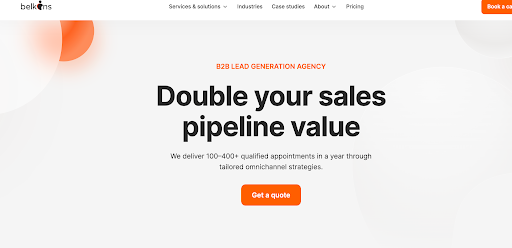
2. Belkins: Best for Enterprise Outsourcing Where the Deal Size Justifies Signal-Based Calling
Belkins runs a signal-based outbound program: callers reach out after a prospect has already engaged with an email or a LinkedIn touch. The call arrives as the second or third contact point, not the first.
So, it reduces resistance on high-value prospects and improves the quality of the conversation.
Founded in 2017, Belkins operates exclusively in B2B appointment setting with more than 200 specialists. No inbound support, no customer service.
Every part of the operation is focused on one deliverable: qualified decision makers in a client’s sales calendar, with unqualified ones filtered out before they get there.
Industries served: Technology, SaaS, healthcare, finance, manufacturing, and professional services
Pricing: Custom; strongest fit for deal sizes above $50,000
Best fit: Enterprise sales teams where pre-call engagement is worth the additional setup time
3. SalesRoads: Best for Complex B2B Sales Where Caller Experience Matters
SalesRoads assigns SDRs with an average of 7+ years of experience to each program. Dedicated sales coaches review call recordings and track weekly conversion from calls to appointments. Every client engagement includes a dedicated SDR, a sales operations team and a Director of Client Success.
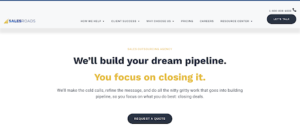
The program combines phone outreach with AI-boosted email cadences. Phone stays the primary channel. For companies that have worked with lower-cost outsourcing programs and received poor-quality appointments, the quality difference at SalesRoads is noticeable.
Industries served: Broad B2B; strongest track record in enterprise sales and professional services
Pricing: Typical engagements run $8,000 to $10,000 per month; month-to-month
Best fit: Long sales cycles and high-value deals where a bad meeting costs real time and revenue
4. Martal Group: Best for SaaS and Tech Companies Expanding in North America
Martal Group uses an AI platform to build ICP-specific contact lists from more than 10 million intent signals before any outreach begins. Callers work with data that indicates a prospect is actively researching solutions in the client’s category, not generic lists scraped from a database.
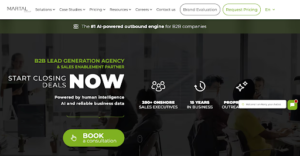
The agency is particularly well-suited for expansion into the North American market. Their team understands the regional complexity of selling across US time zones. They also navigate state-level compliance requirements alongside federal TCPA rules.
Industries served: SaaS, technology, finance, and professional services
Pricing: Starting at approximately $5,000 per month; retainers up to $12,000 for full-service programs
Best fit: Mid-market SaaS and tech companies with deal sizes in the $10,000 to $100,000 range
5. Callbox: Best for Multi-Channel Enterprise Outsourcing Across US Markets
Callbox runs a multi-channel outbound model covering cold calling, email, LinkedIn, and content syndication. The agency operates across all four US time zones and brings direct experience with the geographic and regulatory complexity of selling across different US markets.
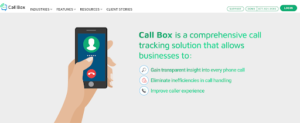
Their enterprise focus shows in the verticals they serve best: fintech, enterprise SaaS, managed IT, commercial real estate, and healthcare technology. Callbox has the infrastructure and volume capacity to support such campaigns at scale.
Industries served: Enterprise SaaS, fintech, managed IT, commercial real estate and healthcare technology
Pricing: Custom enterprise pricing; contact for a quote
Best fit: Large organizations running multi-channel outbound at scale across multiple US geographies
6. Sales Focus Inc.: Best for Companies That Want a Long-Term Outsourcing Partner With SDR Training Built In
Sales Focus Inc. positions itself as a long-term growth partner rather than a campaign vendor. Their outsourcing model includes SDR training on objection handling. Their gatekeeper handles consultative selling. So, it reduces the gap between an external caller and an internal team member.
Their outbound programs include list building, script development, live calling, follow-up cadences, and performance reporting.
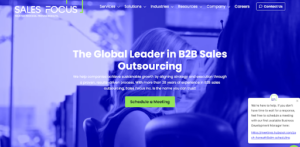
They do everything for companies that want a single vendor to own the full outbound motion rather than manage multiple point solutions. Mainly, Sales Focus operates as an end-to-end partner.
Industries served: Broad B2B and B2C; experience across technology, financial services, healthcare and manufacturing
Pricing: Custom; contact for a quote
Best fit: Companies looking for a long-term outsourcing relationship with a vendor that invests in caller development over time
How to Transition to an Outsourced Cold Calling Company?
Outsourcing cold calling does not happen overnight. The transition period determines how quickly results arrive and how well the outsourced team represents the client’s brand. Here is how to make it work.
Step 1: Brief the vendor thoroughly before onboarding.
The outsourcing company needs your ICP definition, key value propositions, common objections and the context behind your best current customers. The more specific this briefing is, the more accurate the first script variants will be. Vague briefings produce generic scripts.
Step 2: Approve the contact list before dialing begins.
Most outsourcing companies build or refine the contact list during onboarding. Review it against your ICP before approving. Contacts that do not fit should be removed at this stage, not after they have been called.
Step 3: Run the A/B test phase seriously.
The first two weeks of most outsourced programs involve testing multiple script variants. Pay attention to which openers and value prop framings are producing conversations rather than hang-ups. The data from this phase shapes the rest of the campaign.
Step 4: Set a clear definition of a qualified meeting upfront.
Before the first appointment is booked, agree in writing on what qualifies a prospect for a meeting. Title, company size, budget awareness, timeline, and pain point confirmation should all be defined. Ambiguity here leads your closers to sit through calls with prospects who do not fit.
Step 5: Review call recordings in the first month.
Access to call recordings is a non-negotiable. Listen to a sample of calls in the first three to four weeks. The recordings will show whether the messaging is landing, whether callers are handling your most common objections correctly and whether the conversations sound like your brand or an outsourced script.
Frequently Asked Questions
What is a cold calling outsourcing company?
A cold calling outsourcing company is a specialist vendor that handles outbound phone prospecting on behalf of a client’s sales organization. The company provides trained SDRs, a call methodology, dialing technology and reporting infrastructure. Clients receive qualified meetings on their calendars without building or managing the outbound function internally.
How much does it cost to outsource cold calling?
Retainer-based programs start at $3,500 per month for entry-level US-based calling and scale to $12,000 or more per month for full-service managed programs with intent-based targeting and omnichannel outreach. Watch for add-ons not included in the quoted price: list building, dialer fees and CRM integration can add $1,000 to $2,000 per month on top.
Is outsourcing cold calling cheaper than hiring internally?
In most cases, yes, particularly in the first year. A full-time US-based SDR costs $90,000 to $120,000 per year when total employment cost is factored in. A mid-tier outsourced program runs $72,000 to $120,000 per year with faster ramp time, no hiring risk and built-in management infrastructure.
How long until an outsourced cold calling company produces results?
Most programs launch within two to four weeks of onboarding. The first two weeks cover ICP definition, list preparation and script development. First qualified meetings typically appear in week two or three. Predictable, consistent pipeline flow stabilizes around week four or five.
What should I look for in a cold calling outsourcing company?
Prioritize companies that can show their appointment show rate across the full client base, not just selected case studies. Confirm their call methodology is documented and specific, not a generic script. Verify that compliance infrastructure, DNC scrubbing and time zone enforcement are built into their platform. Get the total program cost including all add-ons before making a comparison.
Can I outsource cold calling for a niche or specialist industry?
Yes, provided the outsourcing company has direct experience in the vertical. Request a case study in your industry or a comparable one before signing. Agencies with only generalist experience will struggle with industry-specific objections and terminology, which affects conversation quality and conversion rates.
Making the Outsourcing Decision
Cold calling outsourcing is worth it when your sales team is ready to close, but the pipeline isn’t providing enough qualified conversations. In that situation, hiring an agency can be faster and easier than building an SDR team from scratch.
But it is not for every business. If your product is too technical or every call needs deep product knowledge, an outside caller may not be the best fit.
The right agency should help you fill the gap between the leads you have now and the sales conversations your closers actually need.