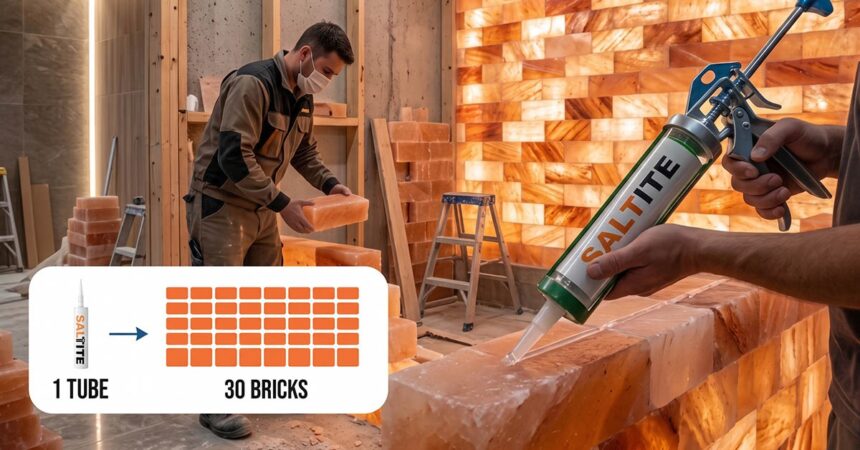
You need approximately one Saltite adhesive tube for every 30 bricks, according to Pink Salt Wall product information. This makes it easy to estimate the adhesive needed before installing a salt wall. Actual usage can vary depending on application technique, surface condition, and wall design.
Pink Salt Wall offers Saltite Adhesive specifically for bonding Himalayan salt products, making it a convenient choice for salt wall installations. With bulk salt bricks, wall kits, and adhesive options available, Pink Salt Wall can help simplify material planning for projects of different sizes.
What Is Saltite?
Saltite is a premium Himalayan salt adhesive specially formulated for bonding Himalayan salt bricks and salt tiles. This 99% solvent-free salt brick glue provides a strong, durable, and transparent bond without harmful fumes, making it an ideal choice for indoor salt wall installations, wellness spaces, spas, and saunas.
Saltite is intended to simplify the installation of salt bricks while providing a dedicated salt adhesive option for salt-wall projects. It is best suited for salt bricks, Himalayan salt tiles, and blocks.
How to Calculate Saltite Adhesive for a Salt Wall?
You can calculate the required Saltite adhesive for a salt wall by keeping in mind that each tube covers approximately 30 Himalayan salt bricks. The actual coverage depends on how the salt adhesive is applied and the condition of the installation surface.
For a simple project, the calculation is:
Saltite tubes needed = Total number of bricks ÷ 30
This calculation is more useful than estimating adhesive only from wall dimensions because different layouts can require different numbers of bricks.
Quick calculation table
| Brick Quantity | Calculation | Approx. Tubes |
| 30 | 30 ÷ 30 | 1 |
| 60 | 60 ÷ 30 | 2 |
| 90 | 90 ÷ 30 | 3 |
| 100 | 100 ÷ 30 | 4 |
| 150 | 150 ÷ 30 | 5 |
| 200 | 200 ÷ 30 | 7 |
| 300 | 300 ÷ 30 | 10 |
| 400 | 400 ÷ 30 | 14 |
| 500 | 500 ÷ 30 | 17 |
| 1,000 | 1,000 ÷ 30 | 34 |
These figures use the manufacturer’s approximate 30-brick coverage rate.
How Much Saltite Do You Need for Different Wall Sizes?
Wall area can help you estimate the number of bricks, but you should calculate the adhesive from the actual number of pink salt bricks. Wall dimensions can help estimate the required number of bricks, but adhesive should ultimately be calculated from the actual brick quantity specified for your layout or kit.
The following examples estimate the number of 8″ × 4″ × 2″ bricks and the Saltite requirement based on the stated coverage rate:
| Wall Size | Coverage | Bricks | Adhesive Included |
| 3 × 3 ft | 9 sq. ft. | 41 bricks | 2 tubes |
| 4 × 6 ft | 24 sq. ft. | 108 bricks | 4 tubes |
| 5 × 5 ft | 25 sq. ft. | 113 bricks | 4 tubes |
| 6 × 6 ft | 36 sq. ft. | 162 bricks | 6 tubes |
| 5 × 10 ft | 50 sq. ft. | 225 bricks | 8 tubes |
| 6 × 8 ft | 48 sq. ft. | 216 bricks | 8 tubes |
| 8 × 10 ft | 80 sq. ft. | 360 bricks | 12 tubes |
Pink Salt Wall listed salt wall kits show that adhesive quantities are packaged according to each project’s coverage.
What Factors Can Affect Saltite Adhesive Usage?
The 30-brick figure is an approximate coverage rate. Several factors can affect how much product you actually use.
Adhesive Application
Applying an unnecessarily thick layer can consume Saltite adhesive faster. Follow the manufacturer’s application instructions instead of assuming that more adhesive provides a better result.
Surface Condition
The installation surface should be properly prepared and suitable for the salt adhesive. Dust, loose material, or other contaminants can weaken the installation.
Wall Design
Corners, edges, openings, patterns, and custom layouts may require additional Himalayan salt tiles and more adhesive.
Repositioning
Repeatedly removing and repositioning Himalayan salt bricks can affect adhesive use and make the installation less efficient.
Installation Technique
Different installers may apply different amounts. For a large commercial project, using a consistent application method can make material planning easier.
How Should You Plan Saltite Adhesive for a Large Project?
Large projects deserve more careful planning because running out of adhesive can stop installation.
Use this process:
Step 1: Measure the Wall
Calculate the total wall area properly. If there are major openings, such as doors or windows, account for them when estimating the covered area.
Step 2: Determine the Brick Quantity
Use the selected layout and product dimensions to determine how many bricks are required.
Step 3: Separate Bricks of Different Sizes
Record the number of each type so that you do not underestimate the material.
Step 4: Calculate Adhesive
Divide the total Himalayan salt brick count by 30.
Step 5: Round Up
If the answer is a fraction, move to the next whole tube.
Step 6: Review Project Conditions
Consider whether there are unusual shapes on your wall, difficult access, a lot of different cuts, or other things that could lead to higher consumption.
Step 7: Confirm the Product Instructions
Before application, follow the manufacturer’s recommendations for installation, preparation of the surface to be covered, and curing.
Saltite Vs. Construction Adhesive
Saltite is designed specifically for the installation of Himalayan salt bricks; on the other hand, general construction adhesives can vary widely in their formulation and compatibility.
The key differences to consider are:
| Feature | Saltite | Construction Adhesive |
| Intended Use | Designed for Himalayan salt products and their installation | May be used as a general construction adhesive |
| Salt Compatibility | Specifically intended for Himalayan salt products | Compatibility should be verified before use |
| Approximate Coverage | About 30 salt bricks per tube | Varies by product and application |
| Application Method | Follow Saltite’s installation instructions | Depends on the adhesive |
| Curing Time | 24-48 Hours | Varies by formulation |
| Material Planning | Coverage estimates make quantity planning easier | Coverage must be determined from product specifications |
What Are the Most Common Saltite Calculation Mistakes?
- Estimating only by square footage: Wall area does not always tell you the exact number of bricks
- Rounding down: A result of 6.67 tubes means you should plan for 7
- Ignoring brick dimensions: Mixed layouts contain different brick sizes
- Applying excessive adhesive: More adhesive usage is not recommended
- Skipping surface preparation: The substrate can affect installation performance
- Ignoring product-specific quantities: Wall kits may include a set number of adhesive tubes, so check what is already supplied
These steps are especially important when ordering Himalayan salt bricks in quantities of several hundred.
Expert Tips to Avoid Running Out of Adhesive?
The best way to prevent shortages of salt adhesive is to calculate the requirement before installation begins.
Keep these practical tips in mind:
- Count every planned salt brick
- Use 30 Himalayan salt bricks per Saltite tube as the basic planning rate
- Round up fractional calculations
- Check how much adhesive is already included with your wall kit
- Consider the complexity of the wall
- Have the adhesive available before installation starts
- Follow the manufacturer’s application instructions
- For unusually complex projects, confirm the quantity with the supplier before ordering
For a simple wall or a commercial salt wall installation involving hundreds of bricks, it can prevent a costly interruption.
Conclusion
Saltite adhesive makes it simple to estimate the adhesive needed for a salt wall. It is perfectly suitable for 30 Himalayan salt bricks. To calculate your requirement, count the bricks, divide the total by 30, and round up.
For a more accurate estimate, do not rely on square footage alone. Consider the actual brick count, wall layout, surface condition, and application method. Also check whether your selected Pink Salt Wall kit already includes adhesive.
FAQs
Is Saltite suitable for salt tiles?
Yes, Saltite is suitable for Himalayan salt tiles. It is specifically designed to bond salt tiles and salt bricks, creating a strong and durable hold for indoor salt wall installations.
How many bricks does one Saltite adhesive cover?
One Saltite tube covers approximately 30 bricks, although actual coverage can vary depending on application technique and installation conditions.
Does the type of salt product affect adhesive requirements?
Yes, different salt products may require different adhesive quantities because their dimensions, weight, layout, and installation methods can vary.
How much Saltite do I need for 100 bricks?
You need approximately 4 Saltite tubes for 100 bricks, based on the recommended coverage of 30 bricks per tube.
Should I buy extra Saltite for a large wall?
Yes, keeping a small reserve can help prevent installation delays when actual adhesive consumption exceeds the initial estimate.