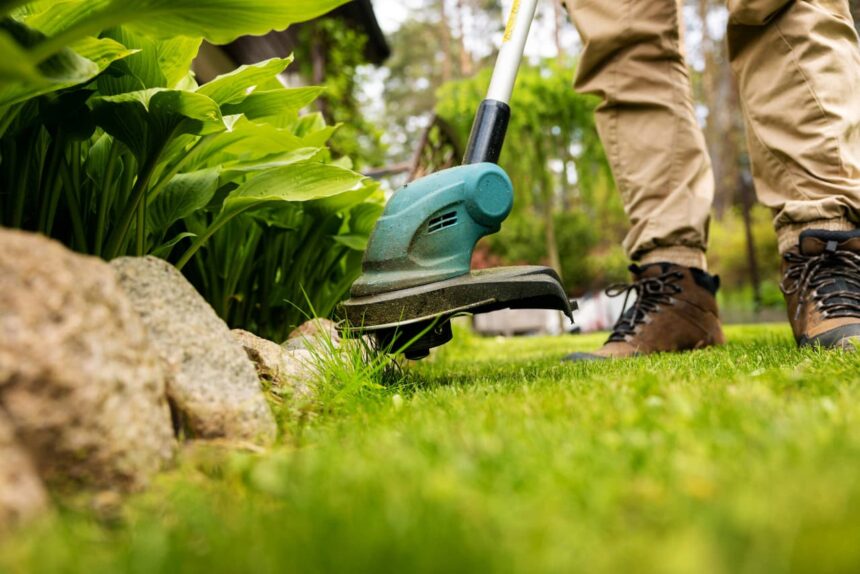
A mower can handle the broad, open parts of a lawn efficiently, but it is not designed to reach every blade of grass. Fence lines, tree trunks, garden borders, steep edges, narrow spaces, and areas around outdoor structures often require a different approach. That is where a weed whip becomes useful.
After years of maintaining residential and landscaped properties, I have found that the difference between an average-looking lawn and a well-finished one often comes down to these overlooked edges. Mowing establishes the primary cut, while a string trimmer or weed whip handles the transition zones where larger equipment cannot safely or effectively operate.
The important point is that a weed whip is not simply a tool for cutting weeds. Used correctly, it becomes a finishing tool that connects the main mowing pattern with the property’s boundaries and hard-to-reach spaces.
Why Mowers Naturally Leave Certain Areas Uncut
Rotary mowers work best when their cutting deck can move freely across a relatively open surface. Their size, wheel placement, and deck geometry create unavoidable limitations.
A mower may struggle to reach grass:
- Directly against fences or walls
- Around tree trunks and shrubs
- Beneath low landscaping
- Along narrow garden borders
- Around posts and utility boxes
- Beside steps and retaining walls
- On steep or uneven edges
- Between closely spaced structures
Trying to force a mower into these spaces can create its own problems. The deck may strike an obstacle, the machine may leave an uneven strip, or the operator may have to make repeated passes that accomplish very little.
A trimmer is designed for exactly these transition areas.
How a Weed Whip Complements the Mower Instead of Replacing It
The most efficient approach is usually to divide the lawn into two types of work: coverage and finishing.
The mower provides coverage across the main lawn. The string trimmer handles the finishing work around boundaries and obstacles.
This division is particularly useful on properties with substantial landscaping. Instead of repeatedly maneuvering a riding or walk-behind mower around every tree and garden bed, the operator can mow the open grass efficiently and then make one systematic pass with the trimmer.
The result is not simply a cleaner appearance. It can also reduce unnecessary equipment movement and make the mowing routine more predictable.
Fence Lines and Property Boundaries Need a Different Cutting Approach
Fence lines are among the most obvious places where mower decks leave grass behind.
A mower cannot always get close enough to a fence without risking contact between the deck, wheels, or blades and the structure. Grass can consequently grow into a visible strip along the base.
A string trimmer allows the operator to work closer to the boundary while maintaining control over the cutting head.
Keep the cutting angle consistent
For routine edging or trimming along a fence, consistency matters more than speed. Holding the tool at a controlled angle helps produce a uniform finish instead of creating a scalloped or uneven line.
It is also worth remembering that fences can conceal rocks, wire, metal stakes, and other debris. Inspect the area before trimming rather than assuming the entire boundary is clear.
Tree Trunks and Landscaping Beds Require Careful Technique
Trees create another common mowing blind spot.
A mower deck may leave a ring of grass around the trunk because the machine cannot safely position its blades close enough. A weed whip can clean up that area, but the operator needs to avoid hitting the trunk itself.
Repeated contact between nylon line and tree bark can damage the protective outer tissue. Young trees can be particularly vulnerable.
The better approach is to leave a small safety margin around the trunk and manage the remaining grass carefully rather than trying to make the area completely bare.
The same principle applies around ornamental shrubs and delicate landscape plants.
Narrow Spaces Are Where Trimmers Save the Most Time
Some of the most frustrating mowing areas are strips of grass that are too narrow for a mower to enter comfortably.
Consider the space between a garage wall and a fence. A mower may physically fit, but turning and positioning it can take longer than the actual cutting. A trimmer can handle the same strip in a fraction of the time.
This is one reason experienced lawn-care workers think about access efficiency, not simply cutting capacity.
A larger mower is not necessarily faster if the property requires constant maneuvering. Sometimes the fastest overall system is a capable mower paired with a smaller finishing tool.
Steep Edges and Difficult Terrain Require Extra Caution
Areas around drainage ditches, embankments, retaining walls, and steep slopes can present both access and safety challenges.
A mower should only be operated on terrain within its manufacturer’s specified limits. If a section is unsuitable for riding or walk-behind mowing, a trimmer may provide a practical alternative, provided the operator can maintain stable footing and safe control.
The Occupational Safety and Health Administration emphasizes following manufacturer guidance for riding mower operation and exercising caution around slopes, drop-offs, ditches, and embankments. OSHA’s riding mower safety guidance is a useful reference when evaluating difficult lawn areas.
Never treat a trimmer as permission to work from an unstable position. If the ground is too steep, wet, loose, or hazardous to stand on safely, the area needs a different solution.
How to Use a Weed Whip for a Cleaner Lawn Finish
The quality of the finished lawn depends heavily on technique.
A practical mowing sequence is:
- Remove obstacles and inspect the lawn.
- Mow the open areas first.
- Identify remaining strips around structures and landscaping.
- Trim those areas systematically.
- Edge designated lawn boundaries where appropriate.
- Clear clippings from hard surfaces.
Working in this order makes the trimmer a finishing tool rather than something you repeatedly pick up throughout the mowing process.
Use the right motion for the job
For ordinary grass trimming, controlled side-to-side movements are usually sufficient. Avoid swinging the tool excessively or cutting far beyond the immediate target area.
When edging along sidewalks or driveways, a more deliberate vertical orientation can help establish a sharper boundary, depending on the equipment design and manufacturer’s instructions.
The goal is controlled material removal, not maximum line exposure.
Choosing Between Trimming and Edging for Different Areas
Trimming and edging are related but not identical jobs.
Trimming removes grass and weeds from places the mower cannot reach.
Edging establishes or maintains a distinct boundary between turf and another surface, such as a sidewalk, driveway, or planting bed.
A property may require both.
For example, grass around a mailbox post needs trimming, while the boundary between a front lawn and concrete walkway may benefit from edging. Understanding the difference helps prevent homeowners from trying to create crisp lawn borders in areas where simple trimming is the appropriate solution.
Common Mistakes That Create More Work
Several habits can make trimming less effective.
Cutting too aggressively around trees
Hitting bark repeatedly can injure trees. Maintain a safe distance rather than chasing every blade of grass.
Letting grass become excessively tall
A trimmer can handle taller vegetation, but allowing boundary grass to become heavily overgrown makes finishing work slower and less consistent.
Trimming before mowing
This can leave cut material across areas that the mower will later travel over. In many situations, mowing first and finishing second creates a cleaner workflow.
Ignoring hidden debris
Wire, stones, glass, irrigation components, and other objects can become projectiles when struck by a spinning line. Inspect unfamiliar areas before starting.
The U.S. Consumer Product Safety Commission also provides general lawn-mower safety information worth reviewing as part of a broader outdoor-equipment safety routine. CPSC lawn mower safety resources offer practical guidance on reducing common injury risks.
A Simple Decision-Making Guide for Hard-to-Reach Grass
Before deciding how to maintain an awkward area, consider four questions:
- Can the mower reach it safely? If yes, mow it normally.
- Is the space too narrow for the mower? Use a trimmer.
- Does the area require a sharp boundary? Consider edging.
- Is the terrain unsafe for either machine? Find an alternative method rather than forcing the equipment into the area.
This approach prevents a common mistake: treating every patch of grass as if it requires the same equipment.
How Frequently Should Hard-to-Reach Areas Be Trimmed?
There is no universal schedule because growth rates vary with grass species, rainfall, temperature, and irrigation.
As a practical observation, perimeter grass often becomes noticeable before the main lawn looks overdue for mowing. Fence lines and landscaping borders can therefore benefit from attention whenever they visually break the otherwise consistent height of the lawn.
Instead of following a rigid calendar, inspect the property after each mowing cycle. If the edges remain clean, there is no reason to trim them simply because a certain number of days have passed.
The Small Areas Often Define the Finished Lawn
Most of a lawn’s visual quality comes from consistent mowing, but the edges determine whether that work looks finished.
A mower is the primary tool for covering turf efficiently. A weed whip fills the gaps created by the mower’s physical limitations, handling fence lines, tree bases, narrow strips, landscaping boundaries, and other areas where a deck cannot reach.
Used thoughtfully, it is less about doing more work and more about assigning the right tool to the right part of the property. Mow the areas where a mower is efficient, trim where access is limited, and edge where a defined boundary is needed.
That simple division can make routine lawn maintenance faster, safer, and noticeably more consistent.
FAQ: Using a Weed Whip Around Areas Mowers Cannot Reach
Can a weed whip replace a lawn mower?
Generally, no. A weed whip is designed for targeted trimming and finishing rather than efficiently cutting large areas of turf. Using a mower for broad coverage and a trimmer for inaccessible areas is usually more practical.
Should I trim around tree trunks?
Yes, if grass is growing around the trunk, but use care. Avoid striking the bark with the cutting line because repeated damage can harm the tree.
Is a weed whip useful for fence lines?
Yes. Fence lines are one of the most common places where mower decks leave uncut grass. A string trimmer can clean the strip without requiring the mower to operate directly against the fence.
Should I trim before or after mowing?
For most routine lawn maintenance, mowing first and trimming afterward is efficient because the trimmer serves as the finishing step. This also makes it easier to see exactly where grass remains.
What should I do with steep areas?
Only use equipment where the terrain can be handled safely. Follow the manufacturer’s instructions and avoid unstable footing, hazardous slopes, drop-offs, and wet or loose ground.
===============
Meta Description:
Learn how weed whips complement mowers by maintaining fence lines, tree bases, narrow spaces, landscaping edges, and other hard-to-reach lawn areas.