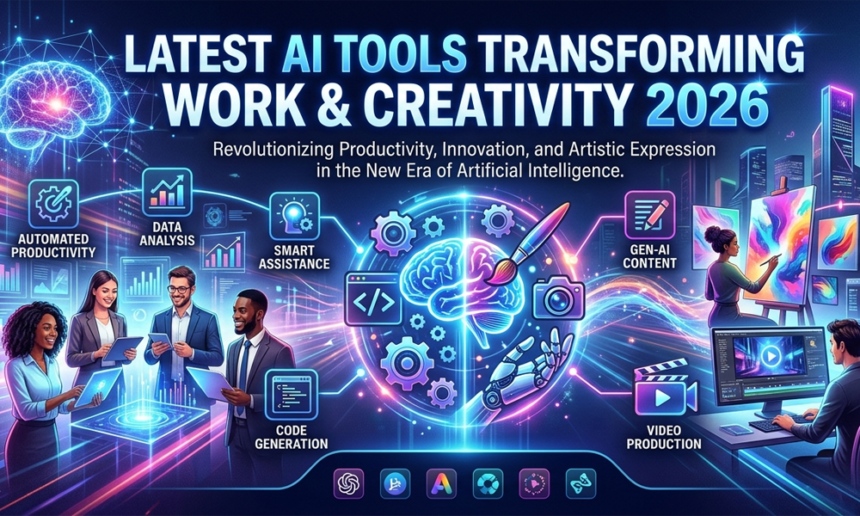
Artificial intelligence continues changing how people complete daily tasks, build creative projects, and manage business operations in 2026. New applications now support writing, coding, design, video production, customer service, marketing, and research with better speed and accuracy than before. Similarly, professionals, students, creators, and companies rely on intelligent assistants to reduce repetitive work while focusing on ideas that require human thinking. As a result, choosing the right AI tool has become more important than simply using AI. This article highlights the latest solutions making a real difference across multiple industries and explains why they continue gaining attention worldwide.
This article covers popular AI tools, current industry trends, research statistics, practical use cases, and the benefits they bring to modern work and creative projects.
Why AI Tools Continue Changing Everyday Work
Artificial intelligence has moved far beyond simple chatbots. Modern platforms assist with planning, content creation, presentations, software development, image editing, voice generation, and workflow automation. Consequently, businesses save valuable time while improving productivity across different departments.
According to recent industry reports, more than 78% of organizations now use AI in at least one business function, while generative AI adoption has grown significantly during the past two years. Similarly, marketing, education, healthcare, finance, and software development remain among the fastest-growing sectors adopting AI-powered solutions.
Several factors continue driving this growth:
- Faster project completion
- Better collaboration among teams
- Reduced repetitive manual work
- Improved content quality
- Smarter data analysis
- More personalized customer experiences
However, successful adoption still depends on selecting tools that match specific business goals instead of following every new trend.
AI Image and Design Platforms Continue Supporting Creative Teams
Graphic designers no longer spend hours completing every repetitive editing task manually. Modern AI-powered design software assists with background removal, object replacement, image expansion, color correction, and concept generation within minutes.
Creative agencies also use artificial intelligence to prepare multiple design variations before selecting the strongest concept for clients.
Popular use cases include:
- Marketing banners
- Social media graphics
- Brand identity concepts
- Product mockups
- Presentation visuals
- Advertising creatives
Despite these improvements, experienced designers still provide artistic direction, storytelling, and final quality control that automated systems cannot fully replace.
Video Creation Has Become Faster Than Ever
Video production previously required expensive equipment, editing expertise, and long production schedules. Today, AI simplifies many of these processes through automated editing, script generation, subtitles, voice cloning, translation, and realistic avatars.
Similarly, businesses create promotional videos, internal training materials, educational lessons, and product demonstrations much faster than before.
This shift also benefits independent creators who publish content regularly across multiple platforms while managing limited budgets.
Industry analysts expect AI-assisted video production to become a standard workflow rather than an optional feature during the coming years.
Developers Receive Smarter Coding Assistance
Software developers increasingly depend on AI coding assistants to generate sample code, identify programming errors, explain complex logic, and recommend improvements.
Consequently, development teams complete projects more efficiently while reducing debugging time.
These intelligent assistants help with:
- Code completion
- Documentation
- Bug detection
- Testing suggestions
- Database queries
- API integration support
Although experienced programmers still review every critical change, AI significantly reduces repetitive development work across many programming languages.
Businesses Are Building More Personalized Digital Experiences
Customer expectations continue rising across every industry. AI now helps companies deliver personalized recommendations, automated support, smarter email campaigns, and customized shopping experiences.
Recommendation engines analyze customer behavior while conversational assistants answer common questions throughout the day.
Meanwhile, businesses also rely on predictive analytics to forecast customer needs before they become support requests.
This growing personalization improves customer satisfaction while helping companies increase engagement through more relevant communication.
AI Research Tools Help People Find Information Faster
Research has become more efficient because AI can summarize lengthy documents, compare multiple sources, and organize important insights within minutes. Consequently, professionals spend less time searching for information and more time making informed decisions.
Similarly, students, journalists, consultants, and analysts rely on AI to prepare initial research before verifying facts through trusted sources. This balanced approach improves productivity while maintaining accuracy.
Several organizations also use AI to review internal reports, technical documentation, and market data, allowing teams to identify useful information much more quickly.
AI Is Changing Creative Work Across Every Industry
Creative professionals no longer depend on a single software application to complete an entire project. Instead, AI supports multiple stages of production, from planning ideas to polishing the final output.
For example, marketing teams generate campaign concepts, designers refine visual assets, and video editors prepare social-ready content with greater efficiency. In the same way, publishers streamline editorial workflows while maintaining a consistent publishing schedule.
Even creative communities focused on entertainment continue adopting AI to support storytelling and character development. Discussions around AI character websites often highlight how creators experiment with personalities, dialogue, and fictional scenarios before expanding them into larger projects.
Although automation continues improving, creative direction, emotional storytelling, and originality still depend on human judgment.
AI Automation Continues Reducing Repetitive Tasks
One of the biggest advantages of modern AI is workflow automation. Instead of repeating the same administrative work every day, businesses automate routine processes that previously required several hours each week.
Common automated activities include:
- Email organization
- Meeting summaries
- Calendar management
- Invoice processing
- Customer support responses
- Document categorization
- Workflow notifications
Consequently, employees dedicate more attention to strategic planning, communication, and decision-making rather than repetitive administrative work.
Likewise, small businesses benefit because automation reduces operational costs without requiring large technical teams.
AI Communities Continue Sharing Practical Knowledge
The popularity of AI has also created active online communities where professionals exchange ideas, productivity tips, and workflow recommendations.
Meanwhile, educational platforms continue publishing tutorials that help beginners select suitable AI applications for writing, coding, design, and automation.
Resources such as AI Girlfriend Wiki also demonstrate how specialized AI communities organize information about emerging platforms, technology updates, and user experiences. Although the focus differs from business productivity, these knowledge hubs reflect the growing demand for well-structured AI information across multiple categories.
Choosing the Right AI Tool Matters More Than Quantity
Hundreds of AI applications launch every month. However, installing numerous tools rarely improves productivity. Instead, successful users evaluate their daily requirements before selecting software that solves specific challenges.
Before choosing an AI solution, consider:
- Ease of use
- Data privacy practices
- Integration with existing software
- Pricing structure
- Output quality
- Customer support
- Regular product updates
Consequently, businesses avoid unnecessary subscriptions while building efficient workflows that remain sustainable over time.
AI Continues Expanding Across Specialized Industries
Artificial intelligence no longer serves only technology companies. Healthcare providers, financial institutions, educational organizations, manufacturers, and retail businesses continue adopting AI to improve daily operations.
For example, hospitals use AI to assist with medical imaging, while financial firms apply machine learning to identify unusual transaction patterns. Similarly, educators prepare personalized learning materials that better match different learning styles. In retail, leading platforms like iVendNext combine AI with point-of-sale, inventory, customer relationship management, analytics, and omnichannel commerce tools, showing how intelligent technology can become part of a retailer’s broader day-to-day operations. Consequently, AI continues creating practical value across industries with very different requirements.
As adoption grows, organizations increasingly focus on responsible implementation, data protection, and transparent decision-making instead of simply introducing new technology.
Practical Tips for Getting Better Results From AI
Using AI effectively requires clear instructions and thoughtful review. High-quality input usually produces better responses, regardless of the platform being used.
Some useful practices include:
- Define the goal before starting a task.
- Provide enough context for accurate responses.
- Review every AI-generated output before publishing.
- Update prompts when requirements change.
- Combine AI suggestions with human expertise.
- Verify important facts using trusted sources.
Likewise, businesses that create internal AI guidelines often maintain higher consistency across marketing, customer support, and documentation.
Current Research Shows Strong AI Growth
Recent market research continues highlighting the increasing adoption of artificial intelligence around the world.
Some notable findings include:
- More than 75% of professionals report using AI tools in their daily work for at least one recurring task.
- The global generative AI market is projected to grow at a strong annual rate throughout the remainder of the decade.
- Businesses investing in AI-assisted automation frequently report noticeable improvements in productivity and faster project delivery.
- Marketing, software development, customer service, and content creation remain among the leading sectors benefiting from AI adoption.
Clearly, these numbers indicate that artificial intelligence has become a practical business resource rather than an experimental technology.
Another growing trend involves creative communities that exchange ideas through AI unrestricted websites, demonstrating how conversational AI supports entertainment, storytelling, and interactive digital experiences alongside professional applications.
Conclusion
Artificial intelligence has become an essential part of modern work and creative processes. From writing and design to software development, automation, and research, AI continues helping individuals and organizations complete tasks more efficiently. However, success depends on choosing the right tools, verifying important information, and combining technology with human expertise.
As AI continues advancing throughout 2026 and beyond, those who adapt thoughtfully will remain better positioned to improve productivity, support innovation, and create meaningful digital experiences while maintaining quality, accuracy, and responsible use of these powerful technologies.