Changing careers can be difficult when the new profession normally requires years of specialized education. Nursing is particularly demanding because classroom knowledge is only one part of the preparation. Students also need laboratory practice, clinical experience, and eventually professional licensure.
The employment picture helps explain why people consider making that commitment. Florida employed about 217,630 registered nurses in May 2023, making it one of the country’s largest RN workforces. Nationally, registered nurse employment is projected to grow 5% from 2024 to 2034, with roughly 189,100 openings each year on average. For career changers, accelerated study offers one possible way to enter this large profession without repeating an entire undergraduate education from the beginning.
How an Accelerated Nursing Path Actually Works
Accelerated nursing education moves quickly, but it is not simply a shortened version of ordinary college. Students still need to develop clinical judgment, understand medications, assess patients, work safely in healthcare environments, and demonstrate practical nursing skills.
People researching accelerated BSN programs in Florida may come across the hybrid program offered by St. Thomas University. The university’s accelerated pathway combines online coursework with in-person simulation, skills training, and clinical rotations. Its nursing curriculum consists of 60 credits and can be completed in as few as 16 months, with subjects including health assessment, pathophysiology, pharmacology, adult nursing, mental health, maternal care, pediatrics, critical care, and evidence-based practice.
The short timeline is appealing, but those 16 months contain a considerable amount of work.
The Weekly Schedule Can Be Demanding
“Accelerated” sounds convenient until you translate it into an actual calendar.
Students may have lectures and assignments alongside simulation exercises, clinical rotations, exams, skills practice, and independent study. Clinical schedules are particularly important because they cannot necessarily be rearranged around a student’s preferred working hours.
St. Thomas University estimates 12 to 15 hours per week for online coursework, another 15 to 20 hours for study and preparation, and between 12 and 24 clinical hours during clinical semesters. Labs and simulations can add another four to eight hours.
That is worth considering before deciding how much employment or other responsibility you can realistically maintain.
Clinical Experience Is a Major Part of the Training
Nursing cannot be learned entirely through a laptop.
Students need opportunities to apply classroom concepts while caring for patients under appropriate supervision. Clinical education is where subjects such as assessment, medication safety, communication, prioritization, and care planning begin interacting with one another.
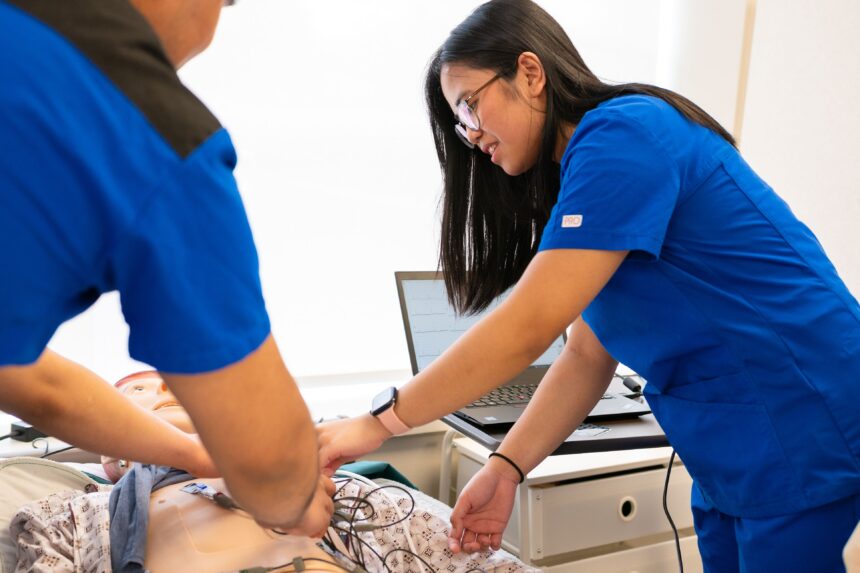
Simulation adds another layer. A controlled environment allows students to practice responding to realistic patient scenarios without placing actual patients at unnecessary risk.
When comparing accelerated programs, look beyond whether coursework is described as “online.” Find out exactly how laboratories, simulations, and clinical placements work. A hybrid program can offer flexible academic coursework while still requiring substantial face-to-face training.
Preparation for Licensure Deserves Attention
Graduation is not the final step toward becoming a registered nurse. Graduates generally must meet the requirements of the relevant nursing regulatory body and pass the NCLEX-RN examination.
That makes licensure preparation an important consideration when comparing schools. The National Council of State Boards of Nursing maintains NCLEX pass-rate information, including data organized by candidate and educational-program categories.
Pass rates should not be your only measure of program quality, but they can provide useful context. Ask how NCLEX preparation is incorporated into coursework, whether students receive structured review, and how clinical judgment is developed throughout the curriculum.
You are preparing for professional practice, not simply trying to finish classes quickly.
Accreditation Should Be Part of Your Research
Program accreditation deserves more than a quick glance at the bottom of a webpage.
It provides an external review of nursing education and can matter when considering graduate education or other professional opportunities later. St. Thomas University’s accelerated nursing program, for example, is accredited by the Commission on Collegiate Nursing Education.
Prospective students can independently check nursing programs through the CCNE accredited-program directory. The directory contains information on CCNE-accredited programs and provides a straightforward way to verify claims rather than relying solely on promotional material.
Approval and licensure requirements should also be checked carefully because accreditation and regulatory approval are related but distinct issues.
Think About the Financial Side Before Starting
Tuition is only one part of nursing-school costs.
Students may also need to budget for textbooks, uniforms, equipment, background checks, examinations, transportation, and other program-related expenses. Accelerated study can create another financial challenge: reduced time for paid employment.
A budget therefore needs to account for both money going out and potentially less money coming in.
Before enrolling, estimate your living expenses across the entire program rather than concentrating only on tuition. Consider transportation, emergency savings, food, technology, supplies, and any responsibilities you already support.
An accelerated timeline may mean fewer semesters of study, but it can also concentrate expenses into a relatively short period.
Your Previous Degree Can Still Be Useful
Career changers sometimes worry that their first degree has become irrelevant. It usually hasn’t.
A background in psychology could help with communication and behavioral health. Business experience may strengthen organization and leadership skills. Someone coming from education may already understand teaching, assessment, and working with families.
Even experience that seems unrelated can influence how you approach patients and colleagues.
The challenge is adding nursing-specific knowledge to those existing abilities. You still need to master clinical assessment, pharmacology, patient safety, evidence-based care, and professional nursing responsibilities, regardless of what you studied previously.
Decide Whether the Pace Fits Your Life
Fast-track nursing education can make sense for someone ready to give school a large share of their time and attention. It becomes much harder when the schedule is treated as something that can simply be squeezed between several other major commitments.
Look carefully at prerequisites, clinical expectations, accreditation, costs, academic support, and the amount of weekly work expected. Ask what happens if you struggle in a course and how students receive additional academic or clinical support.
Most importantly, be realistic about your available time.
The shortest route is not automatically the best one. A good nursing program needs to move quickly enough to suit your goals without sacrificing the clinical preparation and judgment required for safe patient care. If the pace fits your circumstances, an accelerated pathway can turn an earlier college education into the starting point for an entirely different professional direction.