Not every hunting e-bike needs full suspension. If most of the route follows pavement, maintained gravel, or relatively smooth forest roads, front suspension may be enough. Full suspension becomes more useful when hunters regularly ride across rocks, roots, ruts, washboard surfaces, and long sections of uneven ground.
The question is therefore not whether full suspension is always better. It is whether the terrain is rough enough—and frequent enough—to justify the additional weight and complexity.
What Does Full Suspension Actually Do?
Full suspension means the bike has suspension at both the front and rear.
The front fork absorbs impacts reaching the front wheel, while rear suspension helps manage bumps passing through the back of the bike. Together, they can make the bike feel more settled when surfaces change quickly.
This matters on hunting access routes because a road can move from compact gravel to exposed rock, roots, mud, or deep ruts within a short distance.
Suspension does not make rough terrain disappear, but it can reduce repeated impacts and improve comfort and control over longer rides.
When Is Front Suspension Enough?
Front suspension is often sufficient when the route is mostly predictable.
Maintained gravel roads, farm tracks, campground roads, and smoother forest access roads generally place less demand on the rear of the bike. A suspension fork can absorb many of the impacts that would otherwise reach the handlebars while keeping the bike mechanically simpler.
Hunters who spend most of their time on these surfaces should not assume they need full suspension simply because the bike is used outdoors.
Terrain should determine the suspension setup.
When Does Full Suspension Become Worth It?
Full suspension becomes easier to justify when rough terrain continues for miles rather than appearing only occasionally.
Repeated roots, rocks, potholes, ruts, and washboard surfaces can increase rider fatigue. Rear suspension helps absorb some of those repeated impacts instead of sending all of them through the frame and rider.
That can matter during longer scouting or access rides, especially when the bike is also carrying outdoor equipment.
A hunting ebike that regularly travels rough forest roads therefore has a stronger case for full suspension than one mainly used on maintained gravel.
Does Full Suspension Improve Traction?
It can help the wheels maintain more consistent contact with uneven ground, but suspension is only part of the equation.
When a wheel hits a bump, suspension allows it to move instead of forcing the entire bike to react as sharply. This can make the bike feel more controlled on rough surfaces.
Tire width, tread, tire pressure, speed, surface conditions, and rider input still affect traction.
For hunting routes, suspension and tires should be considered together. Full suspension cannot compensate for unsuitable tires or poor riding technique on loose ground.
Does Carrying Hunting Gear Change the Suspension Decision?
It can.
Extra equipment increases the total load the bike has to manage. On rough terrain, repeated impacts can become more noticeable when the rider is also carrying water, clothing, packs, or other gear.
Suspension can improve comfort, but cargo placement still matters. Heavy bags positioned too high or too far behind the rider can change steering and balance even on a full-suspension bike.
Hunters should test the bike with a realistic load before relying on it in remote terrain. A bike that feels comfortable unloaded may behave differently once gear is added.
What Does a Full-Suspension Hunting Setup Look Like?
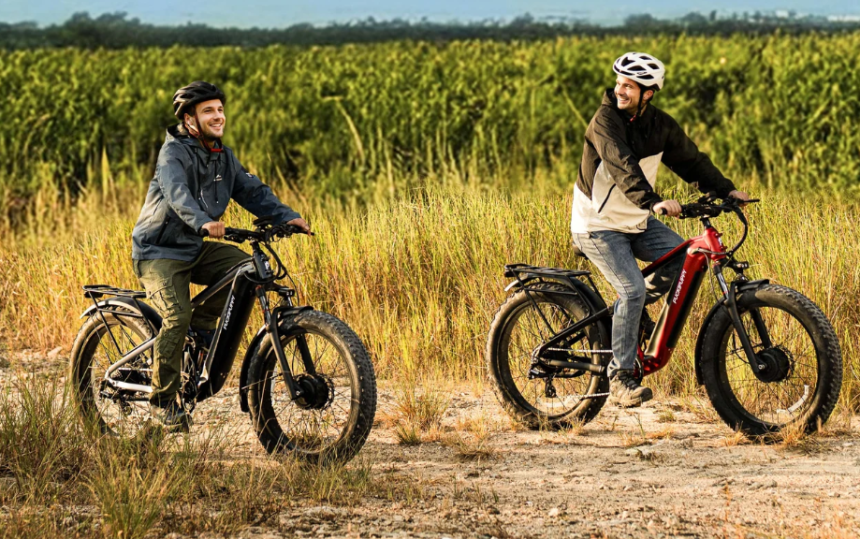
The Puckipuppy GoldenR Pro shows how full suspension can work alongside motor assistance, tires, and braking rather than functioning as an isolated feature.
The GoldenR Pro uses front and rear motors with 1,100W combined rated output and up to 1,600W peak output. Riders can switch between single- and dual-motor operation depending on terrain and assistance needs.
As a dual motor electric bike, it pairs that motor system with 26 × 4-inch fat tires, full suspension with a 130mm adjustable front fork, and 180mm hydraulic disc brakes. This combination is more relevant on loose climbs, gravel, rough forest roads, and changing outdoor surfaces than motor power alone.
Its removable 48V 20Ah battery has a manufacturer-listed range of 40–80 miles, while maximum load capacity is 400 pounds. The bike itself weighs 92.6 pounds.
That weight is an important trade-off. A heavier bike may feel manageable while motor assistance is available, but pushing it around a fallen tree, lifting it onto a rack, or moving it across an unridable section requires considerably more effort.
For riders searching for the most powerful electric bike, peak wattage should therefore not be the only comparison point. On a hunting route, traction, suspension, braking, battery reserve, and overall weight can matter just as much as maximum motor output.
Is Full Suspension More Useful on Long Hunting Routes?
It depends on the terrain more than the mileage.
A 20-mile ride on smooth gravel may place relatively little demand on rear suspension. A much shorter route filled with roots, rocks, deep ruts, and repeated bumps can make full suspension far more useful.
Distance does strengthen the comfort argument. Small impacts that seem insignificant during the first few miles can become tiring when they continue for much of the day.
This is why hunters should judge suspension according to both road quality and how long they expect to remain on rough terrain.
Does a Powerful Hunting E-Bike Automatically Need Full Suspension?
No. Motor power and suspension solve different problems.
The motor assists with acceleration and climbing. Suspension manages impacts from uneven terrain. Tires provide traction, while brakes control speed.
A powerful motor cannot replace any of those systems.
For hunters, the better approach is to evaluate the complete bike rather than focusing on a single specification. A high-output motor is most useful when the tires, brakes, suspension, battery, and frame are also suited to the terrain.
Match Suspension to the Route
A hunting e-bike does not automatically need full suspension.
Front suspension may be enough for maintained roads and smoother gravel. Full suspension becomes more useful when rough forest roads, rocks, roots, ruts, or repeated uneven surfaces are a regular part of the trip.
The right choice comes down to terrain, distance, load, and how often the rear suspension will actually be working.
For hunting access, full suspension is worth having when the route gives you a clear reason to need it—not simply because the specification sounds more capable.