Camping gear has evolved. Phones, GPS units, LED lanterns, portable fridges, and CPAP machines all compete for limited battery life. A portable power station solves that problem by packing hundreds or thousands of watt-hours into a single unit you can load in your trunk.
Choosing wrong means hauling dead weight or watching your battery die on night two. Capacity, output, battery type, and charging speed all determine whether a unit performs through the trip or quits before sunrise.
This guide walks through the five specs that matter, compares leading brands, and flags the mistakes that waste money — so you pick a portable power station that matches your camping style.
Why You Need More Than a Power Bank
A 20,000 mAh power bank handles phones and earbuds well enough. But camp comfort now depends on gear that draws real wattage — devices no power bank was designed to support:
- Mini projector for movie nights under the stars
- Electric cooler or portable 12V fridge
- CPAP machine for managing sleep apnea
A portable power station fills that gap. It converts stored energy into 110V AC, USB-C PD, and 12V DC — all from one unit. No engine noise, no fumes, and it recharges from a wall outlet, your car, or solar panels.
Silent, clean power also means you can run it inside a tent or RV — unlike gas generators, which produce carbon monoxide and require outdoor placement. For safety-conscious campers, this alone justifies the switch.
Specs That Actually Matter
Spec sheets can overwhelm with jargon and numbers. But if you focus on just five core metrics, you can predict real-world camping performance far more reliably than any product listing suggests.
Battery Capacity (Wh)
Watt-hours measure total stored energy. A 500Wh station runs a 50W device for roughly ten hours under ideal conditions. Weekend car camping typically calls for 500–1,000Wh. Multi-day trips with group gear may demand 1,500Wh or more.
Inverter Output (W)
Inverter wattage controls which devices run at the same time. A 600W inverter handles phones, lights, and a laptop, but a portable fridge pulls 80–150W with surges to 400W, and a coffee maker draws 800–1,200W. Match output to your most demanding device.
Battery Chemistry
Most reputable brands now use LiFePO4 (lithium iron phosphate) cells. Compared to older NMC lithium-ion, LiFePO4 delivers 3,000–6,000 charge cycles, better thermal stability, and safer indoor operation. Any unit still using NMC chemistry in 2026 should raise a red flag.
Charging Speed
How fast a portable power station recharges separates current from older models. Leading units reach 80% in under an hour from a wall outlet. Budget models may take three to five hours. Prioritize units with MPPT solar controllers.
Weight and Portability
A 1,000Wh station typically weighs 25–35 pounds. Car campers can tolerate that easily. For walk-in campsites or kayak trips, every pound counts. Compare weight-to-capacity ratios across brands rather than raw numbers alone.
Match Your Portable Power Station to Your Trip
Different camping trips place very different demands on your power supply. Before committing to a specific capacity or price range, run through these three questions — your answers will narrow the field fast:
- How many nights will you camp without grid access?
- Which devices need power, and what is their combined wattage?
- Will you carry solar panels for daytime recharging?
| Trip Type | Recommended Capacity | Solar Needed? |
|---|---|---|
| Weekend car camping | 500–1,000Wh | Optional |
| Multi-day off-grid | 1,500Wh+ | Yes |
| Ultralight solo | 200–300Wh | Optional |
Weekend Car Camping
For one- or two-night stays with vehicle access, a 500–1,000Wh portable power station covers phone charging, LED lanterns, a Bluetooth speaker, and a small electric cooler. You will likely head home before the battery runs dry.
Multi-Day Off-Grid Adventures
Extended backcountry trips call for 1,500Wh or higher capacity paired with foldable solar panels for daytime recharging. Expandable models that connect to external battery packs handle group camping well and let you scale power without replacing the base unit.
Ultralight Solo Trips
Solo backpackers should target units under 10 pounds and 300Wh. These smaller stations cover phone charging, headlamp batteries, and satellite communicators. Hauling anything heavier defeats the purpose of going light — save the larger stations for car-accessible sites.
How the Top Brands Stack Up
Four brands dominate the portable power station market for campers in 2026. Each leans into a different core strength, and understanding those trade-offs before you buy simplifies the decision considerably.
Price ranges vary widely — from under $300 for compact units to $3,000+ for whole-home backup systems. For camping, most buyers find the best value between $400 and $1,200, where capacity, output, and build quality hit a practical sweet spot.
| Brand | Key Strength | AC Charge (0–80%) | Best For |
|---|---|---|---|
| EcoFlow | Fastest charge + best app ecosystem | ~50 min | Tech-forward campers |
| Jackery | Lightest builds in class | Moderate | Weight-conscious hikers |
| Bluetti | Highest expandable capacity | Moderate-fast | Extended off-grid stays |
| Anker | Strong price-to-performance | ~55 min | Budget-focused buyers |
What the Numbers Reveal
EcoFlow and Anker lead on charging speed — a critical edge when you have limited prep time between trips or need storm-readiness on short notice. Jackery wins on raw portability for hikers counting every ounce. Bluetti suits campers who want days of runtime and maximum expandability through add-on battery modules.
No single brand wins every category. Your priority — fast recharging, light weight, or maximum runtime — shapes the best fit. For campers who value speed, smart controls, and a broad product ecosystem, EcoFlow tends to score highest across independent testing.
Mistakes That Cost Campers Money
Even experienced buyers make avoidable errors when shopping for camp power. A few minutes of focused research before checkout prevents each one and saves hundreds of dollars over the life of the unit.
Overbuying Capacity
A 3,000Wh station is overkill for weekend car camping. You pay more upfront, carry extra weight, and rarely tap more than half the battery. List your devices, add up their wattage, multiply by daily hours of use, and buy to that number with a 25% buffer.
Ignoring Solar Compatibility
Not every portable power station accepts high-wattage solar input. For multi-day trips, solar recharging can mean the difference between hours and days of runtime. Before buying, confirm the unit supports these features:
- MPPT charge controller (more efficient than PWM)
- Solar input of 400W or higher
- Standard MC4 connectors for broad panel compatibility
Skipping Weather Protection
Rain, blowing dust, and temperature swings can damage exposed electronics. Look for units rated IP54 or higher if you camp in variable weather. At minimum, store the station inside a tent vestibule or vehicle during storms to extend its lifespan.
Buying Based on Price Alone
The cheapest unit on Amazon may use outdated NMC cells, lack solar input, or ship with no meaningful warranty. Spending slightly more for LiFePO4 chemistry and a recognized brand pays for itself in cycle life, safety, and long-term reliability.
What to Look for in Your First Camping Power Station
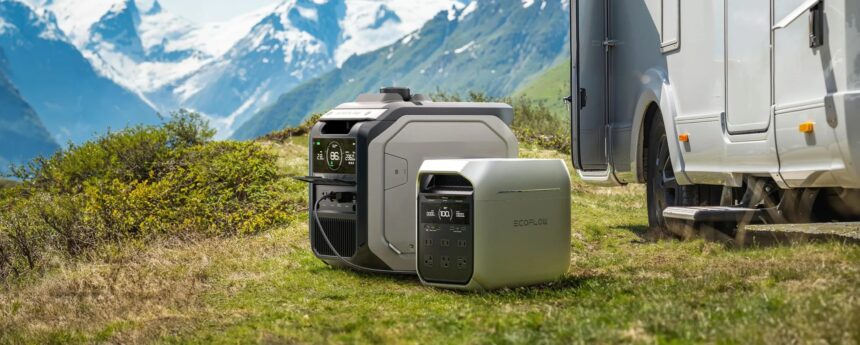
A great portable power station earns its spot through fast charging, reliable cells, and controls you can manage from your sleeping bag. EcoFlow’s DELTA and RIVER series deliver on every front — rapid AC and solar recharge, LiFePO4 cells rated for thousands of cycles, and expandable capacity.
An intuitive app monitors battery status in real time. For campers who want dependable power without guesswork, the lineup handles every trip from a weekend at the lake to a month off-grid.