Wait, Whose Anxiety Is This Anyway?
Have you ever walked into a room and felt an instant, heavy tension, even though everyone was smiling? Families can operate the exact same way, sometimes for decades. You might carry a persistent sense of dread or a baseline level of anxiety that does not seem connected to anything that has actually happened to you.
You have a decent job, your relationships are stable, and your childhood was, on paper, completely fine. Yet, there is a ghost in the room.
A lot of us are walking around bearing the weight of stories we were never told. We often think of mental health as something deeply personal, but our minds do not develop in a vacuum, which is why a dedicated mental health center focuses so heavily on a person’s entire background .
We are shaped by the people who raised us, just as they were shaped by those who came before them. When a family experiences a major psychological shock, like a sudden loss, a financial ruin, or a collective cultural trauma, the ripples do not just stop because time passes.
Sometimes, the way a family copes with a catastrophe is by never talking about it again. Silence becomes the armor. The problem with armor, though, is that it gets heavy, and eventually, you pass it down to your kids. They wear it without knowing why they are protecting themselves, or what they are even hiding from.
The Heavy Weight of the Unsaid
There is a massive difference between keeping a secret and harboring an unspoken trauma. A secret is conscious; you actively choose to hide the fact that you dented the family car or dropped out of college.
Unspoken trauma is different because it often functions as a structural rule of the household. It is an unwritten law that dictates what emotions are allowed, which topics are dangerous, and how much joy you are permitted to feel.
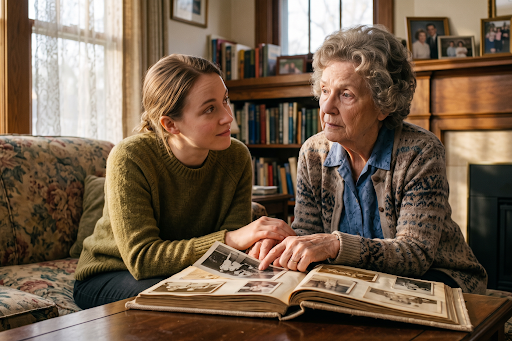
Imagine a grandmother who lost a sibling at a young age. The grief was never discussed, and the sibling disappeared from family conversations. As an adult, she becomes intensely protective of her own children without fully understanding why. Her fear shapes the next generation, even though the original tragedy remains unspoken.
Now, her children grow up believing the world is an inherently dangerous place where disaster lurks around every corner. By the time that reaches you, the grandchild, you may simply believe your anxiety is part of who you are.
You are hypervigilant, constantly checking the locks, or waiting for the other shoe to drop. You have no clue that your nervous system is actually reacting to a tragedy that happened decades ago.
It is a game of emotional telephone where the words disappear, but the fear remains. We absorb our parents’ coping mechanisms long before we understand them. If a parent responds to conflict by shutting down emotionally, children often learn that vulnerability feels unsafe.
What Mental Health Professionals Call It
If you talk to a clinical psychologist or a licensed family therapist about this, they will likely use terms such as intergenerational trauma or transgenerational trauma. While some individuals process these deep rooted dynamics in an intensive outpatient program, for many years, mental health care focused primarily on the individual. Today, family systems theory recognizes that emotional patterns often develop within relationships as well.
But systems theory changed the game. It looked at the family as an emotional ecosystem. When one part of the system is broken or suppressed, the whole system adapts to compensate. This framework suggests that emotions left unaddressed often influence behavior in indirect ways.
The Science of Epigenetics
Researchers have also explored epigenetics, including studies involving descendants of survivors of major historical traumas. Some evidence suggests that severe stress may influence epigenetic markers, although scientists continue to study how these changes may affect future generations. It does not change the genetic code itself, but it flips the switches on how those genes express themselves.
Researchers are continuing to study whether inherited biological factors, together with family environment and learned behaviors, may influence how people respond to stress. That is not to say you are broken or doomed by your biology.
It simply means your baseline stress response may be more sensitive than someone whose family history involved fewer significant stressors. This does not mean you are destined for poor mental health. It simply suggests that some people may begin with a greater sensitivity to stress.
Possible Signs of Intergenerational Trauma
How do you know if you are carrying something that belongs to your family tree? Because it is so nebulous, it rarely shows up as a clear memory. Instead, it shows up in behavioral patterns and somatic complaints. Here are a few ways it tends to manifest in everyday life.
The Chronic Fixer Persona
You may feel responsible for solving everyone else’s problems because stability feels essential. If someone around you is sad or angry, your anxiety spikes. This pattern may reflect a long-standing family belief that stability must be maintained at all costs to prevent conflict or crisis.
An Unexplained Fear of Success or Joy
Success may feel uncomfortable because you expect something to go wrong. This may sometimes be associated with families that experienced sudden loss right after a period of prosperity.
Emotional Numbness or Boundary Issues
You may struggle with emotional boundaries, either keeping others at a distance or taking on more than you can manage. This leaves you feeling constantly drained by your interpersonal connections.
Vague, Somatic Ailments
Chronic muscle tension, digestive discomfort, or headaches that do not have an obvious physical explanation. These symptoms can have many possible causes and should be evaluated by a healthcare professional if they persist. Chronic stress can sometimes affect both emotional and physical well-being.
These symptoms can be confusing, especially when you cannot identify a clear cause. Feeling guilty for struggling may only add another layer of emotional distress, making it helpful to process these patterns in talk therapy with a specialist
Why Silence Is the Worst Kind of Legacy
Parents often stay silent because they want to protect their children from painful experiences. Yet children notice tension even when they do not understand it. Without answers, they often create explanations that place the blame on themselves.
Over time, silence can create shame. When certain experiences remain off limits, people may begin hiding their own emotions to preserve family harmony.
Breaking the Chain Without Blowing Up Thanksgiving
So, how do we actually stop this cycle? It sounds great on paper to say “break the cycle”, but in reality, it is messy, uncomfortable, and often met with a lot of pushback from the very people you love. When you start naming the things that have been ignored, the family system will naturally try to pull you back into alignment with the old rules. They might call you overly sensitive, or tell you to leave the past in the past.
You do not need to stage a dramatic confrontation at the next holiday dinner to heal. Healing this type of emotional wound is often an internal process. Here is how you can start tracing the threads.
1. Start Asking Different Questions
Instead of asking your parents about their failures, ask them about their context. What was happening in the country when they were kids? What were their parents stressed about? Sometimes, framing it through a historical lens makes it safe enough for them to open up.
You might discover that your mom’s obsession with food security comes from her parents surviving severe poverty. Suddenly, her nagging feels less like control and more like an old scar.
2. Map Your Family Emotional Tree
Therapists use a tool called a genogram, which expands on a traditional family tree by mapping emotional and relationship patterns. Instead of just listing names and dates, you map out emotional trends.
3. Separate Your Feelings From Their History
When a wave of anxiety or shame hits you, pause and ask yourself if this is yours. Did something happen today to warrant this level of panic, or could this reaction be influenced by patterns you learned within your family? You can acknowledge the feeling without letting it drive the bus.
4. Talk To A Pro Who Gets It
Finding the right therapist matters. Look for a clinician trained in family systems, somatic experiencing, or EMDR. Directories like Psychology Today and Alma can help you find professionals who specialize in intergenerational trauma and explore how family experiences may be influencing your emotional patterns.
The Burden Ends With The Awareness
Realizing that you may be carrying emotional patterns passed down through generations can be unsettling, but it can also be empowering. Once you recognize the unspoken rules shaping your reactions, you have the opportunity to choose different responses.
Healing does not erase the past or excuse harmful behavior. Instead, it helps you understand how family experiences may have influenced your emotional world while giving you the freedom to build healthier patterns.
The process is rarely linear, but every step toward greater awareness can reduce the influence of long-standing family dynamics. By addressing what previous generations could not, you create a healthier foundation for yourself and those who come after you.