Developing a new baby product can be exciting, but every product idea comes with a certain level of risk. A design may look good on paper but require changes once a physical sample is created. Materials may not perform as expected, packaging may need improvement, or production details may become more complicated when larger quantities are involved. For growing brands, reducing these risks before mass production can save both time and money.
One practical way to manage the development process is to work with an experienced baby product OEM ODM factory that can support different stages from concept development to production preparation. Instead of moving directly from an idea to a large order, brands can use a more structured process that includes design review, sampling, specification approval, manufacturing planning, and quality checks before committing to full production.
Why Product Development Risk Matters
Every product launch involves investment.
Brands spend money on design, materials, samples, packaging, manufacturing, shipping, marketing, and inventory. If a major issue is discovered too late, correcting it can become expensive.
For example, changing a small detail during the sample stage may be relatively simple. Making the same change after thousands of units have already been produced can create a much larger problem.
This is why risk management should begin early.
The goal is not to remove every possible challenge. No manufacturing project is completely free from unexpected issues. Instead, brands should identify the most important risks and deal with them before they become difficult to correct.
Start With a Detailed Product Brief
A clear product brief gives the development team a strong starting point.
It should explain what the brand wants to create, who the intended customer is, and which features are most important.
A useful brief may include:
- Product type, size, and intended age group
- Preferred materials, colors, and finishes
- Important functions or design features
- Target price range and market position
- Branding and packaging requirements
The more specific the brief is, the less room there is for misunderstanding.
This does not mean every technical detail needs to be finalized before development begins. Some elements may change during sampling. However, the brand should clearly communicate its priorities so the manufacturer understands what should not be compromised.
Avoid Designing Only Around Appearance
Visual design is important, especially in a competitive baby product market.
However, appearance should not be the only consideration.
A beautiful product still needs to be practical to manufacture, package, transport, assemble, and use.
During early development, brands should think about how different parts work together. For a stroller, this might include the frame, wheels, folding system, handle, fabrics, and storage areas. For a tricycle or ride-on product, it may include the seat, wheels, steering system, structural components, and assembly method.
A design that is unnecessarily complicated may increase manufacturing difficulty without adding meaningful value for the customer.
The strongest products usually balance appearance with practical construction.
Use Prototypes to Find Problems Early
A prototype is one of the most useful tools for reducing development risk.
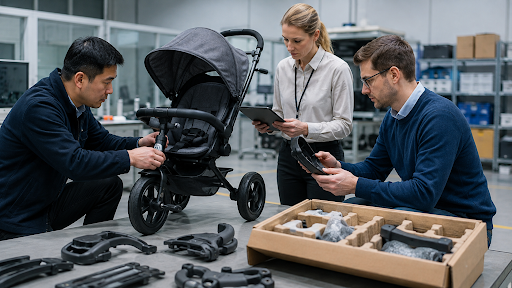
Digital drawings and renderings can show the overall design, but a physical sample reveals details that may not be obvious on a screen.
Once the sample is available, the team can examine its size, weight, materials, movement, proportions, finishing, and packaging.
Common issues discovered during sampling may include:
- A component that feels uncomfortable or awkward
- A color that looks different on the real material
- A folding or moving part that needs adjustment
- Packaging that does not protect the product well
- Branding that is too small or poorly positioned
Finding these issues before mass production gives the brand more freedom to make changes.
A sample should therefore be tested and reviewed carefully rather than approved only because it looks close to the original design.
Control Changes Before They Become Expensive
Product development often involves revisions.
A brand may change a color, material, component, accessory, or packaging detail after reviewing a sample.
These changes are normal, but they need to be controlled.
One common risk is making too many changes at different stages without keeping a clear record of the final version.
This can create confusion between the brand and manufacturer.
Every important adjustment should be documented. When a new version is approved, outdated specifications should no longer be used.
Clear revision management becomes even more important when several products are being developed at the same time.
Build Quality Requirements Into the Development Process
Quality should be considered while the product is being developed, not only after production finishes.
Brands need to decide what they expect from materials, components, construction, appearance, and packaging.
When evaluating a baby product OEM ODM factory, it is useful to understand how quality is handled throughout the production process.
A structured approach may include checks at different stages rather than relying on one final inspection.
For example, quality management can involve material checks, component inspection, assembly monitoring, functional testing, finished-product review, and packaging inspection.
The advantage of this approach is simple: problems can be found closer to the stage where they begin.
Do Not Ignore Small Component Decisions
Large product features often receive the most attention during development.
However, small components can have a major influence on the overall customer experience.
Fasteners, wheels, handles, fabrics, connectors, labels, and packaging inserts may seem like minor details individually, but they all contribute to how the finished product feels.
Brands should avoid approving small components without considering how they affect the complete product.
A cheaper component may reduce unit cost slightly, but if it creates poor movement, an inconsistent finish, or frequent complaints, the saving may not be worthwhile.
Product development should therefore consider the complete experience rather than focusing only on major visible features.
Plan Packaging Before Final Production
Packaging problems are often discovered late because brands focus heavily on the product itself.
This can be a costly mistake.
Packaging affects protection, presentation, shipping, storage, and customer experience.
Brands should review whether the product fits securely inside the carton and whether important areas are protected from movement or impact.
A practical packaging review may consider:
- Carton strength and dimensions
- Internal protection and product positioning
- Instructions and labeling
- Branding and product identification
- Shipping and warehouse requirements
Packaging should also be tested in a way that reflects real transportation conditions whenever appropriate.
A product that leaves the factory in perfect condition can still reach the customer damaged if the packaging is weak.
Understand the Cost of Over-Customization
Customization is valuable because it helps brands create a distinctive product.
However, too many changes can increase risk.
Every unique component, material, color, or packaging option adds another element that needs to be sourced, produced, checked, and managed.
Brands should ask whether each customization provides a real benefit.
If a design change improves usability, customer appeal, or brand identity, it may be worthwhile. If it adds complexity without creating clear value, it may be better to keep the product simpler.
This is especially important for new brands that are still learning which features customers care about most.
A controlled product design can make the first production run easier to manage.
Confirm the Final Version Before Mass Production
Before production begins, both sides should clearly understand what is being manufactured.
This final approval stage is extremely important.
The brand should confirm that the approved sample, product specifications, packaging, colors, materials, branding, and accessories all match the intended final version.
Important areas to confirm include:
- Product specifications and dimensions
- Approved materials and finishes
- Color references
- Logo and label placement
- Packaging artwork
- Included accessories
- Quantity and production details
This final confirmation creates a reference point for the production team.
It also reduces the chance of disagreements later about what was originally approved.
Keep Production Timelines Realistic
Rushing a manufacturing project can increase risk.
Brands may want to launch quickly, especially when they are working toward a seasonal campaign or retailer deadline. However, shortening the development process too aggressively can leave less time for sampling, revisions, material preparation, and quality checks.
A realistic timeline should allow each stage to be completed properly.
If a sample needs changes, those changes should be reviewed rather than approved only to save time.
Similarly, production should not begin before important packaging or specification details are finalized.
A carefully planned schedule usually provides better results than a rushed timeline built around an unrealistic launch date.
Think About What Happens After Production
Risk management does not end when products are manufactured.
Brands also need to think about shipping, storage, customer support, returns, and future orders.
For example, if a product is difficult to assemble, customers may contact support more often. If replacement components are difficult to obtain, small issues may become expensive. If packaging is difficult to store, warehouse costs may increase.
Thinking about the complete product journey can reveal issues that would otherwise be missed during design.
Brands should consider how the item moves from factory to warehouse, retailer, and finally the customer.
This broader view helps create products that are easier to manage after launch.
Learn From the First Production Run
The first production run provides valuable information.
Even when development has been carefully managed, real customer and retailer feedback can reveal opportunities for improvement.
Brands should review return reasons, support questions, product reviews, and distributor comments.
Repeated feedback may point to areas that can be improved in the next order.
This does not mean changing the product after every individual comment.
Instead, brands should look for patterns.
If several customers mention the same packaging issue or request the same feature, that information can become useful during future development.
Build Long-Term Manufacturing Knowledge
Each product project should make the next one easier.
Brands can build their own internal knowledge by recording which materials performed well, which packaging solutions worked, what customers liked, and where production challenges occurred.
This information can help future teams avoid repeating the same mistakes.
A long-term manufacturing relationship can also support this learning because the supplier becomes familiar with the brand’s expectations and previous projects.
Businesses researching support for product development, customization, sampling, and production can consider the OEM and ODM capabilities available through bebeluxbaby.com while evaluating possible manufacturing partners for future baby and children’s product lines.
Reducing product development risk is mainly about making important decisions at the right time. Clear product briefs, careful samples, controlled revisions, practical customization, early packaging planning, realistic timelines, and organized quality management can prevent small problems from becoming expensive ones. When brands approach manufacturing as a structured development process rather than simply placing an order, they are better prepared to bring consistent and market-ready products to customers.