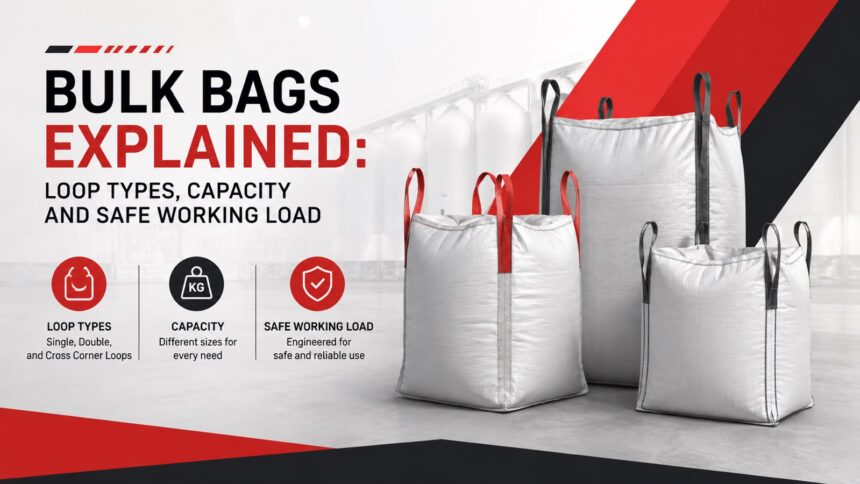
What are bulk bags?
Bulk bags are large woven polypropylene containers that move dry, flowable products in single units of 500-2000 kg. The industry term is FIBC (Flexible Intermediate Bulk Container), and the names big bag, jumbo bag and super sack describe the same product family.
A bulk bag replaces roughly forty sacks of 25 kg. One forklift cycle moves what previously took dozens of manual lifts, which is why warehouses handling granules, powders, minerals or grain switched to this format. Empty bags fold flat, so return freight costs a fraction of rigid container logistics.
Product specification sits under ISO 21898 for non-dangerous goods. Bags carrying hazardous materials fall under the UN/ADR framework and require type approval and marking. Turkish manufacturing of this format began in the mid-1980s: Cesur, producing packaging since 1930, started FIBC production in 1985.
How is a bulk bag constructed?
Construction starts with polypropylene resin extruded into film, slit into tapes and drawn to build tensile strength. Those tapes are woven into fabric on circular or flat looms, then cut, sewn and fitted with lifting loops woven separately on narrow looms.
Four elements define any specification: the body panel layout, the loop configuration, the top opening and the bottom outlet. Cesur produces bulk bags across these variables, and each choice is driven by how the plant fills, lifts and discharges the product rather than by preference.
Fabric weight typically runs in the 130-220 g/m2 band. Heavier fabric carries more load but costs more and folds less compactly. A coating layer closes the weave against fine powders, and an ultraviolet additive protects bags stored outdoors, where uncoated fabric loses strength within months.
Which loop configuration suits which handling method?
Loop count decides how the bag is lifted and how it behaves when full. Four loops distribute load across the corners and keep the bag square, which suits forklift tines and standard pallet handling. Single and two loop designs concentrate lifting at one point, so the bag hangs upright and clears tight filling stations quickly.
| Loop configuration | Handling method | Load behaviour | Typical use |
| Four loop | Forklift tines or crane hook, four points | Even distribution, square shape retained | General industrial filling and palletised storage |
| Two loop | Crane hook or single lifting bar | Load centred, body narrows slightly | Semi automated lines with limited headroom |
| Single loop | Hook or automated gripper, one point | Bag hangs upright, fastest attachment | High speed automated filling lines |
Automated lines usually favour single loop designs because the gripper engages one point without an operator positioning tines. Plants running mixed products across manual and automated stations often standardise on four loop bags instead, accepting a slower cycle for one specification across the whole site.
What is the difference between U-panel and circular bags?
U-panel construction joins one continuous panel forming two sides and the base with two additional side panels. The result holds a square shape when filled, which improves stacking and container loading efficiency.
Circular bags are woven as a tube, so the body has no vertical side seams. Fewer seams reduce a potential failure point, and the tubular body suits products where shape retention matters less than fabric continuity. Baffle bags add internal fabric panels at the corners to force a square profile, and they cost more because of the extra sewing.
How do safe working load and safety factor work?
Safe working load, marked as SWL on the label, is the maximum weight the bag is rated to carry. Safety factor expresses the relationship between that rating and the load the bag withstands in testing.
Single trip bags are commonly built to a 5:1 factor, meaning the tested load reaches five times the rated weight. Multi trip bags are commonly built to 6:1. The higher factor is not a licence to overload; it exists because a reused bag accumulates wear that a new bag has not.
- The label carries the safe working load, safety factor, production date and batch number.
- A rating applies to the bag as designed, including the loop and seam construction.
- Test certificates cover the production batch they reference, not the supplier indefinitely.
- A multi trip rating assumes documented inspection between uses.
How does bulk density decide the right size?
Size selection starts with volume, not weight. Bulk density, the weight of product per cubic metre, determines how much of the rated capacity a given size actually reaches.
A bag sized for one tonne of a dense mineral will sit half empty. The same bag filled with a light granule reaches its volume limit before the weight rating, leaving paid capacity unused. Calculating required internal volume from the product density before requesting dimensions prevents both outcomes.
Pallet footprint and container height are the other constraints. A base wider than the pallet overhangs and risks damage in transit, and total filled height decides how many units stack inside a standard container.
When is a liner required?
A liner is a separate polyethylene bag fitted inside the woven body. It closes the fabric against fine particles and creates a moisture barrier that the weave alone cannot provide.
- Loose liners sit inside the body and suit products where the liner is removed after discharge.
- Tabbed and glued liners attach to the body so the liner opens with the bag on automated lines.
- Barrier liners use multi layer film for products sensitive to moisture or oxygen.
- Conductive liners are specified where the outer bag carries an electrostatic classification.
Coated fabric offers an alternative for dust retention without a separate liner, but it does not provide the moisture barrier a film liner delivers. Food and pharmaceutical work generally combines a hygienically produced body with a liner.
How should bulk bags be stored and stacked?
Storage conditions affect the rating more than most buyers expect. Ultraviolet exposure degrades polypropylene, and bags stored outdoors without an ultraviolet additive lose tensile strength within a single season.
Stacking height depends on product flow behaviour and body construction. Square shaped bags stack more stably than tubular ones, and two or three tiers is a common working range where the base layer sits on a flat, dry surface. Bags stored directly on damp concrete draw moisture into the bottom seam.
What must be checked before reusing a bag?
Reuse is a documented process rather than a judgement call. A bag rated for multiple trips carries that rating only while inspection records exist for each cycle.
- Inspect each lifting loop along its full length for cuts, abrasion and stitching damage.
- Check body fabric for holes, tears and areas thinned by abrasion.
- Examine all seams, particularly where loops meet the body.
- Verify that the label remains legible, including the safe working load.
- Confirm the previous contents are compatible with the next product.
- Record the inspection against the batch number before refilling.
Single trip bags fall outside this process entirely. A bag built to a 5:1 factor is designed for one filling cycle, and refilling it moves the operation outside the manufacturer’s stated rating.
Which specification fits your operation?
Three inputs settle most specifications: product bulk density, the handling equipment already installed, and whether the operation can maintain inspection records. Density sets the dimensions, equipment sets the loop configuration, and record keeping decides between single and multi trip construction.
Automated filling lines narrow the choice further, since loop position and spout dimensions must match the equipment rather than the other way round. Plants running these lines specify the bag and the line together, because a mismatch shows up as unplanned stoppages rather than as a packaging problem.
On the supplier side, documentation separates comparable quotes. Test reports tied to batch numbers, a stated safe working load, and traceability from resin to finished bag matter more than a small difference in unit price. Operations audited by their own customers, particularly in food and pharmaceutical supply chains, feel that difference first.
This content is for information only. Dimensions, capacity and construction depend on the product being carried; verify current technical values against the manufacturer’s product documentation before ordering.
Frequently Asked Questions
What is the difference between a bulk bag and a big bag?
There is no technical difference. Bulk bag, big bag, jumbo bag and super sack are regional and commercial names for the same product, formally called a flexible intermediate bulk container. Specification documents use FIBC, while purchasing and warehouse teams tend to use the informal names. The construction, ratings and standards are identical.
How much weight can a bulk bag carry?
Rated capacity commonly falls between 500 and 2000 kg, and the exact figure appears on the label as the safe working load. Actual filled weight depends on product bulk density, since a bag may reach its volume limit before its weight rating. The rating applies only when the bag is lifted correctly from all designed loops.
Can bulk bags be used more than once?
Only bags built and rated for multiple trips, commonly with a 6:1safety factor. Each cycle requires inspection of loops, seams and fabric, and the inspection must be recorded against the batch number. Bags rated 5:1 are single trip products and fall outside their stated rating once refilled.
Do bulk bags need a liner?
A liner is specified when the product is a fine powder, is sensitive to moisture, or requires a hygienic contact surface. Coated fabric can retain dust without a liner but does not create a moisture barrier. Food and pharmaceutical applications generally combine hygienic body production with a film liner.
How long can bulk bags be stored outdoors?
Outdoor storage requires fabric with an ultraviolet additive, and even then exposure time should be limited and stated by the supplier. Untreated polypropylene loses tensile strength measurably within months of direct sunlight. Bags stored outdoors should also be raised off the ground to prevent moisture ingress at the base seam.