What is a bioclimatic pergola?
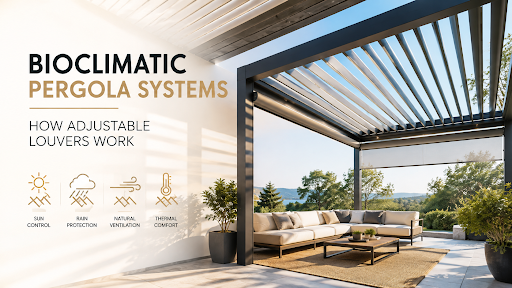
A bioclimatic pergola is an outdoor shade structure whose roof is built from rotating aluminum blades. Those blades, called louvers, pivot on a shared axis and move the roof from open sky to a sealed surface. Most systems rotate through 0 to 135 degrees, and the frames use 6063-T6 aluminum extrusion, a shape formed by pushing heated alloy through a die. The American Architectural Manufacturers Association (AAMA), now part of the Fenestration and Glazing Industry Alliance, publishes the coating standards used to finish those extrusions.
The word bioclimatic describes a control idea rather than a style. A fixed pergola sets one shade condition for the entire year. A bioclimatic pergola changes shade, ventilation, and rain response within seconds, which places the category between a patio cover and a sunroom.
How do adjustable louvers work?
Adjustable louvers work through a linkage bar that ties every blade to one driver. Each blade carries a pin that seats into a slot in a bar hidden inside the perimeter beam. When a motor pushes that bar, every blade rotates to the same angle at the same moment. The mechanism repeats the tilt rod of a window blind, scaled to a roof and engineered for wind.
Blade profiles are extruded rather than folded from sheet. An extruded blade carries an internal web that resists twist across the span, and the top face is shaped to move water toward one edge. Blade widths commonly run 6 to 8 inches, so a 16 footbay, the clear run between supports, carries more than twenty blades. Wider bays need an intermediate beam, because deflection, the amount a span bends under load, grows far faster than the span length itself.
What happens to rain when the louvers close?
Rain on a closed bioclimatic pergola follows a designed path from blade to grade. Each blade overlaps its neighbor against a gasket of EPDM (ethylene propylene diene monomer), a synthetic rubber used in roofing membranes. The path works only when the frame carries a slight pitch, since a perfectly level beam holds standing water in the channel.
- Water lands on the closed blade and runs to its lower edge.
- The edge discharges into the channel inside the perimeter beam.
- The channel carries the flow to the nearest post.
- The hollow post drops the water to grade.
Drainage capacity is the limit that product sheets rarely state. Post interiors act as downspouts, so a four post structure has exactly four of them. Leaf debris collects at the beam to post transition, the first point to block.
Which components define a bioclimatic pergola system?
Bioclimatic pergola components fall into four groups: structure, moving parts, water management, and finish. The table below maps each group to its job and to the problem a poor specification creates.
| Component | Function | Common specification | Problem when underspecified |
| Posts and beams | Carry load to footings | Extruded frame with internal gutter | Frame twist and standing water |
| Louver blades | Rotate for shade and sealing | Extruded profile with EPDM edge gasket | Mid span sag, leaks at overlap |
| Linkage and hardware | Hold every blade at one angle | Stainless pins with nylon bushings | Uneven blades, binding in the track |
| Drive motor | Rotate the blade assembly | Low voltage linear actuator | Slow travel, stalling in cold |
| Sensors and controls | Trigger automatic movement | Rain detection with keypad or remote | Roof left open in a storm |
| Finish | Protect the metal outdoors | Powder coat to a published exposure class | Chalking and color drift |
Finish grade on aluminum louvers is measured against published coating specifications rather than brand language. AAMA 2604 and AAMA 2605 both require a minimum dry film thickness of 1.2 mils (thousandths of an inch), close to 30 microns. The gap sits in the exposure test: 2604 is validated against five years of South Florida weathering and 2605 against ten. The entry grade, AAMA 2603, holds to one year of the same test. Coastal sites and shaded inland sites do not weather at the same rate, so one finish ages two ways inside a single service area.
Hardware fails earlier than coatings on most louvered roofs. Stainless steel pins and nylon bushings resist the salt and grit that reach the linkage joint. Plated steel in the same position corrodes and binds the blades, and the roof then closes unevenly.
Why does louver angle change the temperature underneath?
Louver angle changes temperature because it controls two things at once: direct sunlight and air movement. A partly open roof blocks the direct sun while leaving a gap for warm air to rise between the blades. That upward flow is the stack effect, the movement created when warm air rises and pulls cooler air in at the edges. A sealed roof stops the stack effect, which helps during rain and hurts comfort in August heat.
Blade orientation carries as much weight as blade angle. Blades set across the path of the low afternoon sun shut it out at a shallow tilt. Blades set in line with that path need a steep angle, and steep angles close the ventilation gap. Rotation direction is fixed at installation, so shade behavior is decided on the drawing rather than on the remote.
How do motors, sensors, and controls operate?
Motors on louvered roofs run at low voltage. A 24 V direct current (DC) linear actuator, a motor that pushes a rod in a straight line, drives the linkage bar. A full open to close cycle finishes in well under a minute. Wiring runs inside the posts and beams, so the structure shows no external conduit.
Sensors create automatic behavior that differs between systems on the same terrace. A rain sensor closes the louvers at first contact with water. A wind sensor on a retractable fabric roof does the opposite and pulls the fabric back. A property with both systems holds two automatic responses that move in opposite directions during one storm.
What loads and permits apply in New Jersey and New York?
Load requirements for a louvered roof come from ASCE 7, the load standard published by the American Society of Civil Engineers. The International Building Code (IBC) and the International Residential Code (IRC) both reference that standard. Snow governs the design more often than wind in the Northeast, because a closed roof holds snow like a solid deck. Wind uplift, the suction force that pulls a roof upward, changes with blade position. Footing size follows the worse of the two cases rather than the average.
Permitting in New Jersey runs through the Uniform Construction Code, adopted at N.J.A.C. 5:23 and enforced by the local construction office. A freestanding structure and an attached structure follow different review paths, since attachment makes the roof part of the dwelling. Vision Art Aluminium, an aluminum fabricator at 28 Valley Road in Montclair, builds its SkyBlade louver roof as a bioclimatic pergola for New Jersey and New York. That published project sequence places drawings and permits ahead of manufacturing. Zoning review sits separate from the construction permit and covers setbacks and lot coverage.
Common misconceptions about bioclimatic pergolas
Misconceptions about bioclimatic pergolas cluster around four claims. Each one compares the structure to something it is not: a sunroom, a fixed patio cover, or a fabric awning.
- A closed louvered roof is not insulated, since the blades seal against water rather than heat transfer.
- A rain sensor is not a storm plan, because it reacts to water rather than to the wind ahead of it.
- Louvers do not reduce the load on the ground, since a closed roof sends full snow load into posts and footings.
- Low voltage wiring does not remove the electrical permit, because power still reaches the transformer from a house circuit.
One further boundary separates the category from a sunroom. A sunroom encloses semi-conditioned space behind glazing, while a bioclimatic pergola stays open at the sides. Perimeter screens and sliding glass panels move the structure closer to the enclosure rules in the local code.
Where a bioclimatic pergola earns its place
A bioclimatic pergola earns its place on a terrace that has to work in more than one weather condition. Blade span sets the structural design, since snow load on a closed roof drives beam sizing and footing depth. Drainage is a designed path rather than a product feature, and it depends on frame pitch and clear posts. Finish class and hardware metal decide how the roof moves after a decade, and both are fixed before fabrication.
Permit sequence controls the calendar, because construction and zoning approvals run ahead of manufacturing. A louvered roof adds shade control and rain protection to an outdoor room. That roof does not turn the room into conditioned space, and the difference shows in the code path.
Product specifications, load figures, and permit rules change by municipality and by product year. Blade dimensions, motor ratings, and code thresholds are worth confirming with the manufacturer and the local construction office before an order.
Frequently Asked Questions
What is a bioclimatic pergola?
A bioclimatic pergola is a shade structure with a roof of rotating aluminum louvers. The blades turn together on a linkage bar, commonly across a 0 to 135 degree range. Closed blades overlap on rubber gaskets and drain into a gutter inside the perimeter beam, while open blades let heat escape upward.
How do adjustable louvers work?
Adjustable louvers work through a shared linkage bar connected to a low voltage actuator. Each blade carries a pin that seats in the bar, so one motor sets one angle for every blade. Blade profiles are extruded with an internal web for stiffness and a top face shaped to direct water to one edge.
Do louvered roofs leak when it rains?
Louvered roofs shed rain through overlapping blades and gasketed edges rather than through a sealed membrane. Water runs into a channel inside the perimeter beam and drains through hollow posts to grade. Leaks appear when the frame sits level, when a post is blocked by debris, or when a blade gasket has hardened with age.
How much snow can a closed louvered roof hold?
Snow capacity depends on the design load calculated under ASCE 7 for the site, not on one universal figure. A closed roof behaves like a solid deck and transfers the full load into beams, posts, and footings. Blade span moves most: wider bays need an intermediate beam to keep deflection within limits.
What maintenance does a louvered roof need?
Maintenance on a louvered aluminum roof centers on drainage and moving parts. Clearing debris at the beam to post junction keeps the internal downspout open. Linkage pins and bushings stay quiet when the hardware is stainless and nylon, and rinsing the blade edges removes the grit that wears the gaskets.