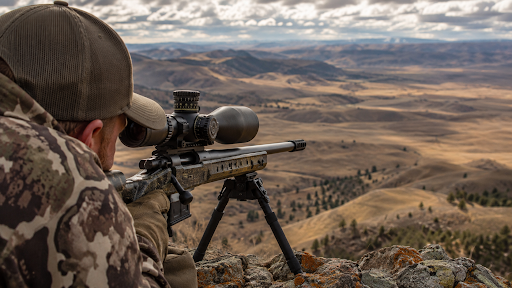
There’s a meaningful difference between hunting inside 200 yards and taking a confident, ethical shot at 400 or 500 yards. As the distance grows, small errors in equipment or technique that would have been forgiving up close become the difference between a clean harvest and a missed opportunity, or worse, a wounded animal that isn’t recovered. Hunters who regularly find themselves in open terrain with longer shot opportunities need to think differently about their scope setup than someone hunting exclusively in tight timber.
This isn’t about needing the most expensive gear on the market. It’s about understanding which features actually matter at extended range and making sure your setup, ideally built around glass from a proven hunting rifle scope manufacturer, is genuinely capable of supporting the shots you’re planning to take.
Why Standard Setups Fall Short at Distance
A scope that performs perfectly well at 150 yards can become a liability at 400 yards, not because it’s poorly made, but because it wasn’t designed with longer shots in mind. Several factors that barely matter up close become significant as range increases: parallax error, precise elevation holdover, wind drift, and even minor inconsistencies in turret tracking all compound as distance grows.
Understanding these factors, and confirming your scope actually accounts for them, is the real foundation of a long-range-capable setup.
Parallax Adjustment Becomes Essential
Parallax error occurs when the target image and the reticle aren’t on the same optical plane, causing your point of aim to shift slightly depending on your eye position behind the scope. At short range, this effect is often negligible. Beyond 300 yards, it can meaningfully affect shot placement, especially from field positions where your head position isn’t perfectly consistent every time.
Many hunting scopes are factory-set for parallax at 100 or 150 yards and don’t offer adjustment. For serious long-range hunting, a scope with an adjustable objective or side-focus parallax knob lets you correct for this at your actual shooting distance, which removes one more variable from an already challenging shot.
Turret Quality and Tracking Accuracy
At longer distances, dialing precise elevation adjustments becomes far more relevant than it is for closer shots, where a simple holdover reticle often suffices. This makes turret quality genuinely important rather than a nice-to-have feature.
A few things worth checking before trusting turrets for long-range use:
- Repeatable tracking, meaning the turret consistently moves the exact amount indicated with each click, verified through a tall target test at the range rather than just trusting the spec sheet.
- Return-to-zero reliability, so if you dial up for a long shot and then back down, the scope returns precisely to your original zero.
- Clear, tactile clicks that you can count confidently by feel, without needing to look at the turret in low light or under pressure.
- Locking or capped turrets, if you prefer to avoid accidental adjustment while moving through the field, versus exposed turrets favored by hunters who dial frequently.
Not every scope on the market is built with these long-range demands in mind, which is why it’s worth checking the specific turret specifications published by a given hunting rifle scope manufacturer before assuming a scope will hold up to repeated dialing in field conditions. Some manufacturers publish tracking test results or offer guarantees on turret accuracy, which can be a useful way to compare options before committing to a purchase.
Glass Quality Matters More at Distance
At extended range, even small differences in lens quality become more noticeable. A scope with average glass might perform acceptably at 150 yards but show its limitations at 400 yards, where fine detail, such as distinguishing antler tines or confirming a clean shot angle, requires genuinely sharp resolution and accurate color transmission.
This is one area where it’s worth prioritizing glass quality over additional features. A simpler reticle paired with excellent glass often serves a long-range hunter better than a feature-heavy reticle paired with mediocre lenses that can’t resolve fine detail at distance in the first place.
Magnification Needs at Extended Range
Magnification matters more at distance, but the jump doesn’t need to be as dramatic as many hunters assume. A quality 4-16x or 5-25x scope covers the vast majority of ethical hunting shots out to 500 yards or beyond, particularly when paired with good glass clarity and a reticle designed for holdover reference.
Extremely high magnification introduces its own challenges at distance, including a narrower field of view that makes it harder to track an animal that moves after your initial shot, and increased sensitivity to any movement or mirage distortion on hot days. Choosing enough magnification to clearly identify your target and hold precisely, without going excessive, tends to serve hunters better than simply maximizing zoom power.
Reticle Choice for Longer Shots
For hunters who regularly shoot beyond 300 yards, a ballistic reticle with holdover marks calibrated to a specific cartridge and load becomes genuinely useful, rather than an unnecessary complication. These reticles let you hold for bullet drop directly rather than dialing turrets, which can be faster in a field situation where an animal may not stay in position long.
That said, a ballistic reticle only helps if you’ve actually practiced with it at various distances beforehand. Understanding exactly where each holdover mark lands with your specific rifle and ammunition combination, confirmed through real range time rather than assumption, is what makes this feature valuable rather than just an extra layer of complexity you’re guessing at in the field.
Wind Reading Becomes Part of the Equation
At extended range, wind drift becomes a factor that can genuinely determine whether a shot connects, even with everything else dialed in correctly. This isn’t strictly an optics issue, but your reticle can help if it includes wind holdover references alongside elevation marks.
Learning to estimate wind speed and direction in the field, and understanding roughly how much drift to expect with your specific cartridge at your intended distance, is a skill that develops with practice. No reticle replaces this judgment, but a well-designed one makes applying that judgment faster and more precise once you’ve developed it.
Practicing at Realistic Distances
None of these features matter if they’re only tested at the range under ideal conditions and never practiced from realistic field positions. Long-range hunting shots rarely happen from a perfectly stable bench rest, so it’s worth practicing from field-realistic positions, including prone with a bipod, off a pack, or braced against natural cover, at the actual distances you expect to encounter while hunting.
This kind of practice reveals gaps between theoretical capability and practical readiness that a spec sheet alone can never show you.
Choosing the Right Setup for Your Terrain
Companies like billingsoptics.com that focus specifically on hunting optics typically offer product lines with these long-range features clearly outlined, making it easier to identify a scope genuinely suited for extended-range hunting rather than guessing based on magnification numbers alone.
Reading through detailed specifications for parallax adjustment, turret type, and reticle options helps ensure you’re choosing gear that matches your actual hunting distances, not just gear that sounds capable in general marketing terms.
Final Thoughts
Long-range hunting demands more from your equipment than closer-range hunting does, but that doesn’t mean you need to overspend on features you won’t use. Focus on parallax adjustability, reliable turret tracking, a reticle you understand and have practiced with, and enough magnification to see clearly without sacrificing field of view.
Combined with genuine range practice from realistic field positions, a scope built around these priorities gives you the confidence to take an ethical, well-placed shot when the distance is real and the moment counts.