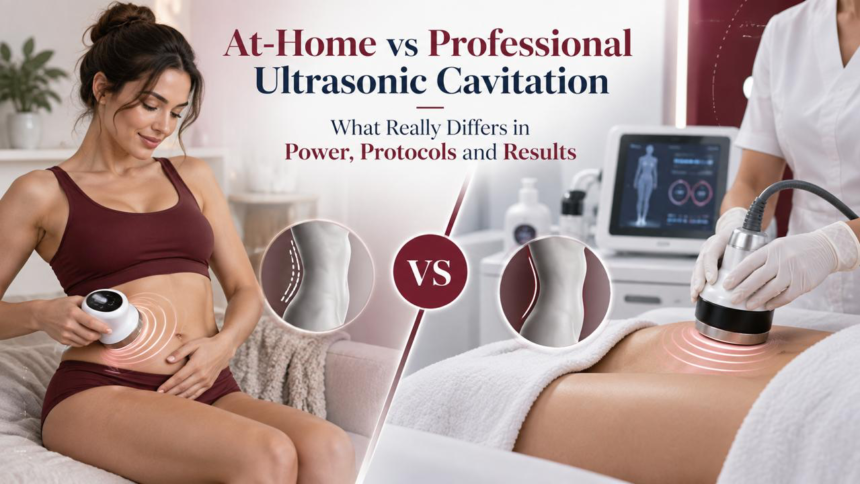
The gap between an at-home cavitation gadget and a clinic machine is not marketing hype, it comes down to how much acoustic energy actually reaches the fat layer. Ultrasonic cavitation, sometimes called ultrasonic lipolysis, uses low-frequency sound waves to disturb fat cells so the body can clear their contents over time. A handheld unit can look almost identical to the salon version, but the amount of stable power behind the transducer is where the real difference in effectiveness and safety begins.
Online listings for body care devices now cover everything from inexpensive personal handsets to salon-grade platforms, and the category page rarely spells out that they are not doing the same physical job. Understanding the mechanism first makes it much easier to judge what a device can realistically deliver, what it cannot, and how to use either type without unrealistic expectations.
How ultrasonic cavitation actually works
The treatment sends ultrasound waves into the tissue at a low frequency, commonly in the range of about 25 to 40 kHz. At this frequency the waves create tiny pressure changes inside the fatty layer, forming microscopic vapor bubbles that rapidly expand and collapse. That collapse, the cavitation itself, is strong enough to disrupt the membranes of some fat cells while largely sparing skin, blood vessels and nerves. The released contents are then carried away through the lymphatic system and processed by the body over the following days and weeks.
Frequency matters more than most product pages admit. Devices working in the kilohertz range are aimed at deeper fat, while some consumer handsets operate in the megahertz range, which sits closer to the surface and behaves more like a skin-oriented, warming treatment than deep fat disruption. A unit that mostly makes the skin feel warm or buzzy is not automatically reaching the fat layer, and that distinction explains a lot of disappointed reviews.
Where at-home and professional devices really differ
Both categories can share the same 40 kHz label on the box, so the number alone is not a reliable guide. The practical differences show up in power delivery, stability and who is operating the device.
| Factor | At-home handsets | Professional systems |
| Power output | Lower and often limited by design for consumer safety | Higher, sustained output intended to reach deeper fat |
| Frequency stability | Can fluctuate with cheaper components | Tighter, more consistent output from the transducer |
| Depth of action | Often shallow, closer to a skin-warming effect | Aimed at the subcutaneous fat layer |
| Operator | The user, with no clinical assessment | Trained or certified practitioner after a consultation |
| Best realistic use | Maintenance, mild firming, routine between other care | Contouring small, stubborn fat pockets |
The claim that professional machines reach the fat layer while many home units mainly warm the surface reflects industry and practitioner experience rather than a single controlled comparison, so it is best read as a general pattern, not a guarantee about any specific model. Still, the direction is consistent: a device that cannot sustain enough stable energy at the right depth is unlikely to produce meaningful contouring, whatever the label says.
What the evidence says about results
Ultrasonic cavitation is a body contouring tool, not a weight-loss method. In practice that means it targets localized, stubborn fat, for example on the abdomen, flanks, hips or thighs, rather than reducing overall body weight. A dermatology review of ultrasound for body contouring reported abdominal circumference reductions in the range of roughly 2 to 4.6 cm with focused ultrasound approaches. Smaller studies have described reductions of about one to three centimeters in a treated area after a few sessions, with participants losing fat in that zone rather than losing weight on the scale.
The overall evidence base is still limited, and results vary with body composition, the area treated, the device used and how many sessions are completed. Changes are gradual because the body needs time to clear the disrupted fat, so nothing dramatic appears overnight. Anyone expecting liposuction-level change from either a home handset or a single clinic visit is likely to be let down.
Safety, side effects and who is a candidate
Cavitation is generally considered a low-risk, non-invasive procedure with no incisions and little to no downtime. The most common effects are mild and short-lived: redness, a warm sensation during treatment, occasional bruising, temporary tenderness, or a headache afterward. Less often, skin can look uneven or dimpled if fat is not reabsorbed smoothly. It is generally suitable across skin types, but that does not make it risk-free or right for everyone.
The commonly described ideal candidate is in good general health, does not smoke, has realistic expectations, and is already close to a target weight rather than seeking major fat loss. People who are pregnant or breastfeeding, or who have significant health conditions, should treat this as a medical decision and speak with a qualified professional before starting, especially before using a device without any clinical assessment. Cavitation does not replace a balanced diet and physical activity, and it is not a treatment for obesity.
Protocols and realistic expectations
Session structure is another place where clinic and home use diverge. A professional treatment typically runs about 40 to 60 minutes per area and is delivered as a course rather than a one-off. Practitioners generally leave at least one full day between sessions so tissue can recover, with weekly treatment being the common rhythm and every one to two weeks a reasonable slower pace. Promises of a finished result in one to four sessions are a red flag rather than a selling point.
- Expect a series of sessions, not a single visit, with recovery time built in between them.
- Support the process with adequate water intake and normal activity, so the body can clear the disrupted fat.
- Judge progress by measurements and fit over several weeks, not by the scale the next morning.
- Pair any device with sensible diet and movement, since cavitation maintains and refines rather than replaces them.
Used this way, a home handset can be a reasonable maintenance and firming tool for someone with modest goals and patience, while a professional system operated by a trained provider is the more credible option for actually contouring a specific, stubborn area. Matching the device to the goal, and keeping expectations grounded in what the evidence supports, is what separates a satisfied result from wasted time and money.