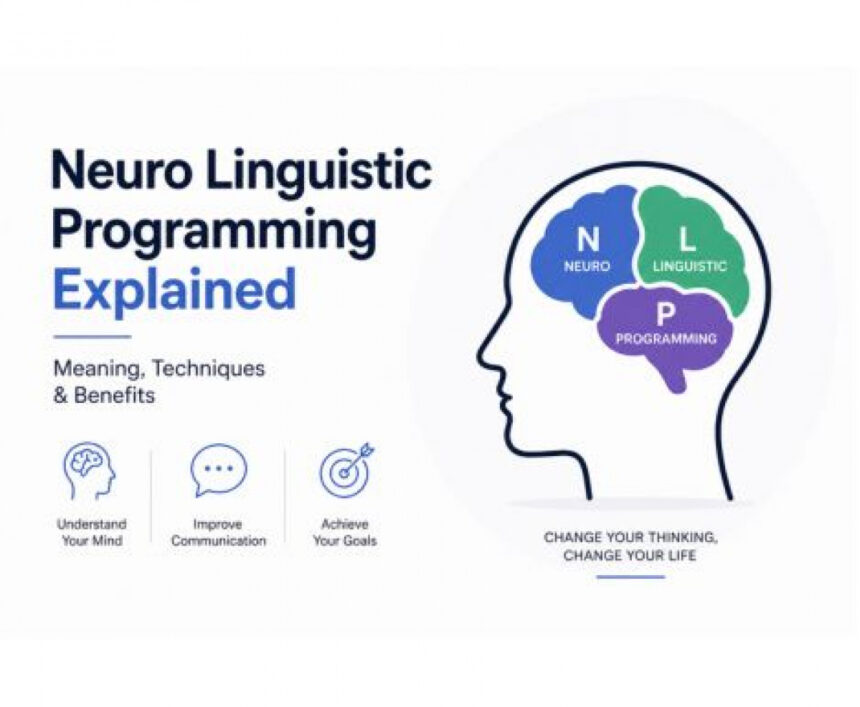
There’s a growing interest in techniques that help people communicate more effectively, manage their emotions under pressure, and break patterns of thinking that no longer serve them. Neuro-Linguistic Programming, better known as NLP, has become one of the most talked-about approaches in this space, moving well beyond its origins in therapy circles and into boardrooms, sales teams, and everyday personal development.
At its core, NLP explores the connection between the way we think, the language we use, and the behaviours that follow. Rather than treating communication as something fixed, it looks at communication as a set of learnable patterns, ones that can be studied, adjusted, and improved with practice. This idea has made NLP particularly appealing to professionals who want practical tools rather than abstract theory, and it’s a big part of why demand for structured nlp courses has grown steadily among people looking to build these skills properly rather than piecing techniques together from scattered online articles.
Where NLP Actually Came From
NLP was developed in the 1970s by Richard Bandler and John Grinder, who set out to study what made certain therapists remarkably effective compared to their peers. Rather than focusing on theory, they observed the specific language patterns, questioning techniques, and behavioural habits that seemed to produce consistent results, then codified those observations into a teachable framework.
That practical, observation-based foundation is part of what distinguishes NLP from many other personal development approaches. It wasn’t built from the top down as an academic theory; it was built by reverse-engineering what already worked, which is one reason it has found such a broad range of applications since.
The Core Ideas Behind the Practice
A central concept in NLP is that each person builds their own internal map of reality, shaped by language, past experience, and the way they process sensory information. Communication difficulties often arise not because people disagree on facts, but because they’re operating from different internal maps without realising it. Learning to recognise and adjust to someone else’s way of processing information, whether they think in pictures, words, or feelings, is one of the foundational skills taught in most NLP training.
Another key idea is that behaviour, no matter how unhelpful it seems, was originally adopted for a reason, often as a coping mechanism or a learned response to a specific situation. Instead of trying to force a behaviour to stop through willpower alone, NLP techniques focus on understanding the underlying pattern and consciously building a more useful alternative in its place.
Why It’s Gained Traction in the Workplace
While NLP has roots in therapeutic settings, its practical applications have made it increasingly popular in professional environments. Sales teams use NLP-influenced techniques to build rapport more quickly and read buying signals more accurately. Managers use similar principles to give feedback in ways that land well rather than triggering defensiveness. Public speakers and coaches often draw on NLP language patterns to make their communication more persuasive and memorable.
This crossover into business isn’t accidental. Many of the skills NLP teaches, active listening, reframing negative situations, recognising unconscious patterns in language, are directly transferable to negotiation, leadership, and client relationships. For professionals whose success depends heavily on how well they communicate, these are far from abstract concepts.
What Structured Training Actually Covers
Self-teaching from books and videos can offer a surface-level introduction, but structured training tends to go considerably deeper, covering practical exercises, supervised practice with feedback, and a clearer framework for applying techniques in real situations. Most recognised courses progress through levels, starting with foundational concepts like rapport building and sensory awareness, before moving into more advanced areas such as reframing, anchoring, and language patterns used in influence and persuasion.
Quality training also tends to include significant hands-on practice rather than passive learning, since NLP techniques are ultimately skills that need to be rehearsed and refined through real interaction. Working alongside experienced practitioners and receiving direct feedback on technique is often what separates a genuinely useful learning experience from one that leaves people with interesting ideas but little practical ability.
Approaching NLP With the Right Expectations
It’s worth noting that NLP has its critics, and not every claim made about it over the years has held up to rigorous scientific scrutiny. The most credible way to approach it is as a practical toolkit for improving communication and self-awareness, rather than a guaranteed formula for success. Used this way, many people find genuine value in the techniques, whether they’re looking to become a more persuasive communicator, manage stress more effectively, or simply understand their own thought patterns a little better.
For anyone curious about exploring these ideas seriously, starting with a properly structured, well-regarded training programme tends to offer a far more reliable foundation than trying to assemble techniques from scattered sources online.