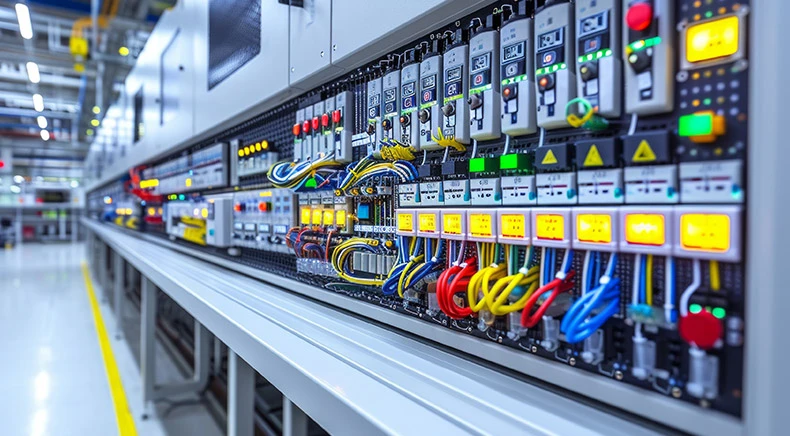
Modern large-scale manufacturing facilities rely on complex, highly engineered electrical distribution systems to power heavy industrial machinery, automated assembly lines, process cooling, and critical plant infrastructure continuously. Unlike standard commercial buildings, industrial manufacturing sites consume immense amounts of electric power, operating at medium and high voltage levels to ensure operational efficiency, voltage stability, and system safety. Understanding how electrical power flows from high-voltage utility grid connections down to low-voltage equipment controls is essential for plant managers, facility engineers, and industrial developers striving to optimize manufacturing uptime.
High-Voltage Utility Substation and Primary Power Entry
The electrical journey inside a large-scale manufacturing plant begins at the high-voltage utility service entrance, where power from regional grid transmission lines enters the facility’s dedicated primary substation. Utility transmission lines deliver electrical energy at elevated transmission voltages—often ranging from 69 kV to 230 kV or higher—to minimize line losses over long transmission distances.
At the main facility substation, large oil-filled step-down power transformers reduce incoming grid transmission voltages to medium-voltage distribution levels, typically between 4.16 kV and 34.5 kV. The primary substation houses heavy-duty outdoor circuit breakers, air-insulated switchgear, protective relaying systems, and surge arresters that isolate internal facility faults and shield plant equipment from external utility voltage surges.
Designing, procuring, and constructing these complex utility-scale electrical hubs requires specialized high-voltage engineering expertise. Partnering with a certified high-voltage EPC contractor in Wyoming or other major industrial regions ensures that primary substations are engineered to meet strict utility interconnection standards, local electrical safety codes, and long-term plant capacity growth projections.
Medium-Voltage Internal Distribution and Step-Down Substation Architecture
Once power transitions through the primary substation transformer, it is routed through the facility via medium-voltage switchgear and underground duct banks or overhead cable trays. Medium-voltage distribution allows manufacturing plants to transport massive quantities of electric power across sprawling campus footprints with minimal voltage drop and conductor copper loss.
Inside the manufacturing facility, power is distributed to strategically located unit substations or load-center transformers situated close to high-demand production areas. These indoor unit substations step down medium distribution voltages to low-voltage utilization levels—typically 480V three-phase for industrial motor drives and heavy equipment, or 208V/120V for facility lighting, office equipment, and sensitive electronics.
Placing step-down unit substations close to heavy manufacturing equipment minimizes long runs of heavy low-voltage feeder cables, significantly reducing conductor costs and system power losses. This decentralized distribution layout isolates localized electrical faults to individual manufacturing bays, preventing plant-wide power outages during equipment maintenance.
Implementing Unit Substation Protection and Safety
Unit substations feature enclosed metal-clad switchgear, dry-type step-down transformers, and vacuum circuit breakers that protect localized feeder circuits from short circuits and overload conditions.
Modern unit substations utilize digital trip units and arc-flash detection sensors to trip main breakers instantly during fault events. Advanced substation protection safeguards personnel and prevents catastrophic equipment damage.
Routing Cables via Overhead Cable Trays and Conduit Banks
Distributing power cables via high-capacity steel ladder cable trays suspended from ceiling trusses protects heavy electrical conductors from physical shop floor damage.
Cable tray systems allow facility engineers to inspect, upgrade, or add power feeders easily as manufacturing lines rearrange. Cable tray routing optimizes shop floor space utilization.
Motor Control Centers and Industrial Automation Drive Systems
Electric motors account for the vast majority of electrical power consumed in heavy industrial manufacturing environments, driving pumps, industrial fans, air compressors, conveyor networks, and mechanical presses. Managing, starting, and controlling these heavy motor loads requires centralized equipment known as Motor Control Centers.
Motor Control Centers consolidate motor starters, variable frequency drives, circuit breakers, and control transformers into unified, modular floor-standing enclosures. Grouping motor controls centrally allows plant technicians to monitor motor operating status, perform routine diagnostic maintenance, and lock out power safely during mechanical servicing.
Integrating Variable Frequency Drives into Motor Control Centers allows operators to regulate motor speed and torque precisely based on real-time process demand, replacing inefficient mechanical throttling valves. Deploying automated motor drive controls slashes motor electricity consumption, reduces mechanical wear and tear, and prevents aggressive voltage sags caused by direct-on-line motor startup surges.
Centralizing Industrial Motor Management in MCC Enclosures
Grouping individual motor starter buckets inside standardized Motor Control Center cabinets simplifies maintenance troubleshooting and streamlines electrical safety procedures.
Modular MCC buckets feature drawout construction, allowing technicians to disconnect and service individual drive units safely without shutting down total plant power. Centralized MCC enclosures improve operational uptime.
Optimizing Energy Consumption with Variable Frequency Drives
Variable Frequency Drives adjust electric motor input frequency dynamically, matching motor output power directly to real-world manufacturing line load requirements.
Utilizing VFDs on large industrial pumps and ventilation blowers cuts motor power usage by up to fifty percent during partial-load cycles. Motor drive automation optimizes facility energy efficiency.
Power Quality Management and Power Factor Correction
Maintaining exceptional power quality is critical in large manufacturing facilities, where non-linear electrical loads—such as arc welders, variable speed drives, robotic automation, and industrial induction furnaces—introduce severe electrical noise and harmonic distortion into the plant network. Poor power quality causes premature motor insulation breakdown, overheating transformers, nuisance circuit breaker tripping, and costly automated machinery halts.
Industrial electrical systems incorporate active harmonic filters, isolation transformers, and transient surge suppression devices to mitigate voltage harmonics and protect delicate microprocessors on automated assembly lines. Monitoring power quality metrics continuously across all main distribution switchboards prevents localized electrical noise from spreading throughout the facility.
Furthermore, heavy inductive motor loads cause power factor lag, leading utility providers to impose severe financial penalties on manufacturing facilities for poor power factor ratings. Installing automatic capacitor banks and synchronous condensers offsets reactive power demand, restoring system power factor close to unity and eliminating utility surcharge penalties on monthly electric bills.
Deploying Active Harmonic Filters for Clean Power
Active harmonic filters analyze network current waveforms continuously, injecting equal opposing harmonic currents in real time to cancel out electrical noise.
Mitigating harmonic distortion protects sensitive programmable logic controllers from data corruption and equipment overheating. Harmonic filtering maintains stable control system performance.
Correcting Low Power Factor with Automated Capacitor Banks
Automatic power factor correction capacitor banks switch reactive compensation stages dynamically based on instantaneous inductive motor load changes across the facility.
Maintaining a high power factor maximizes current capacity within existing transformers and cables, preventing power loss. Power factor correction eliminates expensive utility penalty fees.
Emergency Backup Power Systems and Uninterruptible Power Supplies
Unplanned electrical power outages can inflict catastrophic financial damage on manufacturing operations, causing material spoilage in thermal process lines, severe machinery damage, and extended downtime. Building a resilient electrical architecture requires integrating robust backup power generation and emergency backup systems.
Industrial emergency power systems utilize large diesel or natural gas generator sets equipped with automatic transfer switches that detect utility voltage loss and restore power to critical plant loads within seconds. Emergency backup power maintains essential safety systems, facility lighting, ventilation exhaust fans, and critical material handling equipment during broad utility blackouts.
For sensitive continuous-process lines, automated robotics, and plant data servers where even a momentary power interruption triggers process failure, Uninterruptible Power Supply systems provide instant, zero-break battery backup power. UPS systems bridge the critical time gap between primary grid failure and generator startup, ensuring unbroken operational continuity across automated manufacturing processes.
Integrating Automatic Transfer Switches for Seamless Backup
Automatic transfer switches monitor utility grid voltage constantly, signaling standby generators to start immediately when power levels drop below safety thresholds.
ATS units isolate the facility from utility lines before transferring critical electrical loads to backup power, preventing dangerous backfeeding. Automated power transfer guarantees facility safety.
Protecting Process Automation with Uninterruptible Power Supplies
Static UPS systems utilize battery storage arrays to deliver immediate, clean AC power during utility voltage sags, micro-blackouts, and frequency fluctuations.
Providing uninterrupted battery power prevents automated manufacturing lines from losing process memory or freezing during momentary grid blips. UPS integration safeguards continuous automation.
Conclusion
Understanding the multi-tiered electrical distribution systems in large-scale manufacturing plants is vital for maintaining industrial productivity, operational safety, and energy efficiency. From high-voltage utility substations and medium-voltage plant distribution to unit substations, Motor Control Centers, power quality conditioning, and emergency backup power, every component plays a crucial role in delivering reliable electricity. By designing robust electrical infrastructure, prioritizing power quality management, and deploying automated drive controls, manufacturing enterprises protect expensive capital assets, eliminate unscheduled operational downtime, and achieve sustainable long-term commercial success.