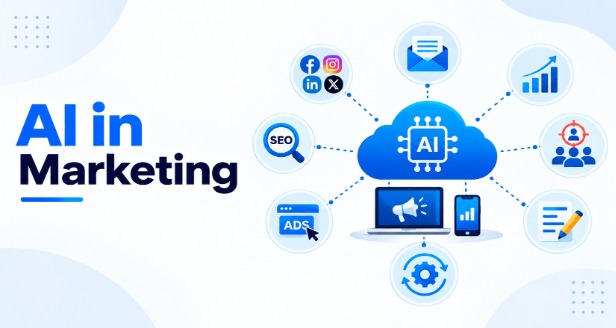
Artificial Intelligence is changing how businesses plan, execute, and optimize their marketing activities. From personalized recommendations and customer segmentation to content creation and campaign analysis, AI helps marketing teams process large amounts of data and make faster, more informed decisions.
In this blog, we’ll discuss how AI in Marketing is being used, its key benefits and challenges, popular use cases, and the future of AI-powered marketing.
What is AI in Marketing?
AI in Marketing refers to using artificial intelligence technologies to analyze customer data, automate marketing activities, personalize experiences, and support better decision-making. It can process large amounts of information and identify patterns that may be difficult to detect manually.
AI-powered marketing uses machine learning, Natural Language Processing, predictive analytics, Generative AI, and recommendation systems. These capabilities can support everything from audience targeting and content creation to customer engagement and campaign optimization.
How Does AI Work in Marketing?
AI marketing systems collect information from sources such as customer interactions, website activity, purchase history, social media, and campaign performance. Algorithms then analyze this data to identify patterns, predict customer behavior, and generate useful insights.
Based on these insights, marketers can automate certain activities, personalize communications, identify high-value audiences, and optimize campaigns. AI systems can also continuously analyze new data to improve recommendations and predictions over time.
Why are Businesses Using AI in Marketing?
Marketing teams manage large amounts of customer and campaign data while meeting rising expectations for personalization and faster communication. Manual analysis and repetitive marketing tasks can make it difficult to respond quickly to these demands.
AI helps businesses automate routine activities, understand customer behavior, and identify opportunities within their data. This allows marketing teams to focus more on strategy, creativity, and customer relationships.
1. Growing Customer Data
Businesses collect customer information from websites, applications, social media platforms, email campaigns, CRM systems, and purchase transactions. Managing this information manually can make it difficult to identify useful patterns.
AI can analyze large datasets quickly and help marketers understand customer interests, behavior, and preferences. These insights can support more targeted and relevant marketing strategies.
2. Demand for Personalization
Customers increasingly expect brands to provide relevant content, product recommendations, and offers based on their interests. Generic marketing messages may not provide the same level of engagement.
AI can analyze individual customer behavior and help businesses deliver personalized experiences across different channels. This can make marketing communication more relevant to each audience segment.
3. Need for Marketing Automation
Marketing teams often spend significant time on repetitive tasks such as email campaigns, customer segmentation, reporting, and lead qualification. AI-powered tools can automate these activities.
Automation allows marketers to reduce manual effort and spend more time on campaign strategy, creative development, and customer engagement.
Key Use Cases of AI in Marketing
AI can be applied across multiple stages of the marketing lifecycle, from understanding audiences and creating content to optimizing campaigns and measuring performance. Businesses can select use cases based on their marketing objectives, customer data, and available resources.
1. Customer Segmentation
AI can analyze customer characteristics, behavior, purchase history, engagement levels, and other data to identify meaningful audience segments. Unlike basic segmentation methods, AI can recognize complex patterns across large datasets.
Marketers can use these segments to create more targeted campaigns and deliver content or offers that are relevant to specific customer groups.
2. Personalized Marketing
AI enables businesses to personalize marketing experiences based on individual customer behavior and preferences. It can analyze browsing activity, previous purchases, content interactions, and other signals to determine what a customer may find relevant.
Marketers can apply personalization to emails, product recommendations, website content, advertisements, and promotional offers. This creates more relevant interactions throughout the customer journey.
3. Content Creation
Generative AI can assist marketers in creating content such as blog drafts, social media copy, product descriptions, email campaigns, and advertising variations. It can help teams generate initial ideas and adapt content for different audiences and channels.
Human review remains important to maintain accuracy, brand consistency, originality, and the appropriate tone. AI works best as a support tool rather than a complete replacement for human creativity.
4. Predictive Analytics
AI can analyze historical marketing and customer data to predict potential outcomes. Marketers can use predictive models to estimate customer behavior, identify potential leads, forecast demand, or determine the likelihood of customer churn.
These insights allow marketing teams to make decisions based on predicted behavior rather than relying only on historical reporting.
5. Lead Scoring
AI can analyze lead characteristics, engagement history, website activity, and interactions to determine which prospects are more likely to convert. This helps marketing and sales teams prioritize high-value opportunities.
AI-powered lead scoring can also update scores as new customer interactions occur, providing a more dynamic view of lead quality.
6. Chatbots and Virtual Assistants
AI-powered chatbots can communicate with website visitors and customers in real time. They can answer common questions, provide product information, collect lead details, and guide users toward relevant resources.
More advanced AI assistants can understand natural language and handle more complex conversations. This can improve customer support while reducing the workload on marketing and service teams.
7. Ad Targeting and Optimization
AI can analyze customer behavior, audience characteristics, campaign performance, and engagement data to improve advertising strategies. Marketing teams can use these insights to identify promising audiences and optimize campaigns.
AI can also evaluate creative variations and identify which messages or formats drive stronger engagement.
8. Customer Journey Analysis
AI can analyze interactions across multiple touchpoints, including websites, email, applications, social media, and customer support. This provides marketers with a broader view of how customers move through the buying journey.
Understanding these patterns can help businesses identify friction points and improve marketing experiences at different stages of the customer lifecycle.
9. Sentiment Analysis
Natural Language Processing can analyze customer reviews, social media comments, surveys, and other text-based feedback. AI can identify sentiment and recurring themes within customer conversations.
Marketing teams can use these insights to understand brand perception, identify customer concerns, and adjust campaigns based on audience feedback.
10. Marketing Performance Analysis
AI can bring together data from different marketing channels and identify patterns in campaign performance. It can help marketers understand which channels, content types, audiences, or campaigns are contributing to specific business outcomes.
These insights can support better budget allocation and help teams optimize marketing strategies based on measurable performance.
Benefits of AI in Marketing
AI can improve marketing processes by combining automation, data analysis, personalization, and predictive capabilities. When implemented with reliable data and clear objectives, it can help marketing teams work more efficiently and make better decisions.
1. Improved Marketing Efficiency
AI can automate repetitive activities such as data analysis, customer segmentation, reporting, and campaign workflows. This reduces manual effort and lets marketing teams focus on higher-value work.
2. Better Customer Personalization
AI helps marketers understand individual customer preferences and behavior. Businesses can use these insights to deliver more relevant content, recommendations, offers, and communications.
3. Faster Decision-Making
AI can process large amounts of marketing data much faster than manual analysis. Marketers can access insights and spot patterns faster, helping them respond to changing customer behavior.
4. Improved Lead Generation
AI can identify potential customers based on behavior, interests, engagement, and other signals. It can also support lead scoring and qualification, helping sales and marketing teams prioritize promising prospects.
5. Better Campaign Optimization
AI can analyze campaign performance and identify areas for improvement. Marketers can use these insights to adjust targeting, content, messaging, budgets, and channel strategies.
6. Increased Productivity
AI-powered tools can support content creation, research, reporting, customer communication, and data analysis. This helps marketing teams reduce time spent on repetitive work and improve overall productivity.
Challenges of Using AI in Marketing
Despite its benefits, AI implementation requires careful planning. Businesses must address data quality, privacy, security, accuracy, and human oversight to ensure they use marketing AI responsibly.
1. Data Quality
AI systems depend on reliable data to generate useful insights. Incomplete, outdated, duplicated, or inaccurate customer data can affect predictions and personalization.
Businesses should establish proper data collection, cleaning, integration, and governance processes before relying heavily on AI-driven marketing decisions.
2. Data Privacy
Marketing AI often processes customer information, including behavior, preferences, and interactions. Businesses must ensure they collect and use customer data responsibly.
Strong access controls, data security practices, transparency, and compliance with applicable privacy requirements are important when implementing AI marketing solutions.
3. Accuracy and Bias
AI models can produce inaccurate or biased results when they are trained on incomplete or unbalanced data. Incorrect predictions can lead to ineffective targeting or poor customer experiences.
Marketing teams should monitor AI outputs, evaluate model performance, and maintain human oversight for important decisions.
4. Integration Challenges
AI marketing solutions often need to connect with CRM systems, marketing automation platforms, analytics tools, websites, and customer databases. For example, AI in CRM systems can help businesses use customer data more effectively and support personalized marketing activities. Poor integration can create data silos and limit AI’s value.
Businesses should establish reliable data pipelines and APIs to ensure relevant information moves securely between systems.
5. Lack of AI Expertise
Implementing AI effectively requires knowledge of data science, Machine Learning, marketing technology, analytics, and software integration. Organizations without the required expertise may struggle to select and implement suitable solutions.
Businesses can address this challenge through employee training, specialized tools, or experienced AI development partners.
How to Implement AI in Marketing
Successful AI adoption starts with a clear understanding of the marketing problem, not simply adopting technology because it is trending. Businesses should identify use cases that can provide measurable value and align with their overall marketing strategy.
1. Identify Marketing Goals
Businesses should determine what they want AI to improve, such as lead generation, personalization, campaign optimization, customer engagement, or content production.
Clear goals help marketing teams select appropriate AI technologies and define measurable success criteria.
2. Assess Available Data
Businesses should identify the customer and marketing data available across their systems. This includes CRM information, website activity, purchase history, campaign data, and customer interactions.
Review the data for quality, accessibility, consistency, and privacy considerations before using it for AI applications.
3. Select the Right AI Technology
Different marketing challenges require different AI capabilities. Machine Learning can support predictive analytics, NLP can analyze customer conversations, and Generative AI can assist with content creation.
Businesses should choose technologies based on their specific objectives rather than selecting tools solely because they’re popular.
4. Start With High-Value Use Cases
Organizations can begin with a small number of practical use cases, such as customer segmentation, lead scoring, content assistance, or marketing analytics.
Starting with focused projects makes it easier to test results, measure ROI, and identify improvements before expanding AI across additional marketing activities.
5. Monitor and Optimize
Businesses should continuously monitor AI marketing systems for accuracy, performance, customer response, and business impact. Models and workflows may need adjustments as customer behavior and market conditions change.
Regular evaluation helps businesses maintain the quality and effectiveness of their AI-powered marketing initiatives.
Future of AI in Marketing
AI marketing is expected to become more integrated, personalized, and automated as businesses adopt advanced AI technologies. Generative AI, predictive analytics, AI agents, conversational interfaces, and real-time personalization are likely to play a growing role in marketing workflows.
Marketing teams may increasingly use AI agents to coordinate tasks across multiple platforms, analyze campaign data, and automate routine decision-making. At the same time, human creativity, strategic thinking, brand governance, and responsible data use will remain essential.
How BigDataCentric Helps Businesses With AI in Marketing
BigDataCentric helps businesses develop AI-powered solutions that support marketing automation, customer analytics, personalization, and data-driven decision-making. Its capabilities across AI, Machine Learning, Data Science, Business Intelligence, Generative AI, and NLP can be applied to different marketing requirements.
1. AI-Powered Marketing Solutions
BigDataCentric can help businesses develop customized AI solutions for customer segmentation, predictive analytics, recommendation systems, lead scoring, and marketing automation.
2. Marketing Data Analytics
Businesses can combine data from multiple marketing channels and use analytics to understand campaign performance and customer behavior. BigDataCentric can help develop dashboards and analytics solutions that turn marketing data into actionable insights.
3. AI Chatbots and Customer Engagement
AI-powered chatbots can help businesses automate customer interactions, answer common questions, qualify leads, and provide personalized assistance. BigDataCentric can develop conversational solutions based on specific business and customer requirements.
4. Generative AI for Marketing
Generative AI can assist marketing teams with content creation, customer communication, research, and workflow automation. Generative AI in marketing can also support more personalized campaigns and efficient marketing workflows. BigDataCentric can help integrate Generative AI capabilities into marketing applications and business workflows.
Conclusion
AI is transforming marketing by helping businesses understand customers, automate repetitive processes, personalize experiences, and make data-driven decisions. From customer segmentation and predictive analytics to AI chatbots and Generative AI, businesses can apply AI across different stages of the marketing lifecycle.
Successful implementation requires reliable data, suitable technology, strong privacy practices, and continuous monitoring. With the right strategy and technical expertise, AI can help marketing teams become more efficient while creating more relevant and engaging customer experiences.