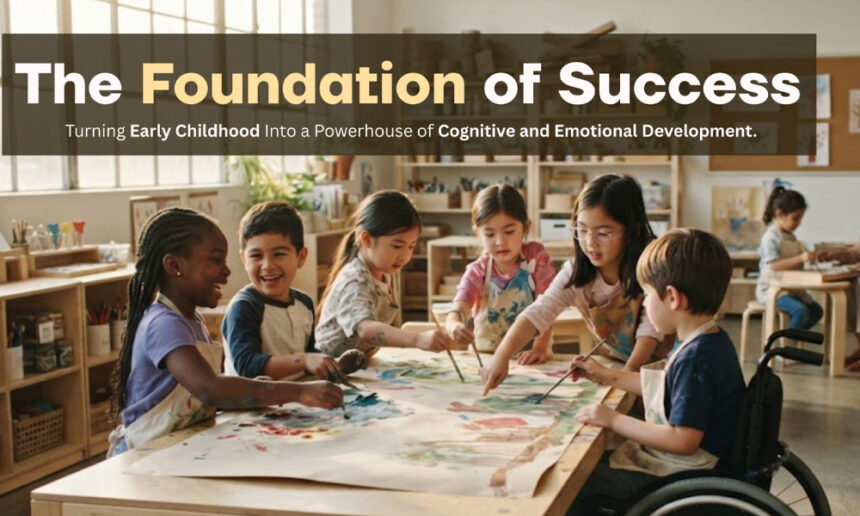
For many busy, career-focused parents, the search for early childhood education is often accompanied by a quiet, lingering question: “Is my child really learning, or are they just playing all day?” This question stems from a traditional, outdated view of education where learning is strictly defined by desks, textbooks, and silence. In the modern educational landscape, however, we know that the early years of life are characterized by rapid neural development that does not respond to rote instruction. Instead, the brain is most active, most plastic, and most capable of absorbing complex concepts when it is engaged in purposeful, structured play.
When you enroll your child in a high-quality childcare centre, you are not simply securing a safe place for them to wait until the workday ends. You are providing them with a sophisticated, pedagogical environment where they are actively “working” on the cognitive, social, and emotional architecture that will support their success for the rest of their lives. This article explores the science behind play-based learning and how the right environment can turn the early years into a powerhouse of long-term development.
The Science of Play-Based Learning
The term “play-based learning” is frequently misunderstood. It is not an absence of structure; rather, it is a framework where the structure is designed to mimic the ways in which human beings naturally learn. Children are, by nature, little scientists. They are constantly testing hypotheses, observing outcomes, and refining their understanding of the world.
When a child builds a tower of blocks, they are learning about gravity, balance, and spatial awareness. When they engage in a pretend-play scenario with a peer, they are learning about perspective, language, and conflict resolution. This is not “just play”—it is early physics, early linguistics, and early sociology. A modern early learning environment is carefully curated to offer these developmental opportunities in a way that remains entirely engaging and age-appropriate. The curriculum is hidden within the activity, ensuring that the child’s natural curiosity is always the primary driver of their learning journey.
Developing the Foundation for Social-Emotional Intelligence
Perhaps the most critical benefit of a structured group environment is the development of social-emotional intelligence. In a world that is becoming increasingly digital, the ability to read facial expressions, empathize with others, and regulate one’s own emotional state has become a vital professional skill.
Conflict Resolution and Negotiation
In the classroom, children are constantly forced to negotiate. Who gets to use the red marker? How do we take turns on the slide? How do we handle the disappointment of losing a game? These are not trivial frustrations; they are the fundamental training ground for emotional regulation. Educators in a professional setting act as facilitators, helping children label their feelings and brainstorm solutions. This guidance transforms a potential tantrum into a lesson in diplomacy, teaching the child that they have the agency to solve problems and the emotional vocabulary to express their needs.
Collaborative Problem-Solving
Modern workplaces prize those who can work effectively in teams. This competency begins in the early years. When children work together to create a mural or clean up a play area, they learn that a group can achieve more than an individual. They learn to value different perspectives and to contribute their own strengths to the team’s goal. This creates a sense of belonging and community, which is the necessary emotional foundation for all future academic and professional success.
Early Literacy and Numeracy: Building the Cognitive Scaffold
While play is the primary vehicle, the content of that play is deeply rooted in academic foundations. A well-designed early learning program introduces literacy and numeracy as integrated concepts rather than isolated subjects.
The Linguistic Environment
A high-quality center is a language-rich environment. Educators use descriptive, complex language during activities, which significantly expands the child’s vocabulary. Storytime is not just about reading a book; it is about questioning, predicting, and identifying patterns. By engaging in these conversations, children learn the structure of narratives, the power of expression, and the joy of inquiry. They are learning to love language, which is the single most important predictor of future reading comprehension.
Mathematical Thinking in Action
Numeracy is everywhere in an early learning classroom. It is in the sorting of toys by color and shape, the counting of steps during a movement activity, and the measurement of ingredients in a cooking session. By experiencing numbers in a physical, tangible way, children develop a sense of “number sense”—an intuitive understanding of quantity, sequence, and logic. This builds the cognitive scaffold upon which all formal mathematics education will be built in the primary school years.
Image From Pexels
Creative Expression and Critical Thinking
Creativity is often incorrectly labeled as a “soft skill.” In reality, it is the mechanism of innovation. The ability to think divergently—to see one object and imagine ten different ways it could be used—is a high-level critical thinking skill.
Artistic activities in a modern childcare setting are not focused on the end product, but on the process of creation. When a child experiments with paint mixing, they are learning about cause and effect. When they decide how to construct a bridge out of recycled materials, they are engaging in engineering and design. This focus on creative problem-solving helps children become comfortable with trial and error. They learn that “mistakes” are simply data points that help them improve their designs, a mindset that is central to the scientific method and to every innovative professional field.
Why Your Investment Matters
Career-focused parents often feel a sense of guilt about the time spent away from their children. It is important to reframe this: by choosing an early learning center, you are providing your child with a broader social circle, a more diverse set of challenges, and a more structured approach to learning than they would receive in a home-only environment.
Your investment is an investment in your child’s brain. The plasticity of the brain between the ages of three and five is unprecedented. Every interaction, every new word, and every solved social challenge creates a physical connection—a synapse—in the developing brain. By ensuring that your child spends their day in a rich, stimulating environment, you are literally helping to wire their brain for future success. You are providing them with the tools to become self-confident, articulate, and resilient individuals.
Choosing the Right Partner for Development
Not all childcare centers are equal. As a parent, you have the right to look for evidence of this developmental focus. When you visit a center, look beyond the cleanliness and the physical toys. Ask the director about their pedagogical philosophy. Do they have a clear curriculum that emphasizes child-led inquiry? Do they document the children’s learning journeys so that parents can see the progress being made?
A center that values transparency and collaboration with parents is a center that is truly invested in your child’s growth. They should be able to explain how their daily schedule serves your child’s developmental milestones. They should be partners who help you understand how your child is growing, what challenges they are currently navigating, and how you can support that growth at home.
Conclusion: The Long-Term Impact of Early Learning
The primary goal of early education is to instill a sense of wonder and a confidence in one’s own ability to learn. If a child leaves their early years feeling capable, curious, and connected to their peers, they are prepared for everything that follows. They will enter the primary school system not just with a collection of facts, but with the habits of mind—persistence, social awareness, and creative thinking—that lead to long-term fulfillment.
Your career is important, and the time you spend working allows you to provide for your family. But don’t underestimate the profound impact of the time your child spends in their educational environment. You are making a decision that serves their developmental future, ensuring they are not just “looked after,” but truly empowered to explore their potential. Trust in the process, trust in the educators you have chosen, and take pride in the fact that your child is using their time in care to build a future of unlimited possibility.
Steven Lagrimas is a freelance writer specializing in STEM, business, health, politics, and the social sciences. His work explores the intersection of society, governance, innovation, and emerging global trends shaping communities and industries today.