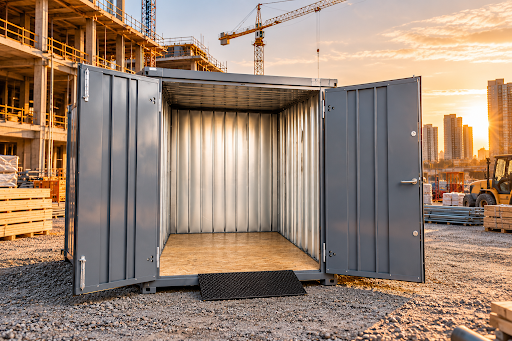
See how contractors can use smarter storage planning to secure tools and materials, work within limited space, control recurring costs, and simplify jobsite logistics.
Construction projects depend on coordination. Materials arrive in phases, crews move between work areas, equipment needs change, and usable space often becomes more limited as the project progresses.
Storage can easily become another operational challenge within that environment. Tools and materials need to remain accessible to crews, but leaving them scattered around a site can increase exposure to theft, weather, damage, and misplacement. At the same time, adding storage without considering placement or capacity can interfere with staging areas, delivery routes, and everyday workflow.
A more structured approach to construction storage solutions can help contractors address these issues together. Instead of viewing storage as simply additional square footage, project teams can treat it as part of asset protection, site planning, cost control, and repeat project operations.
Protect Assets Without Slowing Down the Crew
Construction sites can include employees, subcontractors, suppliers, inspectors, and visitors moving through the property throughout the day. Valuable tools, materials, fixtures, PPE, and equipment may also remain on site overnight.
Creating a dedicated storage area gives project teams a defined location for the assets crews use regularly. It can help reduce unnecessary exposure while making it easier to establish consistent access and organization procedures.
Security planning should consider more than whether a container can be locked. Placement, visibility, access control, interior organization, weather protection, and frequency of use all influence how effectively storage supports the job.
Frequently used materials should remain easy for authorized crews to reach. Less frequently accessed or higher-value equipment may require more controlled storage.
The objective is to protect project assets without turning every material request into an extra step for the field team.
Match Storage Capacity to Available Site Space
More capacity is not always the right answer.
Urban projects, renovations, infill developments, schools, commercial properties, and phased construction can have limited space for additional equipment. Storage competes with parking, deliveries, material staging, waste handling, machinery, pedestrian routes, and emergency access.
Project teams should therefore determine what actually needs to be stored before deciding how much space to allocate.
Tools and PPE may require a different setup than bulk materials or larger equipment. Long materials may benefit from dedicated organization, while multiple trades may need separated access.
A storage footprint that is too large can consume valuable working space. One that is too small can lead to overcrowding or require an additional unit later.
Right-sizing storage around actual project requirements helps contractors balance capacity with the realities of the site.
Consider Cost Across the Project Pipeline
Storage decisions are often evaluated using an initial purchase price or monthly rental rate. Neither figure tells the entire story.
Short-duration or occasional projects may make temporary rental practical. Companies with ongoing construction work may have a different calculation because storage requirements repeat from one project to the next.
Contractors should consider delivery, pickup, relocation, rental duration, ownership costs, maintenance, storage between projects, and expected frequency of reuse.
For businesses with a steady pipeline, the question becomes whether repeated temporary costs are supporting the most practical long-term approach.
Reusable storage may also help simplify future procurement. Instead of sourcing a different solution for every job, an organization can develop standard configurations that move between projects or serve recurring project types.
The appropriate model will depend on project frequency and operational needs, but examining total utilization provides a clearer comparison than looking at the first invoice alone.
Plan Delivery and Placement Before the Site Gets Busy
Storage can solve one logistical issue while creating another if delivery and placement are not considered early.
A site may have enough physical room for a container but insufficient truck access to place it where crews need it. Ground conditions, overhead clearance, gates, equipment routes, door orientation, and future construction phases can all affect placement.
Project managers should identify where storage will arrive, where it will sit, how crews will access it, and whether it may need to move later.
This is especially important on projects where available space changes as work progresses. A convenient location during early construction may eventually interfere with exterior work, paving, landscaping, or another phase of the build.
Treating storage placement as part of the overall logistics plan helps keep access lanes and work areas usable.
Create a Storage Standard That Can Be Repeated
Contractors managing several projects often face similar storage requirements again and again.
Standardizing common configurations can reduce the number of decisions required for each new site. A contractor might establish different setups for compact commercial projects, larger builds, or sites with multiple trades.
Standards can include container size, shelving, access procedures, locking methods, material categories, and placement guidelines.
This does not mean every site must use an identical arrangement. Individual projects will always have different constraints. The advantage is having a proven starting point that teams can adjust rather than rebuilding the storage strategy from scratch.
Procurement teams gain clearer specifications, while field teams receive a more familiar storage environment as they move between projects.
Make Storage Part of the Construction Plan
Effective jobsite storage is ultimately about supporting the way work happens.
Before selecting a solution, contractors should identify what requires protection, how often crews need access, how much space is available, how long the project will require storage, and whether the same setup could serve future work.
Answering those questions early can reduce rushed decisions and help storage function as part of the site’s operating plan.
For contractors managing repeat projects, the goal is not simply to create more storage space. It is to establish a secure, practical, and financially manageable system that supports crews without creating additional site complexity.
Additional Resources
Contractors planning secure storage for upcoming work can explore options for a construction site storage container designed around active jobsite requirements and repeat project use.