You’ve decided to go solar, but standing in your driveway and staring up at your roof, you’re not sure where to start. With energy costs climbing and Quebec’s LogisVert program now in effect, more homeowners are making the move. Choosing the right residential solar panel system still takes more than picking a brand off a website. This guide gives you the framework to make a confident, informed decision.
The Types of Residential Solar Panels
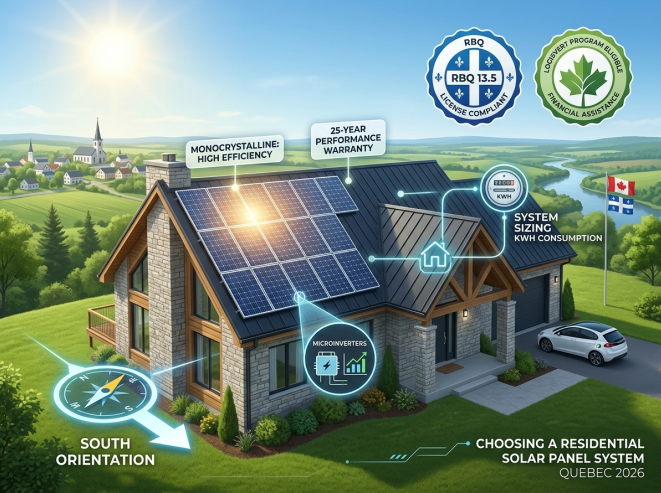
Three panel types compete for your roof: monocrystalline, polycrystalline, and thin-film. Monocrystalline panels lead on efficiency — typically 19% to 23% — and produce more power per square foot, making them the strongest fit for roofs with limited surface area. Polycrystalline panels cost less upfront but deliver slightly lower output. Thin-film panels work on non-standard roofs but fall behind on efficiency.
For most Quebec homeowners in 2026, monocrystalline is the practical default. Performance holds in cold weather, and most manufacturers back them with 25-year-plus warranties long enough to outlast a well-maintained roof.
Assessing Your Roof Before You Buy Anything
No panel decision makes sense until you’ve evaluated your roof. Three factors drive feasibility: orientation, pitch, and structural condition. In Quebec, a south-facing roof with a pitch between 30° and 45° delivers the best annual sun exposure. Southeast or southwest orientations work, though expect a 5% to 15% output reduction depending on the angle.
Structural condition is equally critical. Solar panels last 25 to 30 years — if your roof is nearing end of life, replace it before installation. Pulling and remounting a full array mid-project is an avoidable, expensive mistake. Factor in shading from trees or neighboring buildings too: it cuts output more than most homeowners anticipate.
Sizing the System to Your Actual Consumption
System size is calculated from your annual kilowatt-hour consumption. A typical Quebec single-family home uses between 15,000 and 25,000 kWh per year depending on square footage, heating type, and occupant count. A 10 kWp system produces roughly 9,000 to 11,000 kWh annually in the Quebec City region based on local solar irradiance data.
Self-consumption is the dominant model in Quebec: you use what you produce in real time, and surplus feeds back into the Hydro-Québec grid via net metering. Oversizing your system rarely pays off unless your net metering contract lets you recover meaningful credit for that surplus — confirm the terms before finalizing sizing.
Choosing the Right Inverter
The inverter converts DC power from your panels into usable AC power. It’s as consequential a choice as the panels. String inverters cost less and are easy to maintain, but shading on a single panel can drag down the whole array’s output. Microinverters, mounted per panel, optimize production individually — the right call for partially shaded roofs.
For a Quebec roof with minimal shading, a quality string inverter is sufficient. Power optimizers split the difference: panel-level monitoring paired with a string inverter, without the full cost of a microinverter system.
Quebec’s Regulatory Requirements for Solar
In Quebec, any electrical contractor doing photovoltaic work must hold an RBQ license (Régie du bâtiment du Québec) that includes sub-category 13.5, which specifically covers solar power generation systems. This is a legal requirement — not a differentiator. Never sign with a contractor who can’t produce that license.
Work must comply with the Quebec Construction Code and the Canadian Electrical Code (CEC). A municipal building permit is generally required, and Hydro-Québec approval precedes any grid connection. To understand what a compliant residential solar panel installation looks like from start to finish, consult a licensed contractor before committing to any proposal.
LogisVert: Quebec’s Solar Financial Assistance Program
Launched by Hydro-Québec in March 2026, LogisVert is the primary financial assistance program for Quebec homeowners installing residential solar systems. It covers eligible installations retroactively from June 30, 2025 — if your system went in after that date, you may already qualify without additional work.
Program amounts and eligibility criteria evolve. Instead of citing figures that may be stale by the time you read this, go directly to Hydro-Québec’s website or ask a qualified contractor for the terms that apply to your situation right now.
Questions to Ask Every Contractor Before You Sign
Quebec’s solar market is expanding fast, which means plenty of operators without the credentials to justify their pitch. Ask these before signing anything:
- Do you hold an RBQ license that includes sub-category 13.5?
- What manufacturer warranty covers the panels and inverter?
- What labor warranty do you offer on the installation?
- Do you handle the municipal permit and Hydro-Québec grid connection?
- What software do you use to model estimated annual output?
- Do you provide remote performance monitoring post-installation?
A credible contractor answers all of these without hesitation and hands you a quote that names the specific components. Vague all-in packages and implausibly short timelines in peak season (May through September) are red flags worth taking seriously.
Taking the First Step
A successful project starts with an honest assessment of your consumption, roof condition, and budget. E3 Électricité, holder of an RBQ license including sub-category 13.5, guides homeowners in Quebec City and Lévis from feasibility analysis through commissioning and Hydro-Québec grid connection. You can request a free quote for a site-specific evaluation of what solar looks like for your property.
Conclusion
Choosing residential solar panels in Quebec in 2026 means balancing technical options, regulatory requirements, and a shifting incentive landscape. Homeowners who get it right assess their actual consumption, verify contractor credentials, and hold out for a detailed quote before committing.
Have you already had your roof’s solar potential assessed, or is something still holding you back? Share it in the comments — your question might be exactly what another reader needs to see.