Key Takeaways
- Preventing hazards is more effective than reacting after someone is hurt.
- Workers should help identify risks and shape workable controls.
- Planning, training, and supervision must come before any new safety technology.
- Teams should give special attention to high-consequence hazards, including falls, electrical exposure, moving equipment, and trenching work.
- New tools should be tested for accuracy, usability, privacy, and crew acceptance.
- Small daily improvements can build a stronger safety culture over time.
Construction work changes quickly. Crews, materials, equipment, access routes, weather, and schedules can all shift within a single day. Strong construction site safety programs recognize that reality by making risk control part of normal planning, supervision, and communication rather than something addressed only after an incident.
The most effective approach is practical and human-centered. It gives workers a meaningful role in identifying hazards, helps supervisors act on changing conditions, and uses technology only when it makes a specific safety task easier, clearer, or more reliable.
Why Construction Safety Needs a Practical Reset
A project can appear safe simply because no injury has been reported recently. That does not necessarily mean hazards are controlled. Near misses, rushed work, blocked walkways, poor housekeeping, unclear equipment routes, and incomplete task planning can all signal risk before an injury occurs.
Instead of treating safety as a separate activity, project leaders should build it into how work is planned and performed. OSHA identifies electrical incidents, falls, struck-by events, and trenching and excavation as hazards associated with many serious construction injuries, making them sensible starting points for daily attention. Construction safety guidance can help teams organize their reviews around these major exposures.
Start With the Highest-Risk Activities
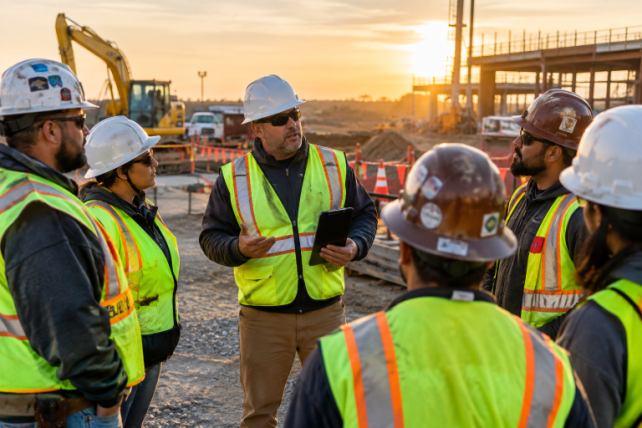
Every shift should begin with a simple review of the work ahead. The goal is not to create paperwork for its own sake. It is to identify which tasks could cause severe harm and confirm that the right controls are actually in place before work starts.
- List the planned tasks, crews, equipment, and work areas.
- Identify activities with the greatest potential for serious injury.
- Review recent near misses, changed conditions, and unresolved hazards.
- Ask workers what could be overlooked or made difficult by the site layout.
- Assign a clear control, a responsible person, and a follow-up check for each major risk.
A crew installing steel near an active delivery lane, for example, may need a defined pedestrian route, an equipment exclusion zone, a spotter assignment, and a delivery schedule that prevents conflicting movements.
Build Safety Into Project Planning
Many hazards can be reduced before workers arrive on site. During estimating, design review, scheduling, and preconstruction meetings, teams can consider access routes, material staging areas, guardrail locations, equipment travel paths, lighting, emergency access, and maintenance needs.
This approach is often called Prevention through Design. It focuses on designing out hazards or reducing them early, when changes are usually easier to make than they are after construction begins. Designing out or minimizing hazards can include planning permanent anchor points, safer roof access, or work areas that keep pedestrians separated from moving equipment.
Use Worker Knowledge as a Safety Resource
Workers often see conditions that are not obvious in a schedule, drawing, or inspection form. A laborer may notice a recurring trip hazard. An operator may recognize a blind spot near a pile of new material. An electrician may identify that another trade’s work has changed safe access to a panel.
Supervisors can capture that knowledge through brief pre-task conversations, verbal reporting, mobile forms, or anonymous reporting options. The critical step is responding quickly. When workers report hazards and see no action, they may stop raising concerns. When managers explain what changed, who owns the correction, and when it will be completed, reporting becomes useful rather than frustrating.
Multilingual crews also need information they can understand. Plain language, visual examples, demonstrations, translated materials, and confirmation questions can be more effective than asking people to sign a form after a long talk.
Make Training Short, Frequent, and Relevant
Training is most useful when it relates directly to the day’s work. Short toolbox talks can prepare a crew for a changed delivery zone, a new lift plan, wet weather, altered traffic patterns, or a task not performed recently.
For example, a ten-minute discussion before deliveries begin can cover vehicle routes, blind spots, pedestrian boundaries, spotter duties, and what to do if a route becomes blocked. Pairing that conversation with a quick walk-through gives workers a chance to see the controls in the actual environment.
Choose Technology That Solves a Clear Problem
Technology should support a defined safety objective, not become a distraction. Digital inspection forms, environmental monitoring, proximity warnings, site mapping, and simulation-based training may be useful when the team knows what risk the tool is intended to address.
Before adopting a system, decide who receives alerts, what action they must take, and how the team will judge whether the tool works. Test it in real conditions and watch for false alarms, missed warnings, slow response times, and worker confusion. Critical controls should always have a manual backup plan.
Avoid Alert Fatigue and False Confidence
If workers receive too many warnings, they may begin ignoring even important ones. Each alert should explain what changed, why it matters, and what action is expected. A dashboard score or completed checklist can support decision-making, but it cannot replace competent supervision, crew communication, or worker judgment.
Protect Privacy and Build Trust
When cameras, location tools, or wearables are used, workers should understand what data is collected, who can view it, how long it is retained, and whether it may be used for disciplinary purposes. Clear boundaries and a way to challenge inaccurate records can make adoption more likely.
Track Leading Measures, Not Just Injuries
Injury records, lost workdays, and property damage reports are lagging measures. They show what has already happened. Leading measures help teams identify whether preventive work is being completed before an injury occurs.
- Hazards corrected by the promised date.
- High-risk tasks are reviewed before work begins.
- Equipment inspections completed on time.
- Worker concerns are answered within a defined period.
- Training refreshers are completed after process changes or near misses.
Create a Simple Daily Safety Rhythm
- Review the plan: Confirm tasks, crews, equipment, and site changes.
- Check conditions: Inspect access, lighting, weather, housekeeping, and equipment status.
- Talk with the crew: Ask what changed and what could go wrong.
- Set controls: Confirm barriers, permits, PPE, spotters, and emergency procedures.
- Verify during work: Recheck controls when the task, crew, or site conditions change.
- Close the loop: Record concerns, assign responsibility, and confirm corrections.
Common Questions About Construction Safety Technology
Can technology replace a safety manager?
No. Technology can improve visibility and reduce manual work, but it cannot replace judgment, accountability, or direct communication with crews.
What is the best tool for a small contractor?
The best tool is usually the one that addresses the most urgent risk with the least disruption. A dependable inspection process or clear communication method may be more valuable than a complex platform.
How should a company test a new system?
Use a limited pilot with a clear goal, worker feedback, baseline conditions, and a scheduled review. Keep the tool only if it improves decisions or controls in practice.
Conclusion: Make Safety Part of the Work
Safer construction sites are built through consistent planning, open reporting, relevant training, and controls that crews can use in real conditions. Technology can help teams recognize hazards sooner, but people still make the decisions that protect one another. The strongest programs are practical, transparent, and shaped by the workers who rely on them every day.