Fielding C4ISR systems, communications gear, drone ground stations, and electro-optical sights means preparing equipment for severe thermal extremes. A system deployed in a 120°F (49°C) desert environment must endure blowing silica sand, intense solar loading, and internal thermal buildup. Months later, that same equipment platform might be stationed in the Arctic at -40°F (-40°C), facing ice accumulation, brittle housing materials, and rapid battery discharge.
Failing to design for environmental extremes leads to cracked seals, fogged optics, corroded circuit boards, and total power failure during critical operations. Ruggedizing tactical electronics requires an integrated approach combining advanced materials, precise structural machining, smart thermal management, and reliable sealing protocols.
1. The Environmental Extremes: Desert Heat vs. Arctic Freeze
Quick Answer: Desert environments threaten electronics through thermal expansion, sand ingress, and internal heat trapping, while arctic conditions cause material embrittlement, seal stiffening, pressure vacuums, and moisture condensation.
Designing for both environmental polarities requires balancing opposing physical reactions. High ambient heat expands metal enclosures and softens rubber gaskets, while extreme cold shrinks materials, hardens elastomeric seals, and makes plastic housings brittle.
- Material Selection for Extreme-Temperature Seals and Gaskets
Quick Answer: Fluorosilicone and specialized silicone elastomers provide the best operational temperature range (-55°C to +200°C), maintaining flexibility in extreme cold while resisting degradation from petroleum, ozone, and desert heat.
Standard Nitrile (NBR) and Neoprene gaskets harden and lose memory below -20°C, causing micro-gaps that allow moisture ingress when temperature cycles occur. Conversely, basic organic rubbers degrade rapidly under high desert UV exposure.
Selecting extreme temperature gasket materials requires evaluating glass transition temperatures ($T_g$) and compression set resistance:
- Fluorosilicone (FVMQ): Combines wide thermal tolerance (-60°C to +200°C) with high resistance to fuel, oil, and harsh chemical exposure.
- Silicone (VMQ): Excellent flexibility at low temperatures (-55°C to +200°C), though less resistant to direct fuel contact.
- EPDM: Superior resistance to UV radiation, ozone, and steam, maintaining flexibility down to -40°C.
3. Precision Enclosure Engineering and Pressure Management
Quick Answer: Machined aluminum housings engineered with matched Coefficients of Thermal Expansion (CTE) prevent structural warpage, while breathable Gore-Tex vents equalize internal pressure changes during thermal cycling.
When a sealed enclosure transitions from a warm command tent to sub-zero outdoor air, internal air contracts rapidly. This creates a vacuum inside the housing that pulls in moisture through microscopic seal imperfections. In desert heat, the reverse occurs: rising internal pressure pushes against seals, risking blown gaskets.
Integrating pressure-equalizing ePTFE (expanded polytetrafluoroethylene) hydrophobic vents allows air molecules to pass through for pressure balance while blocking liquid water, ice, and dust particles.
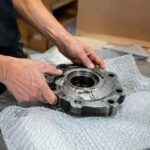
The structural housing itself must maintain tight tolerances across extreme temperature deltas. Custom enclosure fabrication relies heavily on high-precision defense CNC machining to produce rigid, warp-resistant aluminum housings, exact O-ring groove dimensions, and seamless mating surfaces that preserve IP67 or IP68 ingress protection under severe mechanical stress.
4. Thermal Management Strategies: Dissipating Heat and Preventing Freeze-Out
Quick Answer: Effective tactical electronics thermal management uses direct-conduction heat sinks and phase-change materials for high-heat environments, alongside internal thermostatically controlled heaters for cold-weather startups.
Managing internal temperatures requires dual-action systems built into the circuit board and enclosure chassis:
- Desert Cooling: Passive heat dissipation relies on heavy-wall aluminum chassis designs, internal thermal gap pads, and external cooling fins. Conduction carries heat away from sensitive processors directly to the outer casing without requiring vulnerable intake fans.
- Arctic Warming: Cold-temperature startup poses severe risks to LCD displays, crystal oscillators, and lithium-ion battery chemistries. Internal ceramic or flexible Kapton trace heaters warm critical components to minimal operating thresholds before primary power is applied to sensitive processing chips.
- Conformal Coatings & Potting: Encapsulating circuit assemblies in silicone or polyurethane potting compounds protects trace lines from condensation shorts caused by rapid thaw cycles.
5. Connectors, Displays, and User Interfaces
Quick Answer: Military-grade circular connectors with fluorosilicone grommets, glove-compatible resistive touchscreens, and anti-reflective optical bonding ensure reliable operator interface control across climate extremes.
External interface ports are common failure points for weatherproofing. MIL-DTL-38999 series circular connectors equipped with triple-start threads, self-locking couplings, and IP68 sealing keep dust, salt fog, and driving rain out of electrical pin contacts.
Display windows face equal operational challenges. High desert sunlight requires optically bonded glass to reduce internal reflections and UV-blocking coatings to prevent display yellowing. For Arctic operations, integrated transparent ITO (Indium Tin Oxide) conductive heater layers embedded within display glass prevent liquid crystal freezing and touch latency.
6. Testing and Certification Standards (MIL-STD-810H)
Quick Answer: Compliance with ingress protection MIL-STD-810H testing verifies tactical equipment durability through rigorous environmental simulation procedures.
Before field deployment, weatherproofed tactical electronics undergo stringent environmental qualification protocols:
- Method 501.7 (High Temperature): Evaluates system performance under steady-state high heat (+71°C storage) and cyclic ambient thermal loads.
- Method 502.7 (Low Temperature): Tests functional readiness down to -51°C, evaluating housing brittle points and heater activation times.
- Method 510.7 (Sand and Dust): Exposes equipment to high-velocity silica dust particles to ensure complete seal integrity.
- Method 524.1 (Freeze/Thaw): Simulates rapid transition between freezing and thawing conditions to test for condensation accumulation within sealed compartments.
Weatherproofing tactical electronics for desert and arctic deployment requires a comprehensive engineering strategy that accounts for extreme physical mechanics. By selecting wide-temperature elastomers, managing internal pressure differentials, utilizing precision-machined enclosures, and integrating active thermal controls, designers create field-ready systems that withstand nature’s harshest environments.
Designing for environmental resilience at the blueprint stage ensures tactical systems perform reliably, protecting critical communications and operational capabilities anywhere on Earth.