3D printing becomes much more useful when kids do more than make an object. The real learning begins when they test it, notice what happened, and improve the next version.
The seven projects below use simple printed parts and common household supplies. You do not need to complete all seven. Pick one that matches your child’s interests and work through the full cycle:
- Ask one clear question.
- Predict what will happen.
- Build a simple first version.
- Test it the same way several times.
- Change one thing and try again.
Adults should operate the printer, choose age-appropriate part sizes, and manage tools, cords, fans, small pieces, warm surfaces, and moving parts.
Quick guide: which project should you choose?
- Bridge:strength and bracing
- Ramp car:wheels, friction, and straight travel
- Gear train:motion, direction, and ratios
- Shelter:structure and airflow
- Balance mobile:weight and distance
- Tabletop maze:user testing
- Desk organizer:measurement and everyday use
For a first project, the ramp car, maze, or desk organizer is easiest because the results are simple to see.
1. Build a Stronger Bridge
Print a small bridge that rests between two supports. Keep the span the same in every version.
Ask: Can triangle-shaped braces help the bridge hold more weight?
Test it: Add light, equal loads one at a time. Watch where the bridge starts to bend. If possible, weigh the bridge too, so a very heavy design does not win simply because it uses more material.
Change one thing: Add or move one brace. Keep the span, material, print settings, and test method the same.
Talk about the result: Where did the bridge bend first? Did the brace move the force toward the supports?
Safety: Use only light loads and stop before the bridge cracks or breaks.
2. Test Different Wheels on a Ramp Car
Print a simple car with removable wheels. Make a low ramp and mark one release point.
Ask: Does wheel size change how far the car travels?
Test it: Release the car without pushing. Run the test several times. Record the distance and whether the car travels straight.
Change one thing: Print a second set of wheels with a different diameter. Keep the wheel width, axle fit, car body, ramp, and release point the same.
Talk about the result: Did the distance change in most trials? If the car turned sideways, could axle alignment be the real problem?
Safety: Keep the ramp low and the floor clear. Make sure hands and faces stay out of the car’s path.
3. Make a Hand-Turned Gear Train
Print two large gears and mount them on a sturdy board or frame. Mark one tooth on each gear with removable tape.
Ask: How do gear size and tooth count affect speed and direction?
Test it: Turn the first gear one full rotation and count how far the second gear moves. Then switch which gear is the driver.
Change one thing: Replace one gear with a different size, or add a third gear between them.
Talk about the result: Which change affected the speed? Which change affected the direction?
Safety: Turn the gears slowly. Keep fingers away from pinch points and stop if the gears jam.
4. Build a Shelter That Stands Up to a Breeze
Print reusable corner connectors. Use them with paper straws or light sticks to make a small shelter. Add paper walls and place a tissue-paper figure inside.
Ask: Which design change gives the figure better protection?
Test it: Put the shelter at a marked distance from a fan. An adult should use the same low setting each time. Look for sliding, lifting, bending, and air moving through gaps.
Change one thing: Lower the roof, widen the base, add one diagonal brace, or change one wall angle.
Talk about the result: Did the shelter move less, or did it simply send the air in another direction?
Safety: An adult controls the fan. Keep hair, fingers, loose paper, and cords away from the blades.
5. Balance a Mobile by Moving Weight
Print a stable stand, a beam with several hanging points, and two light shapes.
Ask: Can you balance the beam by moving a weight instead of adding more weight?
Test it: Start with equal weights at equal distances from the center. Move one weight farther out. Then move the other weight until the beam balances again.
Change one thing: Adjust one hanging position or use one shape with a different weight.
Talk about the result: Which mattered more: the weight itself or its distance from the center?
Safety: Keep the mobile low and use soft, lightweight parts. Store strings and hanging pieces safely after the activity.
6. Design a Tabletop Maze for Someone Else
Print large wall pieces that connect on a tray. Use a ball that is too large to slip through the gaps.
Ask: Is the maze fun and clear for someone who did not design it?
Test it: Let another family member play. Watch where the player pauses, takes a wrong turn, or escapes through an unintended gap. A timer is optional; player behavior is often more useful.
Change one thing: Move one junction, adjust one wall, or improve one connector.
Talk about the result: Where did the player become confused? What did the designer expect to happen instead?
Safety: Choose ball and wall sizes that are safe for everyone in the home.
7. Make a Desk Organizer That Fits Real Objects
Choose a few items, such as pencils, an eraser, and index cards. Measure them before designing the organizer.
Ask: Which dimensions make the organizer easy to use every day?
Test it: Print small fit samples first, such as several pencil holes or two card-slot widths. Use cardboard to test the full layout before printing the complete organizer.
Change one thing: Use the organizer for a week. Then adjust the compartment that stayed empty, became too full, or was difficult to reach.
Talk about the result: What did everyday use reveal that measurements alone did not?
Safety: Adults should manage any finishing work. Do not use the organizer with food, heat, or loads it was not designed to hold.
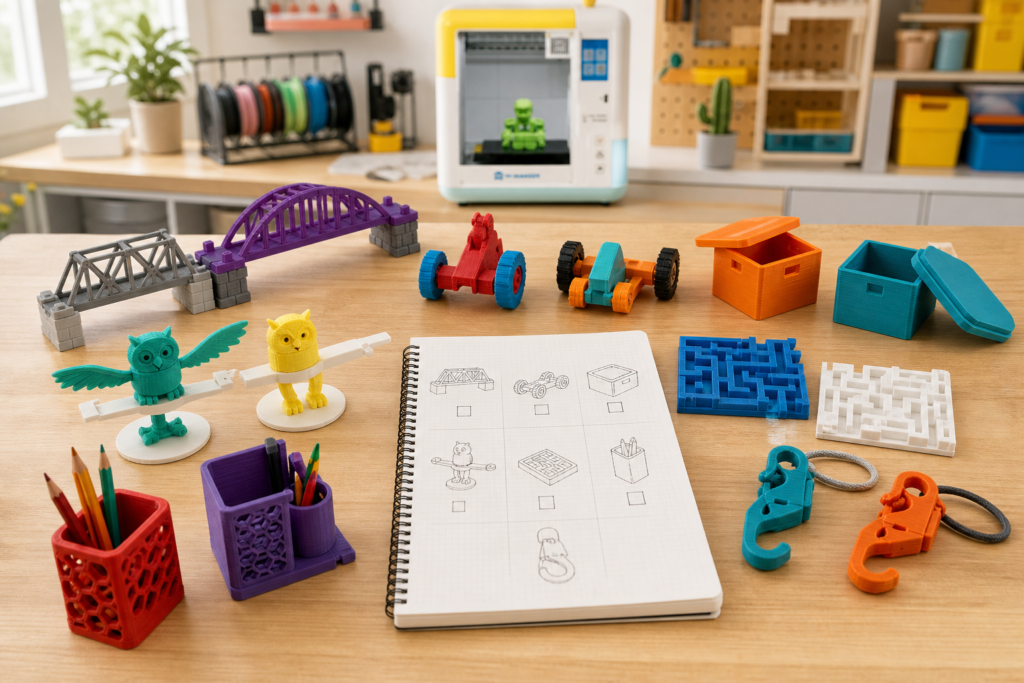
Use the Same Simple Project Record Every Time
A one-page record helps kids focus on their thinking instead of the final appearance. Include these seven prompts:
- Question:What are we trying to find out?
- Prediction:What do we think will happen?
- Constants:What will stay the same?
- First version:What happened during the test?
- Evidence:What did we measure or notice?
- Revision:What one thing will we change?
- Limitation:What made the comparison less than perfect?
The evidence will look different for each project. A bridge may be judged by bending. A car may be judged by distance and straight travel. A maze may be judged by player mistakes. All of them still follow the same engineering process.
Choosing a Family-Friendly 3D Printing Setup
The best printer for these activities is not simply the fastest one. It should make it easy to create a small first version, print safely with adult oversight, and return to the design after a test.
a family 3D printing platform offers enclosed 3D printers and guided creation tools for young makers. Families can compare the 3D printer range for young makers by age fit, project size, guided workflow, and support. Whatever system you choose, look for one that makes a second version feel possible—not one that turns every imperfect print into a troubleshooting project.
The Best Result Is a Good Explanation
A finished object does not need to be perfect. Ask the child to show:
- the first version,
- what happened during the test,
- the one change they made, and
- what they would try next.
A bridge that bends or a car that travels less far can still be a successful engineering project. The important result is that the child can use evidence to make the next decision.
Frequently Asked Questions
Which project is easiest for a beginner?
Start with the ramp car, tabletop maze, or desk organizer. Their results are easy to observe, and each can be improved with one small change.
Do we need to complete all seven projects?
No. One project with a fair test and a thoughtful second version teaches more than seven projects printed only once.
How many things should change between versions?
Change one main variable when you want to understand cause and effect. Keep the rest of the test as similar as possible.
Are these projects suitable for every age?
No single age rule works for every child. Adults should adapt the part size, measurements, tools, project difficulty, and level of supervision.
What if the first version does not work?
That is useful evidence. Record what happened, choose one possible cause, and make the smallest change that can test the idea.