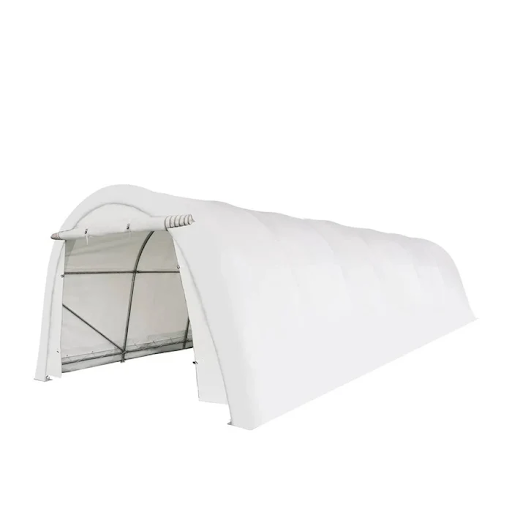
What a Car Shelter Protects Against and What It Does Not
Fabric shelters are bought to keep a vehicle out of the weather, which is a reasonable summary and a poor specification. Weather is several different problems, and a cover that solves three of them can make a fourth noticeably worse. A car shelter with rounded roof is a partial solution chosen deliberately rather than a garage made of fabric.
Ultraviolet is the damage that accumulates
A car shelter exists mostly because Australian sun degrades paint, clearcoat, rubber and plastic continuously, and the damage is cumulative rather than dramatic. A dashboard cracks and a clearcoat goes chalky over years, not seasons. This is the problem a shelter solves most completely. Any opaque cover removes essentially all of the ultraviolet load, and on that measure a basic fabric structure performs as well as a built garage.
Hail is about the gap, not the fabric
A car shelter roof stops a hailstone by absorbing its energy, which it does well provided the stone never reaches the panel underneath. On a tensioned rounded roof the fabric deflects and recovers. What matters is clearance. A cover that sags onto a roof panel transmits the impact straight through, so the protection depends on the frame holding the fabric clear rather than on the weight of the material itself.
Dew and condensation work in the opposite direction
This is the problem a shelter can make worse. A vehicle parked under cover still cools overnight, moisture still condenses on the paint, and under a sealed cover that moisture has nowhere to go once the sun comes up.
Air movement is the answer. A shelter open at the ends dries out in the morning; one closed tightly at both ends holds humid air against the paint for hours, which is how a covered car develops surface corrosion that one parked outside does not.
Why ventilation beats fabric weight
Three habits make the difference:
- Leave at least one end open to airflow
- Keep the cover tensioned off the vehicle
- Park dry rather than wet where possible
The last one sounds obvious. Driving a wet car into a closed shelter puts several litres of water under the cover, and it leaves the same way it arrived only if there is somewhere for it to go.
What a rounded roof changes
A curve sheds water and wind in a way a flat or shallow pitched panel does not. Rain leaves rather than pooling, and wind passing over the curve produces less lift than it does against a flat face. It also removes the place where debris collects. A flat fabric roof under a tree accumulates leaves, those leaves hold water, and the weight sits in exactly the spot least able to carry it.
Tensioning is the maintenance
Fabric relaxes as it settles in, and a cover that was drum tight on installation day has slack within weeks. Slack fabric moves in wind, and movement at a contact point is what wears a cover through.
Checking tension after the first month and then seasonally is close to the whole maintenance programme. It is also what keeps the hail clearance described earlier, since a sagging cover is one that has lost it.
Anchorage is what keeps it in place
A car shelter weighs very little against the uplift a curved roof generates in wind. What holds it down is the connection between the frame feet and the ground, and the required anchor depends entirely on the surface.
Concrete takes expansion anchors. Soil takes auger anchors or driven stakes with guy lines, and on sandy ground the required length grows quickly. A portable garage pegged into dry summer soil and left through a wet winter is relying on ground that no longer grips.
Where the frame actually fails
Fabric structures rarely fail in the fabric. They fail at the joints, where a tube meets a fitting and the two work against one another every time the wind moves the cover. Checking the fasteners at each joint after the first month, and then seasonally, is what prevents it. A joint that has started to elongate its hole cannot be re tightened back to where it was, which is why the first inspection matters more than the later ones.
Reading a specification past the fabric weight
Dimensions and fabric grade are the comparison figures, and grade matters for lifespan rather than for protection. Shade cloth sides are sometimes offered as an option, and they change airflow rather than weather protection. Frame spacing, how the cover is tensioned, what anchorage is supplied and whether the ends can be closed describe how it performs on the site.
TMG Industrial builds this one at 3.7 by 9 metres with a rounded roof and a heavy duty cover. Deciding which weather actually matters at the site, before comparing fabric specifications, is what makes the shelter worth its footprint.