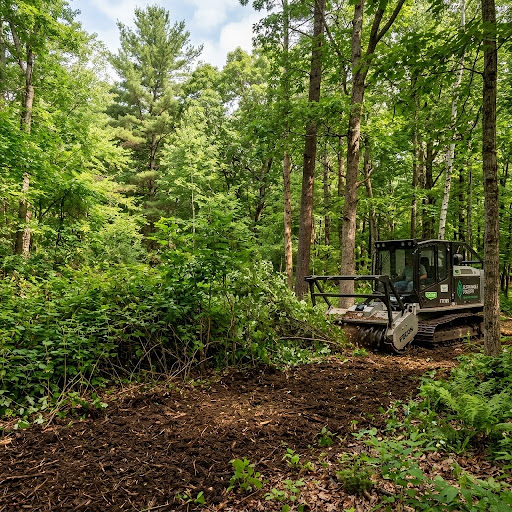
Overgrown land is more than an eyesore—it’s a fire hazard, a breeding ground for invasive species, and a barrier to putting your property to productive use. Forestry mulching has emerged as one of the most efficient and environmentally responsible ways to reclaim land, and the results speak for themselves. Whether you’re dealing with dense brush, unwanted trees, or years of unchecked overgrowth, this single-step process transforms problem terrain into clean, usable ground without the mess of traditional clearing methods.
What makes forestry mulching stand out isn’t just speed. It’s the combination of precision, sustainability, and lasting results that traditional land clearing simply can’t match. No burning, no hauling, no stumps left behind—just cleared land and a layer of nutrient-rich mulch that protects the soil beneath.
What Exactly Is Forestry Mulching?
Forestry mulching is a land-clearing process that uses a single machine—typically a tracked or wheeled mulcher—to cut, grind, and clear vegetation in one pass. Trees, shrubs, and brush are processed on-site and left as a layer of organic mulch across the ground. That mulch naturally decomposes over time, returning nutrients to the soil and reducing erosion.
Unlike conventional clearing, which involves chainsaws, bulldozers, burn piles, and multiple crews, forestry mulching accomplishes everything in a fraction of the time. One machine replaces an entire operation.
Why Forestry Mulching Outperforms Traditional Land Clearing
Traditional land clearing methods come with serious drawbacks. Bulldozing strips the topsoil, leaving land vulnerable to erosion and compaction. Burning requires permits, poses safety risks, and pollutes the air. Hauling debris off-site adds time, fuel costs, and logistical headaches.
Forestry mulching sidesteps all of that.
The process preserves topsoil integrity by leaving the mulched material in place. Root systems remain partially intact, which stabilizes the ground and reduces runoff. The cleared area is ready for use almost immediately—no waiting for burn piles to cool or debris trucks to arrive.
For landowners who need results without the collateral damage, the difference is significant.
The Wide Range of Land Types Forestry Mulching Can Handle
One of the most compelling aspects of this service is its versatility. Forestry mulching performs well across a wide variety of terrains and vegetation types, including:
- Dense woodland and overgrown pastures reclaimed for agricultural or recreational use
- Pipeline and utility corridors that need regular vegetation management
- Firebreak creation in wildfire-prone regions
- Residential and rural lot clearing for new construction or landscaping projects
- Roadside and fence line maintenance to keep access routes clear and functional
Steep slopes, wet ground, and rocky terrain that would challenge conventional equipment are handled effectively by modern mulching machines, which are built for traction and stability in difficult conditions.
How Forestry Mulching Protects Your Land’s Long-Term Health
Beyond clearing, forestry mulching actively benefits the land. The mulch layer left behind does several important things simultaneously. It suppresses weed regrowth by blocking sunlight from reaching the soil surface. It retains moisture during dry periods, reducing the need for irrigation in newly prepared planting areas. And as it breaks down, it feeds the soil with organic matter that improves structure and fertility over time.
This is a meaningful distinction. Traditional clearing often leaves land in a degraded state that requires additional remediation before it can be used productively. Forestry mulching, by contrast, leaves the land better conditioned than it was before—cleared, stable, and primed for whatever comes next.
What to Expect from a Professional Forestry Mulching Service
Working with a dedicated forestry mulching service means the job gets done with the right equipment, operated by experienced professionals who understand land and vegetation management. The process begins with an assessment of the site—its size, the density of vegetation, soil conditions, and the landowner’s intended use for the cleared area.
From there, the team maps out an efficient clearing approach that protects any vegetation you want to keep while eliminating everything that needs to go. Boundaries are respected, precision is prioritized, and the work is carried out with minimal disruption to surrounding areas.
ClearCut Forestry Mulching brings together the right equipment, trained operators, and a results-driven approach that handles even the most overgrown or challenging properties—giving landowners a clean, cleared site they can actually use from day one.
Timelines vary depending on the scale of the project, but most jobs that would take traditional crews days to complete are finished in a matter of hours. That efficiency translates directly into lower labor costs and faster turnaround for landowners who have been waiting to move forward with their plans.
The Environmental Case for Choosing Forestry Mulching
Environmental responsibility isn’t a trade-off with forestry mulching—it’s built into the process. No chemicals are used. No debris is trucked to landfills. No fires are lit. The carbon stored in the cleared vegetation stays on-site in the form of mulch rather than being released into the atmosphere through burning.
For landowners who care about how they manage their property, this matters. Forestry mulching is one of the few land-clearing methods that can genuinely be called low-impact. The soil stays in place, the beneficial organisms living in it are largely undisturbed, and the cleared land recovers and establishes new vegetation much faster than land cleared by more aggressive methods.
The Right Time to Schedule Forestry Mulching
There’s rarely a bad time to schedule forestry mulching, but certain periods offer advantages. Late fall and winter, when vegetation is dormant, can make clearing faster and more thorough since there’s less leafy canopy to work through. Spring clearing allows freshly mulched ground to benefit from warm-season rain and decomposition. Summer clearing is effective for fire mitigation, creating defensible space before peak fire season.
The key is not to wait. Overgrown land doesn’t manage itself, and unchecked vegetation becomes harder—and more expensive—to clear the longer it’s left alone. Acting sooner means less work, lower cost, and faster access to land that’s ready for use.
Take Back Your Land
Reclaiming overgrown, unusable land doesn’t require weeks of labor, heavy disruption, or environmental compromise. Forestry mulching delivers results that are fast, clean, and lasting—without the downsides that come with conventional clearing approaches.
For landowners ready to move forward with a project they’ve been putting off, or for those managing ongoing vegetation across large tracts of property, professional forestry mulching is the practical, responsible, and results-driven choice. Contact ClearCut Forestry Mulching today to discuss your property and find out how quickly your land can be transformed.