Have you ever noticed how a small phrase can carry a much bigger meaning than expected? Languages are full of these little expressions that tell stories, show emotions, and help us understand people better. One such phrase in Portuguese is dado à. Although it looks simple, it can reveal a lot about habits, personality, feelings, and even the reasons behind certain actions.
Many Portuguese learners see dado à and wonder what it really means. Some people think it only explains a reason, while others see it as a way to describe someone’s natural behavior. The truth is that this expression has more than one use, and understanding it can make your Portuguese much stronger.
In this article, we will explore the meaning of dado à, its grammar rules, everyday uses, and the feelings behind it. We will also look at simple examples, common mistakes, and why this small Portuguese expression has such a special place in the language. By the end, you will have a clear understanding of how to use dado à with confidence.
What Does Dado À Really Mean?
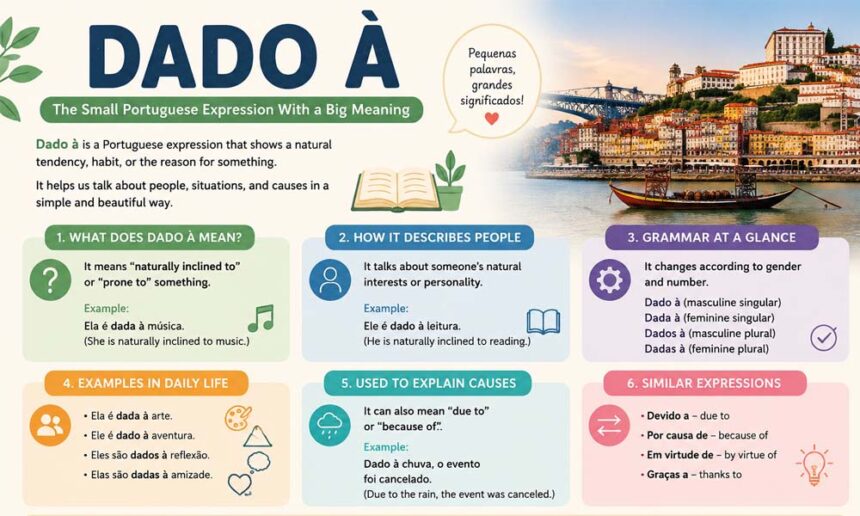
The phrase dado à may look small, but it has a rich meaning. In simple words, it is used to show that someone is naturally connected to something. It can describe a person’s habit, interest, personality, or strong tendency toward a certain activity or feeling.
For example, imagine someone who always spends free time painting, drawing, and creating new ideas. You could say, “Ela é dada à arte.” This means she is naturally interested in art. Art is not just a hobby for her; it feels like a part of who she is.
The same idea works in many situations. If someone loves reading, you can say, “Ele é dado à leitura.” If someone enjoys helping others, you can say, “Ela é dada à gentileza.” The phrase helps us describe what feels natural for a person.
Another important thing to understand is that dado à does not only talk about actions. It can also describe emotions and personal qualities. Someone may be given to creativity, kindness, deep thinking, or even worry. It helps explain the way a person naturally acts or feels.
This is what makes dado à special. Instead of simply saying what someone does, it gives a deeper picture of why they do it. It connects actions with personality and shows the natural side of human behavior.
The Two Main Uses of Dado À
One reason people find dado à confusing is because it can be used in two different ways. The first use is connected to personality and natural tendencies. The second use is connected to causes or reasons. Understanding this difference makes the phrase much easier.
The first meaning is about being naturally inclined toward something. It describes a person who has a strong connection with an activity, feeling, or behavior. For example, “Ele é dado à música” means he naturally loves music or feels connected to music.
The second meaning is used to explain a reason for something happening. In this case, dado à works more like “because of” or “due to.” For example, “Dado à chuva, o event was canceled.” This means the event was canceled because of the rain.
These two uses may seem different, but they share a common idea. Both talk about a connection between one thing and another. One connects a person with a habit or quality, while the other connects an event with a reason.
A good way to remember the difference is to look at the sentence. If you are describing a person’s nature, dado à often talks about a tendency. If you are explaining why something happened, it talks about a cause.
Dado À and Personality: Talking About Natural Habits
One of the most interesting uses of dado à is describing people. Portuguese speakers often use this expression when they want to explain someone’s personality in a soft and friendly way.
Imagine a person who always helps friends, supports family members, and cares about others. Instead of only saying “She is kind,” you could say, “Ela é dada à gentileza.” This shows that kindness is not just something she does sometimes. It feels like a natural part of her.
The same can be used for creative people. Someone who loves writing stories, making music, or creating art may be described as “dado à criatividade.” This tells us that creativity is something that comes easily to that person.
The expression can also describe less positive habits. For example, someone who worries often may be called “dado à preocupação.” This does not mean the person is bad. It simply explains that worrying is a common tendency for them.
This gentle way of describing people is one reason why dado à feels so meaningful. It allows us to talk about someone’s nature without sounding too negative or judgmental. It focuses on understanding rather than criticism.
Dado À Grammar Rules Made Simple
Even though dado à is easy to understand, it has some grammar rules that learners need to know. The most important rule is that the word changes depending on who or what we are talking about.
When the subject is masculine, we use dado. For example, “Ele é dado à leitura.” The word “dado” matches the masculine subject “ele.”
When the subject is feminine, we use dada. For example, “Ela é dada à música.” The change from dado to dada happens because the subject is feminine.
For groups, the word changes again. We use dados for a group of men or a mixed group, and dadas for a group of women. These small changes help the sentence sound natural and correct.
Examples:
-
Ele é dado à aventura.
-
Ela é dada à arte.
-
Eles são dados à reflexão.
-
Elas são dadas à criatividade.
Learning these forms may feel strange at first, but with practice, they become simple. A helpful tip is to always look at the person you are describing first. Once you know the gender and number, choosing the correct form becomes much easier.
The grammar of dado à is small, but it plays an important role. Using the correct form helps your Portuguese sound smoother and more natural.
How to Use Dado À in Everyday Portuguese
In everyday conversations, dado à can help people describe friends, family members, and even themselves. It is often used when someone wants to explain a person’s usual behavior or interests.
For example, imagine your friend spends every weekend reading books. You might say, “She is given to reading.” In Portuguese, this idea becomes “Ela é dada à leitura.” It shows that reading is something close to her personality.
Another example is someone who loves exploring new places. You could say, “Ele é dado à aventura.” This tells others that adventure is something he naturally enjoys.
The phrase can also appear in conversations about emotions. Someone who thinks deeply about life may be described as “dado à reflexão.” Someone who loves making people laugh may be “dado ao humor.”
These examples show that dado à is not only a grammar phrase. It is a way to understand people better. It helps us describe the small things that make each person unique.
As you hear more Portuguese conversations, you may notice that native speakers use expressions like this to add more feeling to their words. Instead of giving a simple description, they create a clearer picture of someone’s personality.
Dado À in Formal Writing and Professional Use
While dado à is often used when talking about people and personality, it also has an important place in formal Portuguese. You can find this expression in reports, articles, official messages, and professional conversations. In these situations, it is often used to explain a reason or cause behind something.
For example, a company may write: “Dado à falta de resources, the project was delayed.” This means the project was delayed because there were not enough resources. The phrase helps connect the reason with the result in a clear and organized way.
Using dado à in formal writing can make a message sound more balanced and professional. It helps the reader understand why something happened without adding extra words. This is useful when writing about decisions, changes, problems, or important updates.
However, it is important to understand the situation before using it. When you are describing someone’s personality, dado à shows a natural tendency. When you are explaining a cause, it shows the reason behind an action. Knowing this small difference helps you use the phrase correctly.
Common Mistakes When Using Dado À
Even though dado à is a simple expression, many learners make small mistakes when they first start using it. The most common problem is using the wrong form of the word. Portuguese words often change based on gender and number, and this phrase follows the same rule.
For example, saying “Ela é dado à música” is incorrect because “ela” is feminine. The correct sentence is “Ela é dada à música.” The word must match the person being described.
Another common mistake is confusing dado à with other phrases that have a similar meaning. Some learners use it everywhere when they want to say “because of.” But in Portuguese, different expressions have different uses and feelings.
For example, devido a and por causa de are often better when talking about a simple reason. On the other hand, dado à can sound more natural when talking about a person’s tendency or when writing in a formal style.
The best way to avoid mistakes is to practice with simple examples. Pay attention to the meaning of the sentence and ask yourself: “Am I describing a person’s nature, or am I explaining a reason?” This simple question can help you choose the right expression.
Dado À vs Devido A: Understanding the Difference
Many Portuguese learners confuse dado à with devido a because both can sometimes explain a reason. However, they are not exactly the same. The difference becomes clear when you look at what the sentence is trying to say.
Dado à is often connected to natural behavior, personality, or a strong connection with something. For example, “Ela é dada à música” means music is a natural part of her life.
Devido a, on the other hand, is mostly used to explain a cause. For example, “Devido à chuva, o jogo foi cancelado.” This means the game was canceled because of the rain.
Think of it this way: if you are talking about a person, dado à often describes who they are. If you are explaining why something happened, devido a is usually the better choice.
Both expressions are useful, but they create different feelings. Learning this difference will help your Portuguese sound more natural and clear.
Dado À Compared With Other Portuguese Expressions
Portuguese has many expressions that can explain ideas similar to dado à, but each one has its own style. Learning these alternatives can help you choose the best words for different situations.
One common phrase is por causa de, which means “because of.” It is very common in daily conversations and sounds simple and natural. For example, “Por causa da chuva, fiquei em casa” means “Because of the rain, I stayed home.”
Another phrase is em virtude de, which is more formal. You may see it in official documents, reports, or professional writing. It has a more serious tone but carries a similar idea of explaining a reason.
There is also graças a, which means “thanks to.” This phrase usually has a positive meaning. For example, “Graças à ajuda dela, consegui terminar o trabalho.” This means “Thanks to her help, I was able to finish the work.”
Knowing these different expressions gives you more choices. Instead of using the same phrase every time, you can pick the one that matches the situation and the feeling you want to share.
Dado À Meaning in English: Finding the Closest Translation
One challenge for Portuguese learners is finding the perfect English translation for dado à. The truth is that there is no single English phrase that matches it completely. Different situations need different translations.
When dado à talks about personality, some close English phrases are “prone to,” “inclined to,” or “given to.” For example, “Ele é dado à preocupação” can be translated as “He is prone to worry.”
When it talks about a cause, the closest English words are “due to” or “because of.” For example, “Dado à chuva” can mean “Due to the rain.”
The interesting thing is that Portuguese often gives this expression a warmer feeling. When describing people, dado à can sound personal and thoughtful. It does not only describe an action; it gives a small look into someone’s nature.
This is one reason language learning is so exciting. Words do not always carry the exact same feeling from one language to another. Understanding the emotion behind a phrase helps you understand the culture too.
The Cultural Meaning Behind Dado À
Language is not only about grammar. It is also about how people see the world. The expression dado à shows how Portuguese speakers often enjoy describing feelings, personality, and human behavior.
In many Portuguese conversations, people like to talk about what makes someone special. They may describe a person’s kindness, creativity, or love for something. Dado à helps them do this in a gentle way.
For example, saying “Ela é dada à generosidade” creates a warmer image than simply saying “She is generous.” It suggests that generosity is naturally part of her character.
You may also find this expression in books, songs, and stories. Writers use it to create deeper characters and show their emotions. A person who is “dado à imaginação” may be someone who dreams, creates, and sees the world differently.
This cultural side makes dado à more than a grammar point. It shows how language can reflect human feelings and relationships.
Why Learning Dado À Helps Portuguese Learners
For anyone learning Portuguese, understanding dado à is a useful step toward speaking more naturally. It teaches you how native speakers describe people, habits, and situations in a more expressive way.
Many beginners learn basic words first, but expressions like this help take your language skills further. Instead of only saying what happens, you can explain the deeper reason or feeling behind it.
For example, instead of saying someone likes books, you can say “Ela é dada à leitura.” This sounds more natural and gives more information about the person.
Learning phrases like dado à also helps you understand Portuguese conversations, movies, stories, and articles. Once you know the meaning, you can notice how often people use these expressions in real life.
The best way to learn is through practice. Read examples, listen to native speakers, and try using the phrase in your own sentences. Small steps can make a big difference.
Conclusion
The expression dado à may look like just two small words, but it carries a lot of meaning. It helps us describe personality, habits, emotions, and reasons in a simple and beautiful way.
When used to describe people, it shows natural interests and qualities. When used to explain causes, it helps connect an event with its reason. Understanding both uses makes the phrase much easier to enjoy and use.
Learning Portuguese is not only about memorizing words. It is about understanding the feelings and ideas behind those words. Expressions like dado à show the beauty of language and the way small phrases can tell bigger stories.
With practice, you can start using dado à naturally in your conversations and writing. This small Portuguese expression can help you express yourself with more confidence, warmth, and understanding.
(FAQs)
What does dado à mean in simple words?
Dado à is a Portuguese expression that can have a few meanings depending on the sentence. Most commonly, it describes someone who is naturally connected to something, such as a habit, interest, or personality trait. It shows that something feels normal or natural for a person.
For example, “Ela é dada à música” means “She is naturally interested in music” or “Music is a big part of who she is.” It does not simply describe an action. It gives a deeper idea about someone’s personality and what they enjoy.
The expression can also be used to explain a reason or cause, similar to “due to” or “because of.” Understanding the context is the key to knowing the correct meaning.
How is dado à used when describing a person?
When dado à is used to describe a person, it talks about their natural behavior, interests, or tendencies. It helps explain something that feels like a part of their personality.
For example:
-
Ele é dado à leitura. This means he naturally enjoys reading.
-
Ela é dada à criatividade. This means creativity is a natural part of her.
The phrase gives a softer description of someone. Instead of only saying what a person does, it shows something about their character and inner nature.
What is the grammar rule for dado à?
The form of dado à changes depending on the person or group being described. Portuguese uses different endings for masculine, feminine, and plural subjects.
The main forms are:
-
Dado à → masculine singular Example: Ele é dado à aventura.
-
Dada à → feminine singular Example: Ela é dada à arte.
-
Dados à → masculine plural or mixed group Example: Eles são dados à reflexão.
-
Dadas à → feminine plural Example: Elas são dadas à música.
The most important rule is to make sure the word matches the subject of the sentence.
Can dado à be used in formal writing?
Yes, dado à can be used in formal writing, including reports, articles, professional messages, and official documents. In these situations, it is often used to explain a reason or cause.
For example:
“Dado à falta de recursos, o project was delayed.”
This means the project was delayed because there were not enough resources.
In formal writing, the expression can make sentences sound clear and organized. However, writers should choose it carefully because the meaning changes depending on the context.
What is the difference between dado à and devido a?
The main difference is the purpose of the expression.
Dado à often describes a natural tendency, habit, or personality trait.
Example:
-
Ela é dada à leitura.
-
She naturally loves reading.
Devido a usually explains a cause or reason.
Example:
-
Devido à chuva, o game was canceled.
-
The game was canceled because of the rain.
Both expressions can explain connections between things, but dado à focuses more on natural behavior, while devido a focuses more on reasons.
Is dado à positive or negative?
The expression itself is neutral. It can describe both positive and negative qualities depending on the situation.
Positive examples:
-
Dada à gentileza Someone who naturally shows kindness.
-
Dado à criatividade Someone who naturally creates new ideas.
Negative examples:
-
Dado à preocupação Someone who often worries.
-
Dado ao medo Someone who tends to feel fear.
The phrase does not judge a person. It simply describes a common tendency or connection.
What are some common mistakes people make with dado à?
One common mistake is using the wrong form of the word. For example:
Incorrect:
-
Ela é dado à música.
Correct:
-
Ela é dada à música.
Another mistake is using dado à when another expression would sound better. For example, when explaining a simple reason, por causa de or devido a may be more natural.
Learners should also remember that the meaning depends on the sentence. Sometimes it describes a person, and sometimes it explains a cause.
How can I translate dado à into English?
There is no single perfect English translation for dado à because the meaning changes depending on how it is used.
When describing personality, possible translations include:
-
Prone to
-
Inclined to
-
Given to
Example:
Ele é dado à preocupação.
Possible translation:
“He is prone to worry.”
When explaining a reason, it can mean:
-
Due to
-
Because of
Example:
Dado à chuva, o event was canceled.
Translation:
“Due to the rain, the event was canceled.”
Why is learning dado à important for Portuguese learners?
Learning dado à helps students understand Portuguese beyond basic vocabulary. It teaches them how native speakers describe emotions, habits, and personality.
Instead of only learning simple sentences, learners can express deeper ideas. For example, saying someone is dada à música gives more feeling than simply saying someone likes music.
Understanding this expression also helps learners follow Portuguese conversations, books, movies, and articles more easily.
Why does dado à have a special meaning in Portuguese culture?
Portuguese language often focuses on emotions, relationships, and personal qualities. The expression dado à fits well with this style because it helps people describe who someone truly is.
When someone says “Ela é dada à generosidade,” they are not only saying she is generous. They are showing that kindness is naturally part of her personality.
This makes dado à more than a grammar phrase. It is a small expression that reflects the human side of the Portuguese language and helps people describe others in a warm and meaningful way.
You might also like:Boelis: The New Way People Are Learning to Stay Focused and Work Better