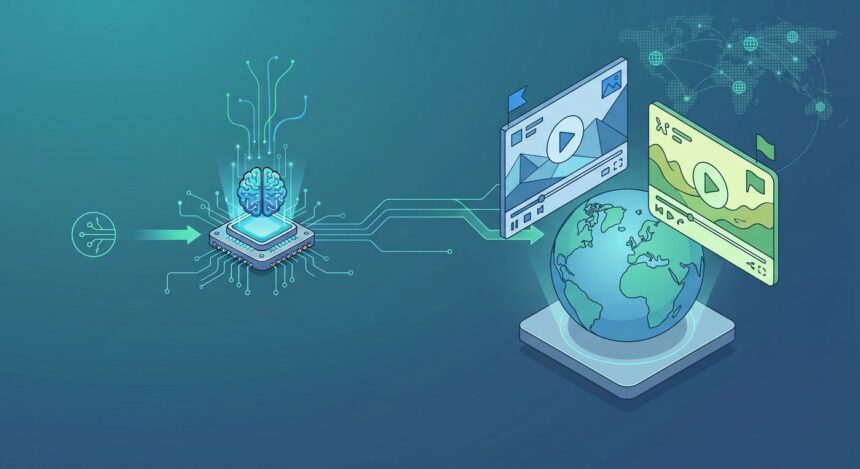
Expanding a brand into international markets used to mean rebuilding your marketing strategy from scratch for each region. Different languages, cultural references, and consumer expectations made global campaigns expensive and slow to execute. Today, AI video localization is changing the math — allowing brands to adapt their video content for any market in a fraction of the time and cost.
If your brand creates video content (and at this point, what brand doesn’t?), you’re sitting on a goldmine of assets that could be working harder for you in international markets. AI video localization makes it possible to take a single video and transform it into dozens of culturally adapted versions — each one feeling native to its target audience.
In this article, we’ll explore how brands are using AI video localization and virtual influencer tools to build global marketing campaigns that actually resonate with local audiences.
Why Video Localization Is Essential for Global Brands
Let’s start with the numbers. Video content accounts for over 80% of all internet traffic, and consumers are significantly more likely to purchase a product after watching a video about it. But here’s the catch — that video needs to speak their language. Not just literally, but culturally.
Here’s what happens when brands skip video localization:
- Engagement drops. Viewers who don’t understand the language or cultural references in a video will click away within seconds.
- Brand perception suffers. A poorly localized video feels lazy and disrespectful to local audiences — the opposite of what you want when entering a new market.
- SEO opportunities are missed. Each language version of your video can rank in regional search results, driving organic traffic that a single-language version can’t access.
AI video localization addresses all of these issues. Instead of creating separate videos for each market, you create one high-quality source video and use AI to adapt it. The AI translates the dialogue, generates natural-sounding voiceovers, adjusts on-screen text, and even modifies visual elements to match cultural preferences.
The result is a set of videos that each feel like they were created specifically for their target market — because in a sense, they were. AI video localization doesn’t just translate words; it adapts the entire viewing experience.
Streamlining Localization with AI Tools
The traditional approach to video localization was anything but streamlined. Here’s how it used to work:
- Hire translators for each target language
- Hire voice actors for each language
- Schedule recording sessions
- Edit and mix the new audio tracks
- Re-edit on-screen text and graphics
- Review and approve each version
This process could take weeks or months per language, with costs adding up quickly. AI video localization condenses this into a single, automated workflow:
- AI translates the script with awareness of cultural context and idiomatic expressions.
- Voice generation. AI creates natural-sounding voiceovers in each target language, matching the tone and style of the original.
- Lip synchronization. The AI adjusts visual elements to match the new audio, maintaining a professional appearance.
- Text adaptation. On-screen text, captions, and graphics are automatically translated and reformatted.
A tool like AI video localization handles this entire pipeline in one place. You upload your source video, select your target languages, and the platform generates localized versions ready for distribution. What used to take a full production team weeks can now be done in hours.
For marketing teams, this means you can launch campaigns simultaneously across multiple regions instead of rolling them out one market at a time. The speed advantage alone can be the difference between leading a conversation and joining it late.
Virtual Influencers: A New Marketing Channel
AI video localization solves the language problem, but there’s another piece of the global marketing puzzle: who delivers your message. That’s where virtual influencers come in.
An AI influencer generator creates realistic digital personalities that can represent your brand across markets. Unlike human influencers, virtual ones never have scheduling conflicts, don’t require travel, and can be customized to match the cultural preferences of each target audience.
Here’s why brands are adding virtual influencers to their marketing mix:
- Consistent brand representation. A virtual influencer always stays on message and on brand — no PR surprises.
- Infinite scalability. One virtual influencer can “appear” in multiple markets simultaneously, speaking different languages and adapting to local cultural norms.
- Cost efficiency. After the initial creation, producing content with a virtual influencer is significantly cheaper than hiring human talent for each campaign.
- Creative freedom. Want your influencer to present from a mountaintop, a space station, or a futuristic city? With AI, the setting is limited only by imagination.
When you combine AI video localization with virtual influencers, you get a marketing engine that can produce culturally adapted, multilingual content at scale. Your virtual influencer delivers the message in the local language, with culturally appropriate references, and the AI video localization ensures the entire video feels native to each market.
Frequently Asked Questions
What is AI video localization?
AI video localization is the process of adapting video content for different languages and cultures using artificial intelligence. It includes translating dialogue, generating voiceovers in the target language, synchronizing lip movements, and adapting on-screen text — all automated through AI tools.
How much does AI video localization cost?
Costs vary depending on the tool and the length of your video, but AI video localization is typically 70-90% cheaper than traditional localization methods. Instead of paying for translators, voice actors, studio time, and editors, you pay a single fee to the AI platform. Most tools offer subscription or per-video pricing models.
Are AI influencers effective for marketing?
Yes, virtual influencers can be highly effective. Several brands have already built successful campaigns with AI-generated personalities, achieving engagement rates comparable to or higher than human influencers. The key is creating a compelling personality and using AI video localization to adapt their content for each target market.
Conclusion
Global video marketing used to require a massive budget, a large team, and months of production time. AI video localization and virtual influencer tools have democratized the process, making it accessible to brands of any size. By automating translation, voice generation, and cultural adaptation, these tools let you focus on strategy and creativity rather than logistics.
The brands that win in the global market will be the ones that embrace these tools early. Start with one video, localize it into three languages, and see the difference in engagement. Once you experience the speed and quality of AI-powered localization, you’ll wonder how you ever marketed without it.
This article explores how AI tools are transforming global video marketing strategies for brands.