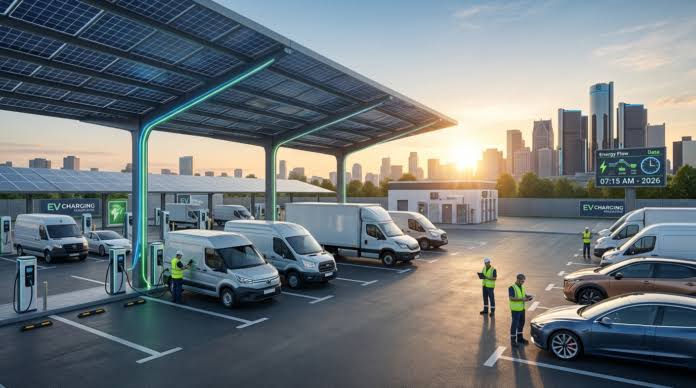
Buying electric vehicles for a business fleet is the exciting part. It’s the part that shows up in the press release, the sustainability report, the LinkedIn post. Charging those vehicles reliably, every single day, without blowing up the operating budget, is the part that never makes the announcement — and it’s usually the part that determines whether the whole electrification plan actually works.
That gap catches a lot of companies off guard. Delivery businesses, corporate campuses, municipalities, and logistics operators have all been converting gas and diesel vehicles to electric at a pace that would have seemed unrealistic five years ago. But somewhere between the vehicle order and the first month of real operations, a lot of fleet managers discover that charging isn’t a detail — it’s the whole ballgame.
Anyone who has tried to scale an EV fleet past a handful of vehicles knows the problem isn’t charging one van overnight. It’s charging twenty of them, on a shared electrical service, before the first shift starts — without tripping a breaker, without a driver showing up to a car that’s only at 40%, and without opening an unpredictable new line item in the monthly energy bill.
Why Fleet Charging Is a Different Problem Than Home or Public Charging
Public charging and workplace charging are built around unpredictable arrivals — cars show up throughout the day, plug in for a while, and leave. Fleet charging is the opposite. Vehicles typically return to a depot or lot around the same time, need to be full (or close to it) by a set departure time, and then don’t touch a charger again until the next cycle. That narrow, predictable window is actually an advantage — if the charging system is built to take advantage of it.
The trouble is that most sites aren’t designed for it. A property might have enough electrical capacity to run a dozen chargers at half power, but not enough to run all of them at full power simultaneously. Left unmanaged, that’s a recipe for tripped breakers, uneven charging, or an expensive utility service upgrade before the fleet can grow at all.
The Real Costs Fleet Operators Run Into
A few issues show up again and again once a company moves past pilot-stage EV adoption:
- Unpredictable energy costs. Electricity pricing shifts by time of day and by season. Without a system actively managing when and how fast vehicles charge, fleets end up paying peak rates for power that could have been delivered more cheaply overnight.
- Downtime from charger outages. A charger that goes offline doesn’t just inconvenience one driver — it can knock a route out of the day’s schedule entirely. For delivery and logistics fleets running on tight windows, that’s a direct hit to service reliability.
- Infrastructure that doesn’t scale. Fleets rarely stay the same size. A charging setup designed for eight vehicles often needs to become a setup for twenty within a year or two, and ripping out and redoing electrical infrastructure every time is neither cheap nor fast.
- No visibility across the lot. When a fleet manager can’t see charger status, energy use, or vehicle readiness in one place, staff end up walking the lot to check plugs manually — a poor use of time for an operation trying to run leaner, not less efficient.
What a Well-Designed System Looks Like
The fleets that scale electrification successfully tend to share a few things in common, regardless of vehicle brand or route type:
- Load management instead of guesswork. Power gets distributed across chargers dynamically, based on which vehicles need to be ready first and how much capacity the site actually has — rather than assuming every charger can run flat-out at once.
- Charging planned around schedules, not plug-in time. The system prioritizes vehicles by when they’re needed, not by which one happened to get plugged in first.
- Site planning built for growth. Instead of maxing out a property’s electrical capacity on day one, a good rollout plan leaves room to add vehicles and chargers later without a full infrastructure rebuild.
- One point of accountability for maintenance. When something goes wrong, fleet managers don’t want to coordinate between an electrician, a software vendor, and a charger manufacturer. A single team responsible for uptime saves time and avoids finger-pointing.
This is the operational layer that turns “we bought EVs” into “our fleet actually runs on EVs without drama.” Companies like Ampaway, which builds ev fleet charging solutions specifically around uptime and load balancing, are a good example of where the industry is heading— treating charging less like a piece of hardware and more like infrastructure that needs to be actively managed, monitored, and scaled alongside the fleet itself.
A Few Questions Worth Asking Before Electrifying a Fleet
For businesses weighing the transition, a handful of questions tend to separate a smooth rollout from a painful one:
- What’s the property’s current electrical capacity, and how much headroom is there before an upgrade is required?
- How will charging be sequenced across vehicles so everyone is ready on time, not just the first ones plugged in?
- Who is responsible when a charger goes down — and how fast is the response?
- Does the charging plan account for the fleet size two or three years from now, not just today?
None of these questions require a background in electrical engineering to ask. But asking them early — before chargers go in the ground — is usually the difference between a fleet that scales smoothly and one that hits a wall the moment it grows past its pilot phase.
The Bottom Line for Business Owners
Fleet electrification isn’t slowing down, and the businesses jumping in aren’t just early adopters chasing a trend anymore — rising fuel costs, tightening emissions rules, and lower total cost of ownership are making EVs the practical choice, not just the trendy one. But the companies that get the most out of the switch won’t be the ones that simply bought electric vehicles. They’ll be the ones that treated charging infrastructure as seriously as the vehicles themselves, planned for growth from day one, and picked a partner who could operate the system rather than just install it.
Get that part right, and fleet electrification stops being a logistical headache. It becomes what it was supposed to be from the start: a quieter, cheaper, more predictable way to keep a business moving.