A security operations centre used to run on a simple assumption: enough analysts, enough coffee and enough patience would get through the alert queue before anything serious slipped past. That assumption is no longer true. Alert volumes climbed faster than headcount ever could, and the gap between what a SOC receives and what it can actually investigate widened into something closer to a permanent backlog. An Agentic SOC is the industry’s answer to that gap, and it works differently enough from earlier automation that it deserves a proper explanation rather than a buzzword treatment.
At its core, this approach replaces some of the repetitive judgment calls analysts make all day with AI agents capable of investigating on their own. Not scripts that follow a fixed playbook. Agents that gather context, reason through what they find and decide whether something needs a human’s attention. This blog walks through what that shift actually looks like in a working security operations centre, where it helps most and where analysts still carry the weight.
What is an Agentic SOC?
This model puts autonomous AI agents in charge of detection, investigation and parts of response without waiting for a person to click through each step. Traditional SOC automation runs on rules someone wrote in advance. If X happens, do Y. Agentic systems work differently. They pull in context from multiple tools, weigh what they see against prior incidents and decide what to do next, adjusting as new information arrives.
That distinction matters more than it sounds. A rule-based system flags a login from an unfamiliar location and stops there. An agent working this way checks the user’s travel history, cross-references the device fingerprint, looks at what that account touched afterwards and arrives with a reasoned verdict rather than a raw alert. The analyst reviewing it gets a case, not a puzzle.
How This Changes Detection And Investigation
The shift shows up first in how alerts get triaged. Most SOCs run well past 10,000 alerts a day, and a large share of those never get a proper look because there simply isn’t time. Agentic AI investigates each one, correlating signals across endpoints, network traffic and identity systems rather than treating them as isolated events. Patterns that would have taken a human analyst an hour to piece together across five different tools get assembled in minutes.
Response is where the practical value becomes obvious. Isolating a compromised endpoint, revoking a suspicious session or blocking a malicious domain no longer waits for someone to be free at their desk. Agents can act within defined boundaries the moment confidence crosses a set threshold, then loop a human in for anything ambiguous. This does not remove analysts from the loop. It moves them from the first responder to the reviewer, which is a very different job.
What Gets Automated And What Does Not
Before listing out where the automation lands, it helps to see the picture as a whole. It does not apply AI evenly across every task. It concentrates effort where volume and repetition make human review impractical, and leaves judgment-heavy decisions with people.
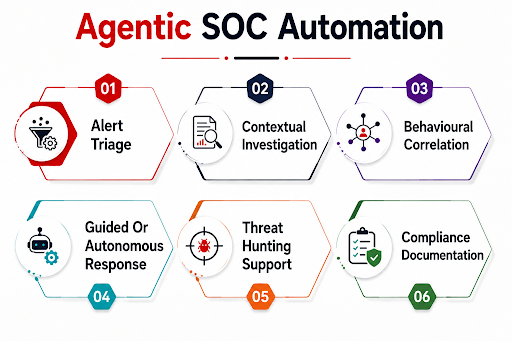
- Alert Triage: Agents cluster related alerts, discard confirmed noise and rank the remainder by actual risk rather than raw severity score.
- Contextual Investigation: Each flagged event gets enriched with identity, asset and threat intelligence data before it reaches an analyst.
- Behavioural Correlation: Agents connect activity across endpoints, cloud workloads and network traffic to surface attack chains that single-tool alerts miss.
- Guided Or Autonomous Response: Containment actions execute automatically for high-confidence cases and get routed for approval when the picture is less clear.
- Threat Hunting Support: Agents generate hunt hypotheses from emerging intelligence and run them continuously rather than on a scheduled basis.
- Compliance Documentation: Investigation trails and response actions get logged automatically, producing audit-ready records without extra manual effort.
Why Indian Enterprises Are Looking At Agentic SOC Models
India’s cybersecurity workforce gap runs into the millions, and BFSI, healthcare and IT services firms feel it most acutely because their SOCs need round-the-clock coverage regardless of headcount. CERT-In’s incident reporting timelines and the RBI’s expectations around continuous monitoring assume a SOC that never sleeps, which is difficult to staff reliably with human shifts alone. This model addresses that structurally rather than through overtime.
There is a regulatory angle too. SEBI’s Cyber Security and Cyber Resilience Framework pushes regulated entities toward faster detection and cleaner incident records, and this approach produces both as a byproduct of how it operates. Every investigation an agent runs leaves a documented trail, which turns what used to be a manual reconstruction exercise into something closer to a stored report the compliance team can pull on request.
Where Human Analysts Still Matter
None of this argues for removing people from the SOC. Agentic systems are good at speed and consistency, not at reading intent behind an unusual but legitimate business action, or deciding how far to escalate a politically sensitive incident. Analysts working alongside these agents spend less time clicking through raw logs and more time on the calls that actually need a person: validating agent-led investigations, tuning what the agents treat as normal and handling the cases that sit in genuine grey areas.
Detection engineers change too. Instead of writing detection rules line by line, they spend more time deciding which signals the agents should trust and at what confidence level an action should fire without review. It is a shift in where expertise gets applied, not a reduction in how much expertise the SOC needs.
Conclusion
An Agentic SOC changes the economics of security monitoring by letting AI agents handle the volume that human teams were never going to keep pace with, while keeping people in charge of judgment calls that genuinely need them. For organisations dealing with regulatory pressure, a stretched analyst team or round-the-clock monitoring requirements, that combination is becoming less of an upgrade and more of a baseline expectation.
CyberNX can help you build that capability as their AI-powered Managed SOC-as-a-Service combines agentic detection and investigation with experienced analysts who own the decisions that need human context, aligned to CERT-In, RBI and SEBI expectations. If your security team is buried under alert volume or struggling to maintain 24/7 coverage, get in touch with our experts to see how an Agentic SOC could work for your environment.