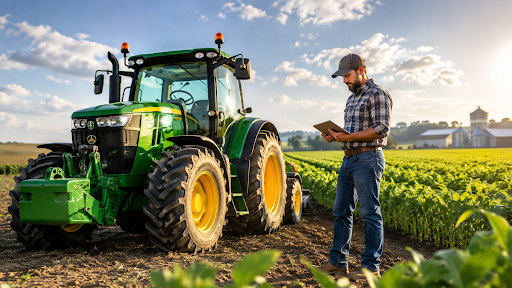
Running a farm is not only about producing crops or managing land. It is also about controlling expenses, using labor wisely, reducing unnecessary delays, and making equipment investments that remain useful for many years. Because tractors are involved in so many daily activities, choosing the right machine can have a major influence on the overall cost of farm operations.
Working with an agriculture equipment manufacturer can help farmers and agricultural businesses compare tractor options according to power requirements, field conditions, workload, and long-term operating needs. The most suitable tractor is not always the cheapest or the most powerful one. It is usually the machine that can complete required jobs efficiently without creating unnecessary fuel, maintenance, or ownership costs.
Why Tractor Cost Should Be Viewed Over Several Years
The purchase price is often the first figure buyers consider when comparing tractors.
However, the amount paid at the beginning is only one part of the total cost of ownership.
During its working life, a tractor may require fuel, oil, filters, tires, routine servicing, replacement parts, and occasional repairs. Storage, transport, and operator time can also add to the overall expense.
A tractor that costs less initially may become expensive if it is poorly matched to the workload or requires frequent attention.
For this reason, farmers should think about how much value the machine can provide over several seasons rather than focusing only on the initial price.
Correct Sizing Can Help Avoid Unnecessary Expenses
Choosing the correct tractor size is one of the most practical ways to control costs.
A tractor that is much larger than necessary may consume more fuel and involve higher purchase and maintenance expenses. It may also be difficult to operate in small fields or narrow spaces.
On the other hand, a tractor that is too small can create a different problem.
It may take longer to complete heavy work, struggle with larger implements, or operate under excessive load.
Farmers should select a machine according to their regular tasks, farm size, soil conditions, and implement requirements.
The goal is to have enough power without paying for capacity that will rarely be used.
Fuel Consumption Can Become a Major Operating Cost
Fuel is a continuing expense throughout the tractor’s working life.
A small difference in fuel use may not seem important during a single day, but it can become significant after hundreds or thousands of operating hours.
Several factors can influence fuel consumption.
These include tractor size, engine load, tire pressure, field conditions, implement selection, maintenance condition, and driving habits.
Using a tractor that is appropriately matched to the job can help avoid unnecessary fuel use.
Operators should also avoid excessive idling and make sure the tractor is serviced properly.
Good operating practices can help farmers control costs without reducing the amount of work completed.
Labor Efficiency Is Another Important Consideration
Agricultural machinery can reduce the amount of manual work required for many farming tasks.
This becomes particularly important where labor is expensive, difficult to find, or needed for several activities at the same time.
A suitable tractor can help one operator complete jobs that would otherwise require more workers or much more time.
For example, mechanical land preparation, hauling, mowing, and cultivation can reduce dependence on manual labor.
However, equipment should be selected according to actual farm needs.
Buying machinery that remains unused for most of the year does not automatically create savings.
The greatest value comes when the tractor replaces repetitive work and is used regularly throughout the farming cycle.
Time Savings Can Have Financial Value
Time is an important resource in agriculture.
Some farming activities must be completed within short seasonal windows. Delays in land preparation, planting, crop care, or harvesting can affect later operations.
A tractor that allows work to be completed faster can therefore provide financial value beyond simple labor savings.
This is especially important when weather conditions create only a few suitable days for fieldwork.
Farmers should think about how long their major tasks currently take and whether a different tractor or implement combination could improve productivity.
A machine that saves several working days during a busy season may justify its cost more easily than one that offers power but little practical time benefit.
Implement Compatibility Can Reduce Extra Purchases
A tractor should be considered together with the implements it will operate.
Farmers may use equipment such as:
- Plows
- Seeders
- Rotary tillers
- Cultivators
- Sprayers
- Mowers
- Loaders
- Trailers
If a tractor is not compatible with existing implements, the farmer may need to replace or modify other equipment.
This can increase the true cost of purchasing the tractor.
Buyers should check power requirements, hydraulic needs, connection systems, and the physical size of their main attachments before making a decision.
When evaluating an agriculture equipment manufacturer, farmers and equipment buyers should consider whether available tractor options can be matched with the implements and workloads commonly used in their agricultural operations. A suitable match can help reduce unnecessary equipment changes and support better use of existing farm assets.
Maintenance Costs Should Be Planned in Advance
Every working tractor requires maintenance.
Routine servicing is not an optional expense because it helps protect the machine and reduce the risk of larger failures.
Farmers should budget for items such as:
- Engine oil
- Filters
- Lubricants
- Hydraulic fluids
- Belts
- Tires
- Batteries
- Regular inspections
It is usually better to include these costs in annual planning instead of treating maintenance as an unexpected expense.
Delaying routine servicing may save money in the short term, but it can increase repair costs later.
A well-maintained tractor is also more likely to remain available when fieldwork must be completed quickly.
Downtime Can Be More Expensive Than the Repair Itself
When a tractor breaks down, the repair bill is not always the largest cost.
The farm may also lose valuable working time.
Employees may be unable to continue their tasks, implements may remain unused, and important field operations may be delayed.
This can become especially costly during planting or harvesting periods.
Preventive maintenance, operator inspections, and quick attention to small problems can help reduce unexpected downtime.
Farmers should also think about parts availability and service requirements when comparing machinery.
Equipment that is easy to maintain can sometimes provide better long-term value than a cheaper machine that frequently interrupts farm operations.
Tire Care Can Protect Both Fuel and Replacement Costs
Tractor tires can be expensive to replace.
Their condition also affects traction and fuel efficiency.
Incorrect pressure may increase wear, reduce grip, or make the tractor work harder than necessary.
Farmers should check tire pressure regularly and inspect for cuts, cracks, or unusual tread wear.
The correct tire setup may vary depending on field conditions and tractor use.
A machine used mainly on soft agricultural soil may have different requirements from one that spends considerable time on firm roads.
Proper tire care helps protect a major equipment expense while supporting better field performance.
Good Operators Can Help Reduce Ownership Costs
The way a tractor is driven has an impact on its long-term condition.
Aggressive operation, unnecessary high engine speeds, excessive loads, poor gear selection, or careless implement use can increase wear.
Operator training can therefore become part of cost control.
Drivers should understand:
- Correct startup and shutdown procedures
- Suitable working speeds
- Safe load limits
- Basic daily inspections
- Warning indicators
- Proper implement connection
- When to stop and investigate a problem
An operator who understands the machine can often notice early warning signs before they become major repairs.
Versatile Equipment Can Increase Annual Utilization
A tractor that performs only one short seasonal job may spend much of the year parked.
In some cases, a more versatile tractor can provide greater value because it can support different activities throughout the season.
For example, the same tractor might be used for land preparation, mowing, transport, spraying, or general farm maintenance when suitable implements are available.
Higher utilization can help spread the cost of ownership across more productive working hours.
However, farmers should avoid buying unnecessary attachments simply to increase usage.
Every additional implement should solve a real farming need.
Future Expansion Can Change the Cost Equation
Farm operations often grow or change.
Additional land may be rented, new crops may be introduced, or larger implements may become necessary.
A tractor that perfectly matches current requirements could become limiting if the farm expands quickly.
At the same time, buying a much larger machine for uncertain future growth can create unnecessary expenses today.
The better approach is to consider realistic expansion plans.
Farmers should ask what changes are likely during the next several years and whether the selected tractor can handle them without being significantly oversized for current work.
This creates a better balance between present cost and future usefulness.
Resale Value Should Not Be Completely Ignored
Agricultural machinery may eventually be sold or replaced.
The condition of the tractor, service history, operating hours, maintenance quality, and general demand can all influence resale value.
Keeping clear service records and maintaining the machine properly can help demonstrate how it has been cared for.
Farmers should not select equipment only according to expected resale value, but it can still be part of long-term financial planning.
A tractor that provides useful service for many years and remains in good condition may offer stronger overall value than one that becomes difficult to maintain.
Buying Decisions Should Be Based on Real Farm Numbers
Farmers can make better equipment decisions when they use simple calculations rather than assumptions.
Before purchasing a tractor, it can be useful to estimate:
- Annual operating hours
- Main tasks
- Current labor requirements
- Expected fuel consumption
- Maintenance budget
- Implement needs
- Time saved
- Expected years of use
These numbers do not need to be perfectly exact.
Even basic estimates can help buyers compare whether a machine is likely to provide enough practical value.
The objective is to understand how the tractor will contribute to the farm rather than choosing equipment simply because a particular model is available.
Conclusion
A tractor should be viewed as a long-term working asset rather than only a one-time purchase. Purchase price, fuel consumption, labor savings, maintenance, downtime, tires, implement compatibility, operator habits, and future farm growth all influence the real cost of ownership.
Farmers who select equipment according to actual workloads are better positioned to avoid both underpowered machinery and unnecessary excess capacity. Careful maintenance and responsible operation can further protect the investment and help the tractor remain productive over many farming seasons. Agricultural businesses and farmers looking for tractor solutions suited to different working requirements can explore more information through Gengjiaagri.com.