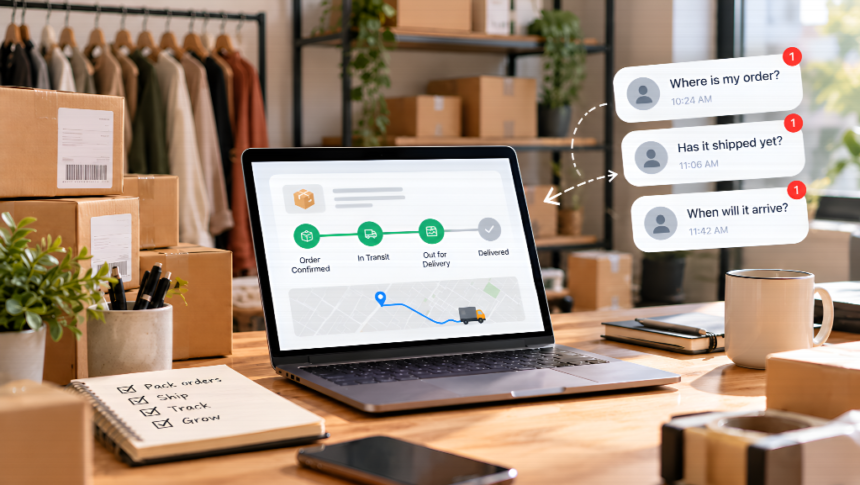
A growing online store usually notices the same problem long before it needs a formal customer service department. Orders increase, packages go out every day, and the inbox slowly fills with versions of the same question: “Where is my order?” These messages are often called WISMO requests, short for “Where is my order?”, and most of them are not complicated support cases at all. The customer usually wants to know whether the package has shipped, where it is now, or whether a delivery date is still realistic. Yet someone on the business side still has to open the order, find the tracking number, check the shipment, write a response, and move on to the next message. For a home-based seller who is also managing inventory, packing boxes, creating listings, and handling returns, that simple task becomes expensive because it keeps interrupting work that actually moves the business forward.
The obvious answer might seem to be faster support, another employee, or a chatbot, but those solutions start too late. A customer who can find a useful answer in thirty seconds has no reason to send the question in the first place. That shifts the problem from customer service to the post-purchase experience: what information does the buyer receive after checkout, where can they find it later, and what happens when delivery does not follow the perfect route shown at checkout? A small store does not need an elaborate logistics platform to improve this. It needs a clear path from order confirmation to shipment tracking, plus a sensible way to separate normal deliveries from orders that actually need attention. Fix that path first, and a surprising amount of support work disappears without adding another person to the team.
Find Out Why Customers Are Asking Before You Automate Anything
WISMO messages look identical in an inbox, but they often start for different reasons. One customer cannot find the tracking number. Another has a number but does not know which carrier has the parcel. Someone else sees “In Transit” for the third day and assumes the package has stopped moving, while another buyer was promised delivery on Tuesday and is writing on Wednesday because nothing arrived. Treat all four as the same support problem and the obvious solution becomes “answer faster.” Look one step earlier and each one points to a different information problem that can be fixed once instead of answered repeatedly.
Take twenty or thirty recent order-status conversations and group them by what the customer was actually missing. You may find that shipping emails are difficult to locate, tracking links do not work well on mobile, expected delivery dates are unclear, or customers become confused when an international order changes carriers. There may also be a pattern around a specific product, destination, or shipping method that creates more questions than the rest. That small review is more useful than installing another support tool without knowing what it is supposed to fix. The goal is to identify the point where a normal buyer loses confidence in the delivery and decides that contacting you is easier than checking it alone.
Put Tracking Where Customers Will Actually Look for It
A tracking number hidden halfway down a shipping confirmation technically gives customers access to their shipment, but it still creates unnecessary work. People delete emails, search badly, order from several stores at once, and sometimes remember the product name without remembering which message contained the delivery information. Give them more than one sensible route back to tracking. The shipping confirmation is the obvious place, but the order-status page and customer account can be just as useful when those features are available. If you send a later delivery update, include the route back to tracking there as well instead of assuming the customer still has the original message open.
The path should also be simple when different carriers are involved. A small ecommerce business may use one carrier for domestic orders, another for international deliveries, and additional services when price or destination makes them a better fit. The buyer should not have to understand your carrier selection process to find their parcel. If a DHL shipment is involved, for example, you can give the customer a direct way to track DHL package status with TrackingPackage using the shipment number rather than making them work out where to search for it. TrackingPackage can identify supported carriers from the tracking information and follow available shipment updates, which is particularly useful when deliveries do not all move through the same network. The result is simple: customers still have access to the shipment information, but your inbox no longer needs to function as a manual tracking lookup service.
Do Not Treat “Label Created” as if the Order Is Already Moving
One surprisingly common source of delivery questions begins with the store itself. A shipping label is generated, the order is marked as shipped, and the customer assumes the parcel is already traveling toward them. The carrier may not actually have the package yet. With DHL, for example, tracking information generally becomes available after the shipment reaches its facility, and DHL notes that status information can take roughly 24–48 hours to appear after a tracking ID is issued. If a customer receives a confident “Your package is on the way” message before there is any physical carrier activity, the business has created an expectation that the tracking page cannot immediately support.
The fix is mostly wording and timing. If the order has been packed and a label exists but handoff has not happened, do not describe that stage more strongly than necessary. Once the carrier accepts the parcel, the tracking history begins to answer a different set of questions because there is now evidence that the package has entered the delivery network. Customers do not need an explanation of warehouse operations, but they should not be led to believe that label creation and carrier possession are the same event. A more accurate first message reduces the chance of receiving “Why hasn’t my tracking moved?” before the shipment has had a realistic opportunity to move at all.
Give Customers a Delivery Window They Can Understand
A vague delivery promise generates support tickets because customers fill in the missing details themselves. “Ships in 2–3 days” can mean dispatch within three days to the seller and arrival within three days to the buyer. “Delivery in 5–7 days” may or may not include order processing, weekends, holidays, or the time before a carrier receives the package. Once the customer chooses the most optimistic interpretation, every later day feels like a delay. Clear expectations do more to reduce WISMO than a beautifully designed tracking page attached to an unrealistic promise.
Separate processing time from transportation time when both matter. If an item normally takes two business days to prepare before it is handed to a carrier, say that before checkout rather than forcing support to explain it afterward. During holiday peaks, promotions, product launches, or temporary stock shortages, change the displayed expectation when operations change. Clear delivery timing helps customers understand when the order should actually leave your business and when it is reasonable to expect the package to arrive. A realistic date may look less exciting than an aggressive one, but a customer who receives the order when expected is far less likely to ask where it is.
Explain the Few Tracking Situations That Actually Generate Questions
Most customers do not need a glossary of twenty-five shipping statuses. They need help with the handful of situations that look wrong. A package may sit on In Transit longer than expected, show a delivery attempt, remain on a label-created status, move to a local carrier, or display Delivered when the buyer cannot immediately find it. Those moments create uncertainty because the words on the tracking page do not always tell a casual shopper what to do next. A short help page or FAQ that deals with your most common cases can answer those questions before support sees them.
Write those explanations around actions rather than definitions. “In Transit means your shipment is in the carrier network” is technically useful, but “No action is usually needed while the package continues to receive normal tracking updates and remains within the delivery window” answers the customer’s real concern. A failed delivery status should point toward the carrier’s current redelivery or pickup instructions. A Delivered status can remind customers to check reception desks, parcel lockers, household members, and safe delivery locations before opening a missing-package case. You are not trying to replace the carrier’s tracking history. You are giving customers enough context to recognize the difference between a normal shipment event and a situation where contacting the business makes sense.
Send Fewer Updates, but Make Each One Useful
More shipping emails do not automatically mean better communication. A customer does not need a notification every time a parcel enters and leaves another sorting facility. Too many updates train people to ignore them, which means the message that actually matters can get lost among routine scans. A small store can often cover the journey with a few meaningful moments: order confirmed, shipment handed off, major delivery change if one occurs, out for delivery when useful, and final delivery. The exact sequence should fit the products and customers rather than imitate a large retailer simply because it has more automation.
Exceptions deserve different treatment from normal movement. If an ordinary parcel passes through another facility, nothing has changed for the customer. If the estimated delivery date moves, an attempt fails, or the carrier reports a problem that requires action, communication becomes useful because the buyer’s expectation has changed. DHL, for example, offers delivery notifications around events such as exceptions, shipment pickup, out-for-delivery, and delivery confirmation, illustrating the difference between meaningful milestones and constant scan-by-scan messaging. A good rule for a small store is simple: send an update when it answers a question the customer would otherwise be likely to ask.
Watch the Exceptions Instead of Watching Every Package
Many small sellers waste time checking shipments that are behaving perfectly normally. If fifty packages are moving through carrier networks and forty-seven have recent scans with reasonable delivery estimates, opening all fifty tracking pages does not create better customer service. The three unusual orders deserve attention. A shipment that has missed its expected date, an address problem, repeated failed delivery attempts, or a long gap after confirmed carrier acceptance is much more valuable to inspect than another parcel that moved through a sorting hub this morning. The working view should make exceptions easier to notice rather than treating every active order as equally urgent.
This approach scales much better than a daily manual tour through every tracking number. Instead of opening different carrier sites one by one, a service like TrackingPackage can help you follow available shipment updates in one place and spot the orders that may need attention. Even a very small business can use the same principle without adopting an enterprise system or building a complicated shipping dashboard. Keep normal orders in the background, focus on shipments with delayed movement, exceptions, or missed delivery dates, and investigate those first. You are not checking less carefully; you are spending attention where it can actually change the outcome.
Do Not Make Support the Only Way to Solve a Routine Delivery Problem
There is a major difference between making information easy to find and pushing customers away. A buyer whose package is moving normally should be able to check it without waiting for an email response. A buyer whose order was damaged, sent to the wrong address, lost, or returned may genuinely need the seller to get involved. If your self-service design hides contact information or keeps sending someone back to the same unhelpful tracking page, WISMO goes down only because customer frustration goes up. That is not a win.
Make escalation obvious when the situation crosses a reasonable threshold. The customer should know what kinds of problems the carrier can solve directly and which ones require the merchant. DHL notes, for example, that some investigations into overdue ecommerce shipments must be initiated by the sender because the sender is DHL’s contractual customer. That is exactly the type of situation where telling a buyer “please contact the carrier” forever creates a dead end. Good self-service handles routine visibility, while support remains available for cases where the business has information, authority, or responsibility that the customer does not.
Returns Need Their Own Tracking Habit
Outbound delivery is not the only source of “where is it?” questions. Returns can create the same uncertainty in the opposite direction. A customer sends an item back, sees that the carrier delivered it, and expects the refund to appear immediately. The business may still need to receive the package internally, inspect the product, match it with the original order, and approve a refund or exchange. If the returns page only says “send it back and we’ll process your refund,” the customer has no idea when one stage ends and the next begins.
Treat the return as a small sequence rather than one vague event. Tell customers when the package has to be sent, whether they should retain the tracking number, what Delivered means on your side, and how long inspection or refund processing normally takes after receipt. A store does not need to send an email for every return scan, but it should make clear that carrier delivery and refund completion are separate milestones. That clarity prevents customers from interpreting “Delivered at 10:14 AM” as “my money should already be back at 10:15.” It also gives support a much cleaner starting point when a return genuinely goes missing.
Look at WISMO as an Operations Metric, Not Just a Support Metric
Order-status messages can reveal more than a busy inbox. If customers repeatedly ask about one shipping method, the issue may be poor tracking visibility rather than support capacity. If questions surge around a certain destination, carrier, or product category, fulfillment or delivery promises may need attention. A high number of “tracking says delivered but I don’t have it” cases tells a different story from a high number of “I never received my tracking number” messages. Counting all of them as WISMO and stopping there throws away useful information.
Add a simple reason tag when answering these contacts for a few weeks. You do not need a complicated reporting system; categories such as tracking not found, no movement, delivery date passed, delivery attempted, delivered but missing, return status can already show where the friction sits. Then fix the largest repeatable problem and compare the volume again. If tracking links were hard to find and those messages fall after you redesign the shipping email, you have measured an operational improvement rather than merely a faster support response. Over time, the remaining messages become more valuable because they are less dominated by questions that a better process could have answered automatically.
The Goal Is Not Zero WISMO
A business that ships physical products will always receive some order-status questions. Customers travel, buildings have access problems, carriers encounter delays, addresses are entered incorrectly, and occasionally a package genuinely disappears. Trying to eliminate every WISMO contact can lead to an impersonal system that works beautifully only when everything goes right. A better target is removing the avoidable messages: the customer who could not find the tracking link, did not understand when the order would ship, or had to ask the store to perform a lookup they could easily have done themselves.
That distinction matters most for small and home-based businesses because the same person often handles both routine work and exceptions. Every simple tracking request that resolves itself creates more time for damaged orders, refunds, product questions, supplier problems, and customers who genuinely need help. Clear delivery expectations, accessible tracking, sensible status explanations, selective notifications, and exception-focused monitoring can remove a large amount of repetitive work without adding another support seat. You are not automating the relationship with the customer. You are making sure a customer does not have to start a relationship with support just to find out where a box is.