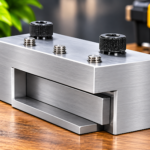
A section has been cut, cleaned and labeled, and it is too small, too thin or too irregular to hold against a grinding disc. Before anything else happens it has to be set in a resin block, and the laboratory has two broad ways of doing that. One presses resin powder around the specimen under heat and pressure. The other pours a liquid resin over it at room temperature and waits for it to cure.
The choice looks routine, and for much everyday metal work it is. It stops being routine when the specimen is sensitive to heat, when the feature of interest sits at an edge, or when the material is full of pores that grit and etchant can hide in. Picking the wrong route often does not show at the mounting bench. It shows later, as rounded edges, gaps around the specimen or a structure the mount itself altered.
In short, compression mounting suits routine metal specimens that tolerate the temperature of a press cycle and benefit from a hard, uniform mount. Cold mounting, also called castable mounting, suits specimens that heat or pressure could change, along with porous, cracked or fragile pieces. Within each route, the resin decides as much as the method does.
On the hot side, hot compression mounting presses treat temperature, pressure, heating time and cooling time as one programmed cycle, and the cold side relies on cups, two-part resins and, for porous work, a vacuum chamber. What follows sets out where each one fits and which questions settle the choice for a given sample mix.
How Each Method Builds The Mount
In compression mounting the specimen sits in a cylindrical mold with a measured amount of resin powder around it. The mold is sealed, heated and pressurized until the resin flows around the specimen and sets into a solid plug. The resin can be thermosetting, such as phenolic, or thermoplastic, such as acrylic. A university teaching guide gives the mounting temperature as around 200 degrees Celsius, and one university lab handout describes plugs of 1 to 1.5 inches in diameter as the common format.
Thermosetting resins need both heat and pressure during the molding cycle. The same handout notes that pressure and temperature are generally held constant during mounting, which leaves time as the variable the operator adjusts. Automatic presses store the whole cycle as a program that can be recalled and repeated.
Cold mounting skips the press. A two-part resin, typically epoxy, acrylic or polyester, is mixed and poured over a specimen placed face down in a mounting ring or cup. The resin cures at or near ambient temperature and pressure, and the finished block is removed and ground like any other mount.
Both routes serve the same purpose. ASTM E3, the standard guide for preparing metallographic specimens, covers mounting small or fragile pieces so that their edges stay flat through grinding and polishing. The guide describes principles rather than a fixed recipe, so the resin and the method are chosen to suit the specimen.
Heat Sensitivity Usually Decides First
The first question is whether the specimen can survive the press. University guidance is direct on this point: if hot mounting will alter the structure of the specimen, a cold-setting resin can be used instead. Another university materials lab makes the same distinction, describing room-temperature curing as important for specimens whose structure or mechanical properties change at elevated temperatures and pressures.
That framing puts the decision in the laboratory’s own hands. A press cycle that reaches temperatures in the region where a material was tempered, aged or otherwise heat treated is a reason to look at the cold route. Preparation guidance from one equipment supplier points to age-hardened aluminum tempers as one such case, on the grounds that a compression cycle runs in roughly the same temperature band as their ageing treatment and can act as a small further age.
Pressure deserves the same thought. University guidance asks that the mounting material not affect the specimen through chemical reaction or mechanical stress, and the load that consolidates resin powder is a mechanical stress. A fragile or brittle specimen can be better served by a poured resin that surrounds it without squeezing.
There is a catch on the cold side, and it is easy to miss. Cold does not mean free of heat, because some castable resins warm up as they cure. One supplier’s fast-curing epoxy is listed as releasing heat during a cure of about 45 minutes at room temperature. Its high-flow epoxy is listed as releasing no heat during curing, at the price of a cure of about 24 hours. For a specimen that cannot tolerate much warming, the slower system is the safer choice, and the schedule has to allow for it.
Edges And Flatness Tend To Favor A Harder Mount
Once heat is ruled out as a concern, edge retention becomes the main question. The mount works best when it wears at a similar rate to the specimen during grinding. If the resin is much softer, it wears away first, the edge of the specimen loses support and rounds over, and a coating, plating layer or hardened case near that edge becomes difficult to measure.
University guidance describes the trade plainly. Phenolic mounts are harder and give better edge retention, but they need high temperature and pressure to cure. Epoxy mounts cure near ambient conditions but are softer, and keeping a flat surface on them can be harder, particularly with a hard specimen.
A lab handout from another university goes further. It describes room-temperature mounting as inferior in quality to compression molding and warns that adhesion between the specimen edges and the epoxy plug can be relatively poor, so gaps often form and degrade the specimen. A gap at the interface leaves the edge without support at exactly the point where grinding is hardest on it.
The method alone does not settle it, though. Hot-mounting resins come in more than one family. Phenolic suits general work, while epoxy types for the press are chosen when better edge retention and low shrinkage are needed, and compression resins are also supplied with fillers that raise hardness. A resin much softer or much harder than the specimen produces voids and uneven wear whichever route is used. Cleaning the specimen before embedding, plus a release agent on the mold of a hot press, prevents most mount defects.
Porous And Cracked Material Needs Resin Inside It
Some specimens cannot simply be surrounded by resin, because the problem lies inside them. Porous castings, cracked parts, some coated material and composites all have open spaces below the surface. If those spaces stay empty, grit, polishing media or etchant can be trapped in them during preparation.
University teaching material states that porous materials must be impregnated with resin before mounting or polishing, partly to prevent that trapping and partly to preserve the open structure of the material. The resin has to reach those spaces before it sets, and vacuum impregnation is built for that job.
The specimen sits in a cup inside a chamber, the vacuum removes trapped air, and a high-flow epoxy is drawn into the pores and cavities. One impregnation system draws a vacuum of minus 600 mmHg and runs up to 99 degassing cycles. A transparent chamber lets the operator watch the resin level in each cup without breaking the vacuum. Filling the pores this way also improves edge retention on the finished mount.
This is also where the search term “cold mounting press” can mislead a buyer. Equipment described under that heading can turn out to be a vacuum impregnation unit rather than a press, since a castable resin cures without applied pressure. A laboratory that mainly needs to fill porosity is looking for a vacuum chamber, a pump and the right resin.
Throughput Looks Different On Each Side
Speed is a common reason to prefer one method, and the comparison is less one-sided than it looks. Mounting capacity also has to match the stages on either side of it, sinceequipment for each stage of metallographic preparation runs from sectioning through mounting to grinding and polishing, and a slow step anywhere holds up the whole sequence.
A compression press produces finished mounts one cycle at a time. Automatic presses free the operator during that cycle. They store up to 100 programs, run heating and cooling from a single setting and sound an alarm when the mount is ready, and built-in cooling shortens the time per sample. Heating and cooling times on one family of presses are each adjustable up to 99 minutes, with a chiller available as an option. Capacity per cycle grows with the mold arrangement. Optional spacers allow one or two samples per mold, and a dual-mold press can produce up to four samples in a single cycle.
Cold mounting runs the other way. Each mount takes longer, from about an hour in one university lab procedure to about 24 hours for a slow, low-heat epoxy, but many cups can cure side by side, and a vacuum chamber can take cups of different heights in the same run. For batches of similar specimens that can wait, pouring many cups at once can offset the longer cure.
Mold and cup sizes also need checking against the specimens. The presses described above accept mold diameters from 22 to 50 mm, or 1 to 2 inches, and castable cups for vacuum work are listed from 25 to 50 mm. A specimen that will not fit with a sound wall of resin around it needs a larger mount, or it has to be cut down first.
Special Cases That Change The Answer
A few requirements override the usual reasoning. If the specimen is to be electropolished or examined in a scanning electron microscope, university guidance calls for an electrically conducting mount. Compression resins are supplied with fillers that raise conductivity, which can make the press the practical route for that work even where a castable resin would otherwise be the default.
Transparency is another. Where it is required, transparent thermoplastics are available for compression molding, although they cost more than a standard thermosetting powder.
Geometry matters regardless of route. University teaching material recommends a mount thickness of about half its diameter so that it does not rock during grinding and polishing, with rounded mount edges to limit damage to grinding and polishing discs. Labeling each mount right after curing keeps its identity and orientation clear through the rest of the sequence.
Questions That Help Choose A Mounting Route
A laboratory weighing one method against the other can work through its own sample mix with a short set of questions.
- Does ASTM E3 Require Hot Or Cold Mounting?
No. ASTM E3 treats mounting as the step that keeps small or fragile pieces flat and protects their edges through grinding and polishing, and it describes principles rather than a single method. The resin and the mounting route are chosen to suit the material, so a laboratory working to the guide can use either, or both.
- Can A Cold Mount Still Heat The Specimen?
It can. Some castable resins give off heat as they cure, and one supplier lists heat release for its fast-curing epoxy but not for its slow, high-flow one. Where the specimen is sensitive to even modest warming, a slower resin that is listed as releasing little or no heat during its cure is the safer choice, at the cost of a longer wait before grinding.
- Why Do Gaps Form Around Some Cold Mounts?
Adhesion between a poured resin and the specimen edge can be weaker than in a compression mount, and a gap can open at the interface as the resin cures. Cleaning the specimen thoroughly before embedding, and curing under vacuum to remove trapped air, can help. Where the edge itself is the subject of the examination, a harder compression resin or a resin selected for edge retention is worth considering.
- Is It Worth Running Both Methods In One Laboratory?
That depends on the sample mix. A laboratory that mounts routine steel sections in volume and also receives coated, porous or heat-treated parts that a press could alter can have a case for both, with a press for the first group and castable resin, with or without vacuum, for the second.