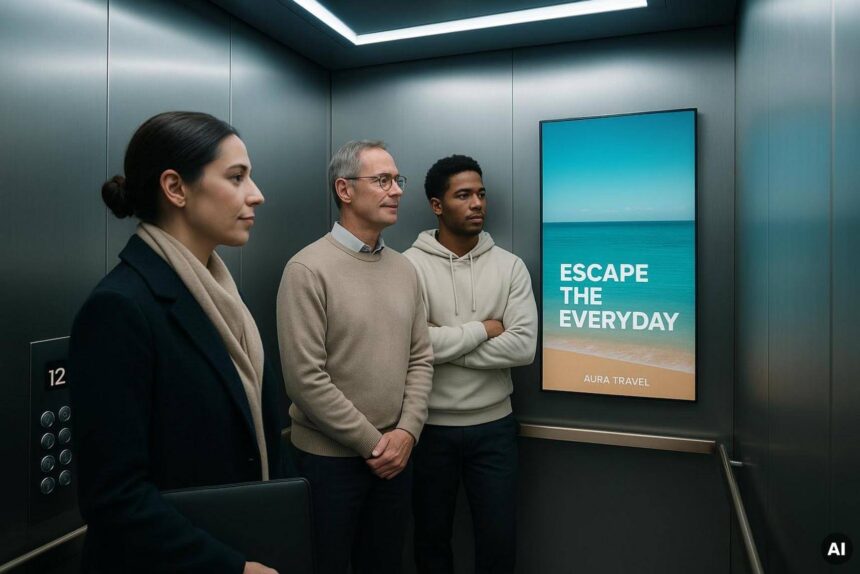
People today have become very good at ignoring digital marketing. Desktop ad blockers, streaming plans without adverts, and quick swipes past sponsored social media posts make it harder for brands to gain real attention. Lift advertising addresses this problem by reaching people during routine pauses in daily life. By placing brand messages inside apartment towers, office buildings, and mixed-use properties, marketers can connect with audiences during natural breaks in their day.
Instead of interrupting a TV show or competing in the fast-moving auction for space in a mobile feed, indoor campaigns in lift cabins use the physical setting around the audience. Using advertising in lifts gives organizations a visible presence where private life and public activity meet. Done well, a short and sometimes uncomfortable ride becomes an engaging brand moment that stays with passengers after the doors open.
What Is Lift Advertising?
Lift advertising is a type of place-based out-of-home (OOH) media. It uses printed displays, digital screens, or interior wraps inside lift cabins and nearby waiting areas. Since the Otis Elevator Company introduced safe passenger travel in 1857, lifts have been a basic part of city life. Today, modern networks turn these practical spaces into media channels for business, public information, and community messages.
This medium gives advertisers a more focused reach than large roadside billboards. Place-based media places brand messages inside or near venues where people already spend time. By putting content in the residential and work settings of city residents, lift media turns a normal daily trip into a regular chance for people to remember a brand and take action.
How Lift Advertising Reaches Consumers at Home and Work
City travel usually follows familiar patterns. Many city residents take about four lift trips each day: leaving their apartment in the morning, arriving at work, going out for lunch or meetings, and returning home in the evening. Since these journeys happen at similar times, in-cab advertising becomes a regular contact point throughout the day.
Reaching people in these settings gives a message a personal link that street billboards often cannot provide. At home, a resident going to the lobby may be interested in meal delivery, weekend activities, or nearby grocery offers. At work, an executive entering a lift may be ready to hear about business software, health checks, or nearby restaurants. By appearing in both settings, brands become part of the short mental break between everyday tasks.
Lift Advertising vs. Elevator Advertising
The terms “lift advertising” and “elevator advertising” usually mean the same thing. The difference comes mainly from local language and culture. In Britain, Europe, Australia, and many Asian business centers, people generally say “lift.” In North America, “elevator” is more common. Both terms describe advertising placed inside vertical passenger cabins.
Some differences can appear in the way media networks are built in different regions. In North America, elevator media first became common in office towers in major financial centers, with a focus on business news and professional audiences. In East Asia and parts of Europe, lift networks have long focused on dense residential towers. There, the lift acts as a shared noticeboard and a direct link to local shops and services.
Why Brands Use Lift Advertising
Marketers look for places where people are calm, present, and willing to look around. A lift cabin creates conditions that are different from most digital and physical media settings. Passengers often welcome something to look at while avoiding eye contact, passing time, or preparing for a meeting or the journey home.
Lift networks are also located inside homes, offices, and other buildings. This helps connect general brand awareness with actions such as ordering dinner, booking an appointment, or researching business tools. Brands use the channel to reach people during daily moments when they are close to making a choice.
Reaches Audiences During High-Dwell Moments
A typical lift ride lasts from about 30 seconds to almost two minutes. In large cities such as New York, the average ride is close to 118 seconds. That may seem short, but it is a long viewing period by advertising standards. Roadside billboards may be visible for only three seconds, while a social media advert can disappear with one swipe. A lift advert can hold attention for much longer.
The small, enclosed space also affects how people behave. Research shows that lift passengers often look at neutral points so they do not have to maintain eye contact with other riders. A screen or poster gives them a natural place to look, which can reduce resistance to the advert. Studies report aided brand recall of more than 80% to 90% in these settings, giving the format a strong memory value.
Influences Consumers Near Purchase Decisions
One of the main benefits of place-based media is that it can reach people close to where they may buy something. Residential lift screens reach people as they plan dinner, think about errands, or relax at the end of the day. If a resident sees an advert for a local grocery shop, bakery, or streaming service while going home, only a few steps separate the message from a possible action.
In offices, the focus often shifts to business services and spending during the workday. Employees may decide where to eat lunch, which café to visit, or which professional service to explore while moving between meetings and breaks. Since they are already out of their seats and using their phones, the advert can prompt an immediate visit to a nearby business or website.
Where Lift Advertising Reaches Consumers
The building that contains a lift affects its audience, travel pattern, and setting. City buildings serve many different groups, so advertisers can choose locations that match their target customers. Instead of placing adverts across an entire postcode, a campaign can focus on buildings whose residents or workers fit the desired customer profile.
A luxury residential tower attracts a different audience from a suburban office campus. The building sets the subject and tone of the message. Knowing how each type of setting affects people helps media buyers choose suitable designs and showing times.
Residential Apartment and Condominium Buildings
Modern residential towers bring many households with spending power together in one place. This includes luxury city condominiums and large suburban rental communities. These properties often attract technology-minded people who value convenience. Advertising in these buildings creates repeated daily contact with families, renters, and young professionals.
The creative style in residential properties should feel friendly, useful, and linked to everyday life. Screens often show building notices, weather updates, and community information beside paid messages. This makes the screen feel like a useful part of the building rather than unwanted commercial noise. That setting can create a more positive view of the brands being shown.
Office Buildings and Corporate Campuses
Premium office buildings and business parks give advertisers access to senior managers, business decision-makers, and higher-income professionals during working hours. These people can be difficult to reach through standard media because many watch little traditional television and use strong digital filters.
Office lift screens may combine financial updates, world news, and industry information with brand messages. B2B software companies, vehicle leasing firms, banks, and corporate food providers can speak to professionals while they are in a work-focused state of mind. This can make the message more effective than an advert shown during personal time. When planning this kind of campaign, it helps to work with an experienced out-of-home partner such as BE Media.
Hotels, Hospitals, and Senior Living Communities
Hotels and other specialist buildings offer different settings for useful, relevant messages. Hotels serve tourists and business travelers who may need restaurants, entertainment, transport, and shopping. Lift screens in hotels can act like digital concierge services, pointing guests toward local attractions and premium stores.
Hospitals, medical centers, and senior living communities reach more specific groups. In medical buildings, pharmaceutical companies, healthcare providers, and wellness services can share calm and supportive messages with patients, visitors, and staff. In senior living facilities, adverts about family care, mobility products, estate planning, and hearing services can speak to residents and their relatives in a respectful setting.
Lift Advertising Formats and Creative Strategies
A successful lift campaign needs the right mix of fixed signs and changing digital content. Lift cabins have limited lighting, short viewing distances, and doors that open quickly. Creative work must suit close viewing and the design of the building. Good campaigns use formats that fit naturally into the lift interior.
Advertisers can use printed signs, digital screens, or both. The main rules stay the same in every format: keep the message clear, short, and attractive. Simple designs usually work better than crowded layouts filled with text.
Static Elevator Posters and Wall Displays
Printed posters remain a dependable and affordable part of lift marketing. Strong aluminum or acrylic frames can be fixed inside the cabin at eye level, keeping the poster visible on every trip. Since the poster does not share time with other adverts, it receives the full attention of the space during each journey.
Static signs work well for long-term brand building among residents who see the same image several times a day for weeks or months. Full-cabin wraps and mirror decals create an even stronger visual effect. They turn the lift walls into a branded display that may also encourage passengers to share photos online.
Digital Screens with Motion and Dayparting
Digital out-of-home (DOOH) screens have turned lift cabins into changing media spaces. High-definition LCD panels can show silent video, motion graphics, and split-screen layouts. Live information such as weather reports, sports results, and morning news can draw people toward the screen.
The main benefit of digital screens is dayparting, which means showing different content at different times. A screen can promote coffee and pastries from 7:00 AM to 9:30 AM, then show business software and quick lunch options during office hours. In the evening, it can feature meal-kit deliveries or streaming services for people returning home.
QR Codes, Promotions, and Mobile Extensions
A clear call to action connects a physical advert with an online purchase. Lift passengers stand close to the screen and often have their phones in their hands, so high-contrast QR codes can work very well. Unlike highway billboards, lift displays give people enough time and space to scan a code.
Marketers can link the codes to local offers, discount vouchers, special promotion codes, or direct app downloads. Mobile retargeting can add another step. For example, a campaign can use location technology around the building and show a follow-up advert in the user’s mobile browser later that evening.
How Lift Advertising Campaigns Work
Running a lift campaign calls for careful building selection and well-planned showing times. Brands do not simply buy general space across a city. They choose groups of buildings that match the purpose of the campaign. Modern lift networks make this easier with central software and automated buying systems that offer much of the flexibility found in online advertising.
Campaign planning starts with checking available locations and ends with placing the final advert on the screen. The plan depends on understanding how people move through a building. By studying when and how often residents and visitors use the lift, planners can set a schedule that builds memory without making the message feel repetitive.
Selecting Buildings, Neighborhoods, and Audience Segments
Planning usually starts with a map. Advertisers identify areas such as financial districts, technology centers, wealthy waterfront neighborhoods, and university zones. They then choose buildings that match the desired audience. This location-led method reduces wasted spending and directs the campaign at people more likely to be interested.
Buildings can also be selected by type. Premium Class-A office towers attract business leaders and may suit luxury vehicles, watches, and enterprise software. Large residential communities in growing neighborhoods may be a better fit for consumer products, gym memberships, and home delivery services.
Using Demographic, Geographic, and Behavioral Insights
Modern lift networks use several data sources to guide screen buying. Advertisers may review average household income, job types, median age, and homeownership levels for each building. Geographic data combined with anonymous foot-traffic information can also show wider habits, such as visits to gyms, restaurants, and travel locations.
This information helps the message feel connected to the people who see it. An advert that reflects the lifestyle or neighborhood of a building’s occupants is easier to remember than a general message. Relevant creative can raise brand recall by as much as 40% compared with a standard campaign used everywhere.
Planning Around Resident and Worker Profiles
A residential tower has a different mood from a downtown office building. Campaign planning should reflect these differences. Residential adverts can focus on home improvement, health, family entertainment, local shops, and household services. The tone should feel helpful and welcoming.
Workplace campaigns should speak to professional needs. Messages in office lobbies and lifts may focus on career growth, better operations, business hospitality, and workplace technology. Matching the subject to the mindset of the audience makes the advert feel like a natural part of the setting.
Scheduling Ads by Location, Daypart, and Frequency
Repeated exposure is a major part of outdoor advertising. Residents and workers often take several lift trips each day, so they may see the same advert many times during a week or month. Digital networks let buyers set a loop, such as a 15-second advert within a 60-second content cycle. This gives passengers a good chance of seeing the message during a normal ride.
Automated buying platforms add more control by allowing brands to change schedules based on live conditions. An advert could appear during rain to promote a rideshare service, run more often during morning and evening travel periods, or show only during the busiest office days to control spending.
Lift Advertising Compared with Other OOH Media
Each out-of-home format has its own strengths. Lift advertising sits between the broad reach of outdoor infrastructure and the close focus of a point-of-sale display. Billboards, transport hubs, and street furniture reach people outside as they move around. Lift screens reach them indoors in familiar, sheltered spaces.
Comparing lift advertising with other formats helps media planners create a balanced plan. The formats do not need to compete. Large outdoor displays can build wide awareness, while lift screens can provide repeated contact in a quiet setting.
Lift Advertising vs. Billboards
Highway and city billboards offer a large physical presence and can build awareness across a whole market. Their main weakness is the short viewing time. Drivers pass them quickly, giving advertisers perhaps three to five seconds to show a headline, phone number, or website.
Lift advertising works in the opposite way. A lift screen is much smaller, but passengers are standing still and may remain nearby for two minutes. This gives advertisers time for fuller stories, several video frames, and clear calls to action that would be difficult to read from a moving car.
Lift Advertising vs. Transit Advertising
Transit advertising includes bus wraps, subway posters, train cards, and platform displays. Like lift advertising, it can benefit from the time commuters spend waiting or traveling. However, public transport spaces are often busy and unpredictable. Announcements, signs, sounds, and many other messages compete for attention.
Lift cabins are quieter and easier to control. With less visual noise than a subway station or busy street, the screen has a better chance of receiving focused attention. Transit networks reach a broad mix of travelers, while lift campaigns can focus on selected residential buildings or office properties.
Lift Advertising Campaign Examples
Example campaigns show how building location and repeated exposure can support business results. With suitable creative and careful property selection, lift campaigns can produce strong results compared with broad regional advertising.
The sample campaigns below show how consumer and business brands can use the main strengths of lift advertising to gain attention, encourage action, and build lasting brand value.
Retail Brand Reaches Apartment Residents Near Stores
A regional organic grocery chain opened three shops in a city and used digital lift screens in 45 apartment towers within 1.5 miles of each shop. Since grocery choices often depend on convenience, the brand showed the exact walking distance from each building to the closest store.
The campaign used a clear QR code offering residents $15 off their first order of $50 or more. The offer worked in stores and through local delivery. The adverts ran mainly during the evening travel period, from 4:30 PM to 8:00 PM, when residents were thinking about dinner. The campaign generated thousands of coupon uses in its first month and helped create a regular base of local shoppers.
B2B Company Targets Office Building Decision-Makers
A cloud cybersecurity company wanted more enterprise clients, so it ran a printed and digital campaign in 20 Class-A financial and corporate towers in a major business district. Instead of using general security messages, the adverts spoke directly to senior IT managers, Chief Information Security Officers, and board members working in those buildings.
The screens showed striking figures about data breaches in financial and professional services companies. They also invited viewers to a private executive breakfast roundtable at a club across the street. The campaign brought in dozens of registrations from verified business leaders and created valuable enterprise sales opportunities at a lower cost than the company’s usual search and social campaigns.
How to Measure Lift Advertising Performance
For many years, advertisers questioned how accurately out-of-home media could be measured. Modern place-based and digital lift networks now use tracking methods that meet the needs of performance-focused marketers. Advertisers can use more than rough estimates to judge the results of a campaign.
By combining standard OOH figures with mobile location data, website reports, and sales models, planners can follow the customer path from the moment the lift doors close to an online order or store visit. This level of reporting has helped make lift media a regular part of multi-channel measurement plans.
Tracking Impressions, Reach, and Frequency
Lift audience figures use building population records, average daily trip counts, and foot-traffic sensors. Media owners estimate impressions with verified occupancy data, lease records, and lift movement reports. These sources support the estimate that a typical resident or worker takes about four lift trips per day.
Digital networks may use privacy-compliant computer vision and audience-counting tools to record whether people are present and how long they stay. These systems do not store personal facial or biometric information. The resulting figures help buyers confirm that adverts were shown to real passengers rather than to an empty lift moving between floors.
Measuring QR Scans, Website Visits, and Conversions
Lower-funnel results can be tracked with response tools built into the advert. These include campaign-specific QR codes, unique discount codes, and dedicated landing page addresses. When someone scans a code or visits a special web address, the marketing system can record the building area and time linked to the exposure.
For larger campaigns using several media types, advertisers can use mobile location data and store-visit studies. By comparing anonymous mobile advertising signals with areas near the screens, analytics firms can see whether exposed residents later visited a shop or branch more often than a similar group that was not exposed. Changes in branded searches and website visits in the selected postcodes can also show increased interest.
Lift Advertising Costs, Benefits, and Limitations
As with any specialist advertising channel, lift media has clear benefits and practical limits. Its main advantage is a focused, low-clutter impression delivered during a quiet period when people are already inside a building. In high-income residential towers and respected office properties, advertisers can reach a carefully selected audience and reduce wasted spending.
The channel also has limits. Lift media cannot create sudden nationwide reach on its own. A multi-city campaign may require agreements with several regional networks or automated buying platforms. Lift rides are also short, so the creative must get to the point quickly. Long or complicated explanations may be cut off when a passenger reaches their floor.
Factors That Influence Lift Advertising Costs
The price of a lift campaign depends on several market conditions. Place-based advertising often falls within a CPM range of $5 to $25. The final rate depends on location, building type, audience quality, and the selected format. A building’s status, position in the city, and tenant spending power also affect the price.
The main cost factors for commercial and residential campaigns include:
- Building Classification and Demographics: Premium Class-A office towers in central business districts and luxury residential towers cost more than suburban garden apartments or smaller commercial areas. The higher price reflects access to high-income audiences.
- Format Selection: Digital screens that share time in an advert loop usually have a lower starting cost per impression. Exclusive printed posters and full lift wraps cost more to produce and install, but they give the advertiser full control of the space.
- Network Scale and Booking Volume: Buying space in many buildings through a longer contract may bring volume discounts. Short automated bookings or tests in one property often have a higher basic rate.
- Geographic Market Density: Major financial centers and dense metropolitan areas have higher property and equipment costs. These costs can make screen space more expensive than in medium-sized regional cities.
- Dayparting and Dynamic Scheduling: Exclusive morning and evening periods may have higher prices. Flexible campaigns that run across available space throughout the day can offer a lower-cost starting point.
As smart building systems develop, lift advertising will gain more ways to respond to local conditions. Connected lifts may adjust messages based on current weather, transport delays, and neighborhood news. By treating the lift cabin as part of the building rather than as a single isolated screen, brands can build regular connections with people in the places where they live and work.