A sashimi knife has one job: to pass through a delicate piece of fish in a single, unbroken stroke. If the bevel is a fraction off, the flesh tears, and no amount of skill can hide it. Sakai’s blacksmiths and sharpeners have worked to that unforgiving standard for centuries, and few workshops meet it as consistently as the Togashi family.
So what separates Togashi knives from the thousands of other blades labeled “Japanese”? The answer starts with the city they come from.
Sakai: Where Japanese Knife Making Took Shape
Sakai, a port city just south of Osaka, has a long history of working iron, dating back as far as the 6th century. In the 16th century, its smiths began making knives for cutting tobacco, and during the Edo period (1603–1868) the city became the center of Japanese knife making.
That heritage is still visible today. Dozens of local artisans hold the title of Dento Kogei-shi, or traditional craftsman, a distinction granted by Japan’s Ministry of Economy, Trade and Industry. Traditionally, Sakai knives pass through several specialists: a blacksmith forges the blade, a sharpener grinds and polishes it, and a handle maker finishes the knife.
A Family Forge Across Generations
The Togashi forge is one of the oldest and most respected workshops in Sakai. It is a family business in the truest sense: Master Kenji Togashi works alongside his three sons, and the know-how moves from one generation to the next at the anvil.
The forge also has its own in-house sharpener, Kenya Togashi. In a city where blades usually travel between workshops, this lets the family control every step, from raw steel to finished edge, under one roof. The result is a level of consistency that is hard to achieve when several independent craftsmen each handle part of the process.
Honyaki: The Hardest Knife to Make
Kenji Togashi’s work has earned him the Order of the Sacred Treasure, one of Japan’s national honors. He is especially known for honyaki, often called the holy grail of Japanese knives.
A honyaki knife is forged from a single piece of high-carbon steel instead of a hard core wrapped in softer layers. Like a katana, it is coated in clay before quenching, so the edge cools fast and becomes very hard while the spine stays tougher. That process leaves a visible temper line, or hamon, along the blade. It is also extremely risky: one misjudged quench can crack a blade that took days to forge. Only a handful of smiths can make honyaki the right way.
Shirogami vs Aogami: The Steels Behind the Edge
Togashi works mainly with two families of Yasuki carbon steel made by Hitachi Metals, now known as Proterial:
- Shirogami (white paper) #1 and #2:very pure carbon steel. It takes an exceptionally fine edge and is easy to sharpen, but it reacts quickly to moisture and acids.
- Aogami (blue paper) #1 and #2:the same pure base with added chromium and tungsten. It holds its edge longer and resists wear better, at the cost of slightly slower sharpening.
In both families, #1 contains more carbon than #2, which means a harder, keener edge that is a little less forgiving.
Five Classic Japanese Knife Types From One Forge
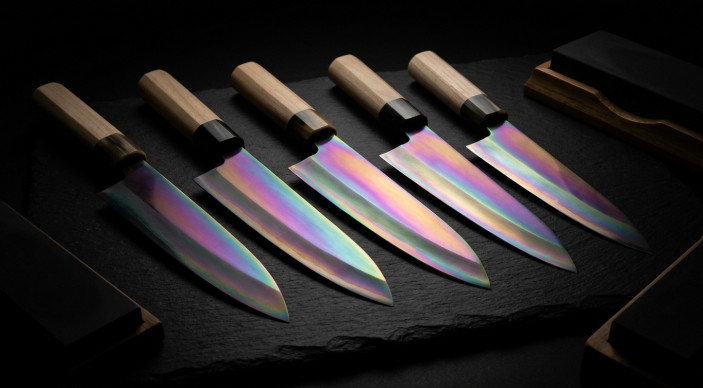
Rather than chasing new designs, the range of Togashi knives focuses on time-tested profiles, each shaped and balanced for a specific task:
- Gyuto (chef’s knife):the all-rounder. A thin edge paired with a controlled spine thickness makes it smooth for push cuts and slicing while staying stable on the board.
- Yanagiba (sashimi slicer):long, narrow, and single-bevel. It is designed to cut raw fish in one long pull, with a carefully hollowed back (the ura) that helps slices release cleanly.
- Deba (fish butchering knife):thick-spined with a strong heel, built for breaking down whole fish. Despite its weight, a well-made deba still cuts with precision.
- Kiritsuke:recognizable by its angled tip and long, straight edge. Traditionally a single-bevel hybrid of the yanagiba and the usuba (vegetable knife), it handles both fish and vegetables but demands solid technique.
- Takohiki (octopus slicer):the Tokyo-style counterpart to the yanagiba, with a straight edge and squared tip. Despite its name, it is used for all kinds of sashimi, not just octopus.
How to Choose Your First Sakai Knife
If you are new to traditional Japanese knives, a few simple guidelines help:
- Start with a gyutoif you want one knife for most daily kitchen work. It is double-beveled and the easiest to learn.
- Choose single-bevel knives for specific tasks.A yanagiba or deba rewards practice, and each one is made for a specific hand, so left-handed cooks need a left-handed version.
- Pick Shirogamiif you enjoy sharpening and want the keenest possible edge. Pick Aogami if you prefer an edge that lasts longer between sessions.
- Plan for carbon steel care.Wipe and dry the blade right after use, and sharpen on water stones.
Craft You Can Feel in Every Cut
Togashi knives show that tradition is not about standing still. It is about refining the same shapes, steels, and techniques until each blade does its job almost perfectly. From a home kitchen to a sushi counter, that precision is something you feel with every slice.
Which Japanese knife type would you add to your kitchen first: a versatile gyuto or a dedicated single-bevel slicer like a yanagiba? Tell us in the comments.