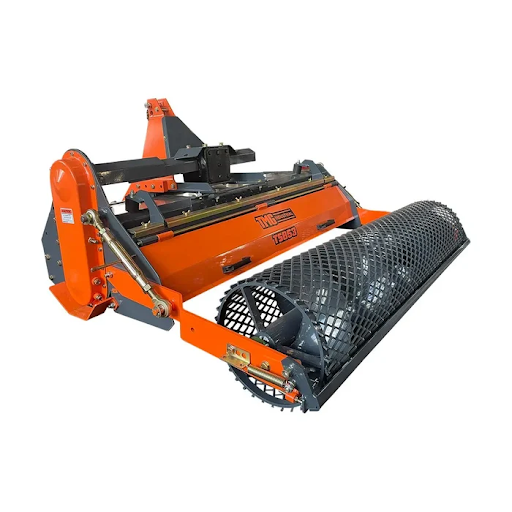
Ground that grows a good seedbed and ground that is full of stones are very often the same ground. Anyone preparing a paddock, a turf field or a market garden eventually has to decide what happens to those stones, and the two available answers lead to quite different machines. A rotary tilling stone burier takes the second answer, and the consequences run deeper than the name suggests.
Picking stones moves the problem rather than solving it
A rock picker lifts stones out of the profile and puts them somewhere else, which is the right call when the stones are large enough to damage equipment. The limitation is that it remains a one way operation: every pass removes material from the field, and the windrows then have to be dumped, hauled or buried at the headland.
Smaller stones also defeat it. Below roughly two inches, a rock picker struggles to separate stone from soil, and those are exactly the stones that chip a mower blade or spoil a turf surface. They stay in the top layer, where traffic and frost keep bringing them back up again.
What burying actually does to the profile
Burying reverses the sort order instead of removing material. On a rotary tiller built as a burier, the rotor lifts the top few inches, a grid behind it lets fine soil fall through first, and the stones and clods ride over the top to be laid down underneath those fines.
The result is a layered profile: a clean, fine seedbed on top and a coarse layer beneath it. That coarse layer is not waste. It drains, it resists compaction, and on a sports field it keeps the rootzone from turning into a sealed pan after a wet winter.
Depth is what decides whether the layering holds. Working around five inches puts the stone layer far enough down that normal cultivation, mowing and foot traffic never reach it. Shallower than that, and the following season brings most of it back to the surface.
Rotor speed is the setting most operators leave alone
Adjustable rotor speed changes the size of the aggregates the machine produces, and on any rotary tiller it is the control that separates a seedbed from a dust bowl. Faster rotation strikes each clod more times per pass, which produces a finer tilth and consumes noticeably more power.
Finer is not always better. A surface worked to powder crusts after rain and sheds water instead of taking it in, which is a familiar problem on sand based rootzones. A slower rotor leaves slightly larger aggregates that hold the surface open and resist capping.
Where this machine sits next to the alternatives
A power harrow stirs the top layer with vertical tines and inverts nothing, so stones stay exactly where they are. It is faster across a field and lighter on power, which suits ground that has already been cleaned up in an earlier season.
A pto tiller mixes aggressively, but it mixes everything together, stones included, which leaves the same surface problem in a looser form. Neither implement produces a layered profile, so on genuinely stony ground the real choice sits between hauling stone away and putting it underneath, which is the gap a burying rotary tiller is built to fill.
Drive layout and what it costs in maintenance
Side chain drive puts the final reduction in a sealed case at one end of the rotor rather than in a central gearbox. The rotor then runs clear across the full working width, with no gap in the middle and no housing dragging a ridge through soft ground.
Chains also tolerate shock better than a gear train does. When the rotor meets a buried stone that will not move, something has to absorb that load, and a chain case is cheaper to open and service than a gearbox is to rebuild.
Four checks before the first pass
Four checks cover most of the decision:
- Tractor power inside the quoted range
- Working width against rear wheel track
- Rear gate adjustment for surface finish
- Depth control that holds on slopes
The rear gate deserves separate mention because it does the final leveling. Raised, it leaves a rougher surface that suits grass seeding; lowered, it presses the fines into a smooth finish for turf or vegetable beds. That one lever changes what the machine is producing.
What a listing leaves out
Dealers list working width and horsepower, which answers whether the implement will run but says little about what it produces. Rotor speed range, working depth and gate adjustment describe the finish, and those become the numbers that matter once the tractor question is settled.
TMG Industrial builds this one at 53 inches with five inches of working depth and an output near 2,100 to 2,800 square meters per hour on 28 to 40 horsepower. Ground that has been buried properly once rarely needs doing again, which makes seedbed preparation worth planning around the profile you want rather than the hours it saves.