Skincare trends tend to circulate in waves. One season it is snail mucin; the next, it is exotic botanical extracts. Yet, while trendy ingredients capture headlines, dermatology professionals consistently rely on a core group of proven compounds to resolve persistent texture issues, stubborn dryness, and compromised skin barriers. Chief among these time-tested workhorses is urea.
For busy working women navigating daily environmental stressors, fluctuating weather, and tight schedules, maintaining smooth, supple skin often feels like a moving target. Complex ten-step routines are rarely sustainable, leading many to seek multitaskers that deliver measurable clinical results. Understanding how high-performance humectants function at a cellular level is the fastest route to streamlining a daily regimen without sacrificing efficacy.
The Science of the Skin Barrier and Natural Moisturizing Factors (NMF)
To appreciate why certain ingredients excel over standard lotion formulations, it helps to examine how the stratum corneum—the outermost layer of the skin—retains moisture.
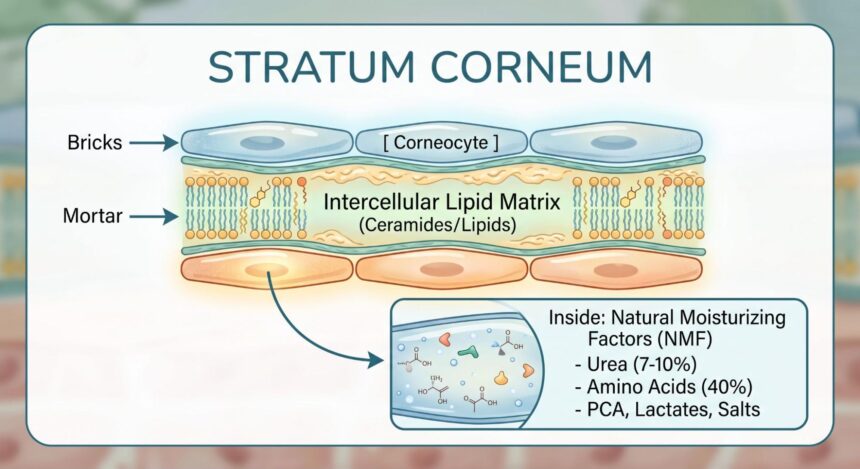
The stratum corneum is often described as a brick-and-mortar structure. The “bricks” are corneocytes (dead skin cells packed with keratin), while the “mortar” consists of a dense lipid matrix composed of ceramides, cholesterol, and free fatty acids. Nestled inside those corneocytes is a complex mixture of water-soluble compounds known as Natural Moisturizing Factors (NMF).
NMF compounds account for roughly 20% to 30% of the stratum corneum’s dry weight. They act as microscopic magnets, attracting ambient water and binding it within the cells to maintain elasticity, softness, and healthy enzymatic function.
Key Components of NMF
- Amino Acids (~40%): Provide foundational hydration and acid-base balance.
- Pyrrolidone Carboxylic Acid (PCA) (~12%): A potent hygroscopic molecule that draws moisture from air and deeper skin layers.
- Lactates (~12%): Help regulate skin pH and maintain moisture retention.
- Urea (~7–10%): A crucial organic compound essential for intracellular hydration and keratin regulation.
When environmental factors—such as dry office air conditioning, low winter humidity, or harsh cleansers—deplete NMF levels, skin loses its ability to hold water. The result isn’t merely surface dryness; it leads to micro-flaking, compromised barrier function, and enhanced sensitivity.
The Dual-Action Mechanism: Keratolytic vs. Humectant Properties
Most standard body lotions and face creams rely heavily on occlusives like petrolatum or dimethicone to form a barrier atop the skin. While occlusives prevent trans-epidermal water loss (TEWL), they do not inherently add water back into dehydrated tissue, nor do they address rough, dead cell accumulation.
This is where multi-functional humectants differ. Depending on its concentration within a formulation, urea performs two distinct, clinically proven functions:
1. Low-to-Moderate Concentrations (2% – 10%): Deep Humectant Action
At lower percentages, the compound functions as a super-humectant. It penetrates deep into the stratum corneum, altering the physical structure of proteins to expose more water-binding sites. While hyaluronic acid sits primarily on top of the skin due to its larger molecular structure, smaller NMF molecules migrate into the upper epidermal layers to replenish lost moisture stores directly.
When evaluating hydration strategies for rough hands, elbows, or heels, understanding what is urea and how it integrates into barrier restoration helps explain why simple plant oils often fall short for severely dehydrated skin.
2. High Concentrations (10% – 30%+): Keratolytic Action
At elevated percentages, its role shifts from simple hydration to gentle exfoliation (keratolysis). It works by breaking down the hydrogen bonds that bind keratin proteins together in the outer skin layers.
Unlike physical scrubs or strong alpha-hydroxy acids (AHAs) that can cause micro-tears or irritation, keratolytic humectants break down dead skin buildup smoothly while simultaneously flooding the area with moisture. This makes high-percentage formulas particularly effective for localized hyperkeratotic conditions like:
- Calloused heels and cracked hands from frequent washing or standing.
- Keratosis Pilaris (KP), commonly referred to as “chicken skin” on the backs of arms and thighs.
- Rough, flaky elbows and knees caused by chronic friction.
Streamlining Skincare for the Modern Working Professional
Between managing careers, family commitments, and personal wellness, few women have the time to research long, multi-product routines. The goal of modern dermatological care is efficiency: achieving maximum skin health with minimal friction.
Incorporating smart NMF-replenishing products into a daily routine eliminates the need for separate exfoliants and heavy body creams.
Smart Formulation Pairing Strategy
To maximize results without causing skin sensitivity, consider how active ingredients interact across your routine:
| Ingredient Combination | Primary Benefit | Application Tip |
| Urea + Ceramides | Complete barrier reconstruction | Ideal for winter months or dry office environments. |
| Urea + Lactic Acid | Enhanced keratolylsis for rough skin | Best used on feet, heels, and body textures 2-3x weekly. |
| Urea + Niacinamide | Soothing hydration & redness reduction | Excellent for stressed hand skin suffering from frequent sanitizing. |
Restoring Radiance Through Smarter Ingredients
A healthy skin barrier requires more than surface-level smoothing; it demands bio-compatible ingredients that work in harmony with natural physiological processes. By prioritizing ingredients that mirror the skin’s inherent Natural Moisturizing Factors, you shift your routine from temporary masking to true structural support.
Whether you are seeking to repair over-sanitized hands, smooth stubborn body texture, or maintain a resilient moisture barrier through demanding workweeks, turning to scientifically validated NMF replenishers is one of the most effective upgrades you can make to your personal care toolkit.
Which ingredients have made the biggest difference in your daily skincare routine? Have you tried functional humectants for targeted dry spots? Share your experience in the comments below!