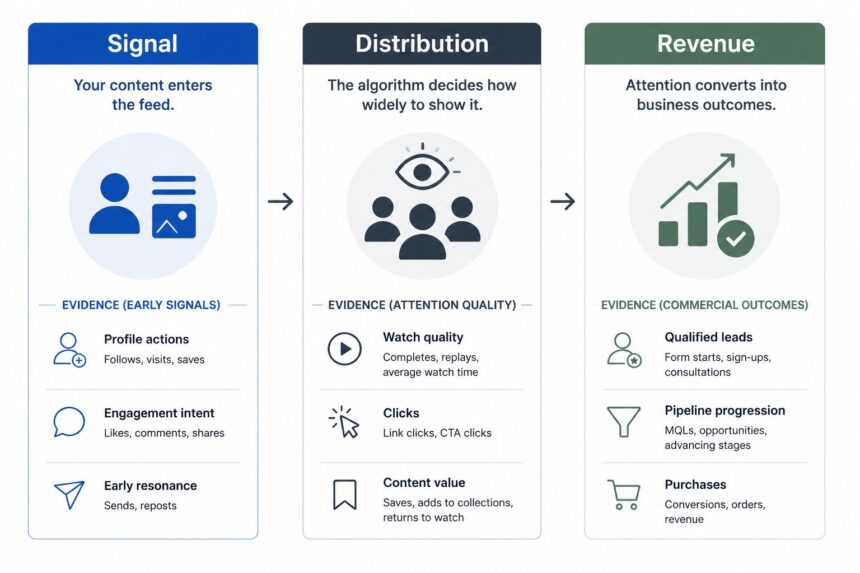
A bigger TikTok follower count can be visible growth without being business growth. The key question is not simply whether the number rose, but what job it was meant to do: improve a first impression, create distribution, or contribute to revenue.
That distinction is essential when deciding whether buying TikTok followers works. A visible count may be noticed by profile visitors; it does not, by itself, demonstrate that videos reached relevant people or that customers took action. Direct causal evidence that purchased TikTok followers increase reach, leads, or revenue remains limited. Results can vary by niche, geography, account maturity, content quality, audience fit, and the conversion objective.
The practical rule: follower growth is evidence of a changed number. Signal, distribution, and revenue each require their own behavioural or commercial evidence.
The three jobs of a follower number
A follower count can be evaluated as a signal, but distribution and revenue require separate behavioural or commercial evidence.
| Job | What it means | Evidence that fits the job |
|—|—|—|
| Signal | A visible cue of scale or popularity during a first impression | Profile actions, qualitative review, controlled brand or conversion testing |
| Distribution | Relevant people seeing, watching, and responding to content | Reach, watch-quality measures, meaningful engagement, profile visits, clicks |
| Revenue | Commercial outcomes linked to activity | Qualified leads, purchases, CAC, ROAS, and incremental lift |
These jobs can occur in the same customer journey, but one does not automatically produce the next. Someone may view a high follower count, then decide not to watch a video. A viewer may watch but never visit a profile. A click may not become a purchase.
Job one: signal is a hypothesis, not a conversion claim
Follower count is a popularity cue. Peer-reviewed research in Electronic Commerce Research and Applications and the Journal of Interactive Marketing has found that visible popularity-related and social-selling cues can influence perceptions such as trust or product quality, with possible implications for attitudes and purchase intention.
Those findings are useful context, not proof that bought TikTok followers create credibility or sales. They concern adjacent social-media and social-commerce settings, and they do not establish that a purchased TikTok count produces incremental revenue.
Signal value also depends on whether the rest of the profile supports the impression. Visitors can compare the follower total with recent views, comment quality, posting consistency, creator expertise, product relevance, and video quality. Large mismatches between public signals may prompt scrutiny rather than confidence.
Treat the possible signal effect as a testable profile hypothesis. Define a desired action and measure whether visitors become more likely to take it.
Profile conversion rate is the number of profile visitors in a defined cohort who complete a defined profile-level action, divided by all profile visitors in that same cohort and time period.
> Profile conversion rate = desired profile actions during the period / profile visits during the same period
For example, the numerator might be unique website clicks, follows, enquiries, email sign-ups, or TikTok Shop actions from profile visitors. Use the same action definition, audience cohort, country set, and observation window before and after a test. A higher count without a change in the selected profile action does not support the signal hypothesis.
Job two: followers are not distribution
Distribution means that relevant people encounter and consume content. It is better assessed through views, reach where available, watch quality, meaningful engagement, profile visits, and clicks than through the follower total.
For a consistent content cohort, define engagement rate as meaningful engagements divided by video views, measured over the same fixed observation period. “Meaningful engagements” should be specified in advance—for instance, likes, comments, shares, saves, or a narrower set such as comments and shares. Do not compare a 24-hour engagement rate for one group of posts with a 14-day rate for another.
> Engagement rate = defined engagements on videos published in the cohort / views of those videos, measured within the same window
Watch-quality metrics describe consumption depth rather than just exposure. Two usable versions are average watch time divided by video length, and completed views divided by total views. Calculate either for videos published during a stated period, among the same geography or audience segment where possible, using an identical post-publication window. These measures are only useful if the available analytics definitions remain stable across the comparison.
When assessing a provider, the useful question is not whether a followers service promises a larger count. It is what is supplied, what can be independently verified, and which downstream behaviour the intervention is expected to change. A provider description is not evidence of future audience relevance, active engagement, recommendation performance, or conversions.
The number-to-behaviour gap
Movement in one metric does not establish movement in the next; measure each stage of the journey separately.
Use ratios to spot questions worth investigating:
| Diagnostic ratio | Formula | What it can reveal |
|—|—|—|
| Views-to-followers | Views on a defined video cohort / follower count at cohort start | Whether content consumption moves with visible scale |
| Engagement-to-reach | Defined engagements / views or reach for the same cohort | How reached viewers respond |
| Profile-visits-to-follows | New follows / profile visits in the same period | Whether profile visitors choose to follow |
| Followers-to-clicks | Unique website clicks / follower count in the same period | Whether scale has a relationship with traffic intent |
| Followers-to-conversions | Qualified leads or purchases / follower count in the same period | Whether scale has a commercial relationship |
These are diagnostic ratios, not universal benchmarks or causal proof. They can change because of creative quality, seasonality, offer changes, paid campaigns, creator activity, tracking changes, or shifts in audience mix. A comparable control period, matched content set, split test, or exposed-versus-control design is needed to make a credible causal claim.
A fast-changing follower denominator can also make account-wide rates difficult to interpret. Keep pre- and post-intervention reporting separate, and rely on cohort-based view, click, lead, and purchase measures when evaluating current performance.
Job three: revenue needs attribution and a counterfactual
Revenue is the strictest job. Define the outcome before testing:
- Qualified lead: an enquiry meeting pre-agreed fit criteria, rather than every form submission.
- Customer acquisition cost (CAC): attributable acquisition spend divided by new customers acquired in the stated period.
- Return on ad spend (ROAS): attributable revenue divided by advertising spend for the defined campaign and attribution method.
- Assisted conversion: a conversion in which TikTok influenced the journey but was not the final recorded touchpoint.
- Incremental lift: outcomes that occurred because of the intervention and would not otherwise have occurred.
TikTok’s measurement documentation distinguishes attribution from incrementality and describes experiments, including lift studies and split tests, for assessing additional business outcomes. Attribution can help map TikTok’s role in a journey; it does not by itself show that an intervention caused an extra purchase.
Attribution windows matter. A short last-click window can understate discovery that later converts through search, direct traffic, or another channel. A broader window can overstate TikTok’s contribution. Record the reporting source, market, date range, conversion definition, attribution model, and window with every result. Platform and third-party reports may differ because their methods and settings differ.
Bought followers, paid reach, creator partnerships, and content
Compare tactics by audience relevance, measurable action, credibility, incrementality, cost, and long-term value rather than headline volume.
| Tactic | Primary intended job | Better evaluation question |
|—|—|—|
| Bought follower growth | Visible scale | Did a defined profile action improve versus a credible comparison? |
| Paid TikTok reach | Targeted distribution | Did the target audience create incremental qualified actions? |
| Creator partnership | Borrowed relevance and credibility | Did suitable viewers take measurable actions? |
| Organic content | Repeatable owned learning | Which topics and formats produce sustained quality attention? |
No option is inherently best in every case. Compare them by audience relevance, measurable action, credibility, incrementality, cost, and long-term asset value—not headline volume. A creator partnership may offer a relevant audience but still require conversion measurement. Paid distribution can be targeted but still needs a clear causal evaluation. Organic content can build a repeatable learning loop but may take time.
A practical test plan
A credible test starts with one assigned job, a defined metric, a comparison, and a pre-agreed stop rule.
- Assign one job. Is the goal awareness, profile credibility, qualified leads, ecommerce purchases, or creator-partnership readiness?
- Choose one primary metric. For awareness, use qualified profile visits; for lead generation, qualified leads; for ecommerce, incremental purchases, CAC, or contribution-margin context—not follower growth alone.
- Build a baseline. Use a representative pre-test period and record posting cadence, content topics, views, watch quality, profile visits, clicks, leads, and sales.
- Create a comparison. Where feasible, use a control group, split test, matched time period, or comparable content cohort. Log promotions, paid media, site changes, press, and creator activity.
- Track secondary behaviour. Use watch quality, meaningful engagement, profile visits, and clicks to explain movement in the primary metric.
- Set attribution rules. Lock the conversion definition, reporting tool, window, and review period before interpreting results.
- Set a stop rule. Stop or replace the tactic if the agreed observation window ends without the behavioural or commercial lift required for its stated job.
Credibility and policy checks
Review current platform rules before acting, since policies and enforcement can change. TikTok’s current Integrity and Authenticity guidance prohibits trading or marketing services that artificially increase engagement, and states that inauthentically inflated followers or likes may be removed. That is a platform-policy consideration, not a legal conclusion or a prediction about every account or provider.
For creator evaluation, follower count should be a screening cue at most. Review recent content, audience fit, public engagement patterns, brand suitability, traffic evidence, and conversion reporting before making a commercial decision.
Decision rule
A purchased number may be tested as a limited first-impression signal, but direct causal evidence for bought TikTok followers remains limited. Do not treat that number as distribution or revenue without measured behavioural and commercial lift.
Continue only if the tactic produces defensible value for its assigned job. If followers rise while profile actions, qualified traffic, leads, or purchases remain flat against a credible comparison, the outcome is cosmetic growth—not demonstrated business growth.
The number may be a signal hypothesis. Behaviour is evidence of distribution. Incremental commercial lift is evidence of conversion.