A branded game is able to do something a static ad or a social post can’t: engage a customer to become a participant, just for a few seconds. Engagement tapping, which involves tapping, choosing and playing, is likely to be more memorable than skimming over a picture and is becoming a more popular choice for small businesses to differentiate themselves in an overcrowded feed for free.
For most small businesses, the reasons it wasn’t common until recently were simple: they didn’t have the developer, the budget and the weeks of lead time required to build a custom game for a single campaign. An ai game builder does that math and delivers a business-branded game to your doorstep within a day.
What Kind of Game Actually Works for a Small Business
Not every idea needs to be elaborate. There are some of the best brand games that are simple to make, like a matching game with pictures of your product, a trivia round about your brand’s history, or a “guess the price” game for a sale. The idea isn’t to create something with extended playability, but to develop a 30-90 second interaction that, in its entirety, leaves a positive and memorable brand impression.
A 3d game maker online can add a bit more depth to a flat quiz format for companies that require more than that. It can be useful for when you’re launching a product or when you want the game itself to be part of the event when you’re in a retail store.
Where Branded Games Fit Into a Campaign
- Social media contests: a shareable game link tied to a giveaway or discount code
- In-store or event activations: a quick game on a tablet or QR code at a booth
- Email campaigns: an interactive element embedded in a newsletter to boost click-through
- Product launches: a themed mini-game that introduces a new product in a memorable way
These contexts are all well-suited to the casual games format: short, low stakes, entry without instructions.
Building One Without a Marketing Tech Team
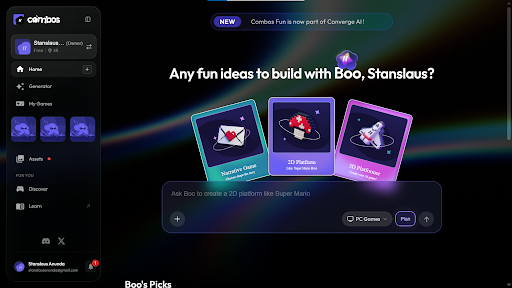
The first step is to enter your campaign objective into the AI game agent Boo, what you’re promoting, the tone you wish to convey, and any specific branding elements, such as colors or product names. Boo then produces a design document and initial build based on that brief, which can then be modified in the no-code editor to swap images, adjust the difficulty or add/remove copy to match your campaign’s voice to perfection.
Since there is no coding to do, a single marketer or small business owner can produce a game from scratch and publish it without bringing in outsiders. This is particularly important if a campaign needs to be delivered in time for a holiday sale, a local event, or a limited-time promotion, for which there’s no time to wait a few weeks for a custom build.
Measuring Whether It Worked
These games can be shared via a link, making it easy to track how far players are progressing. You can see the number of clicks on the link, time spent on the page, or whether the player has completed the page with the discount code at the end. If a game with a brand name did well, then there’s a lot to be learned from a simple uptick in link sharing or a distinct increase in redemptions.
Common Mistakes to Avoid
The most common error is to make the game too complicated for the situation it’s intended to address. A customer at a farmers market won’t want to spend 10 minutes at a farmers market booth just to scan a QR code. To do this, tailor the game to the time span in which it is supposed to be played, and favor “quick and polished” over “elaborate and half-finished.
The second error is to view the game as a single event rather than repeat it. After the game is created under a brand, releasing new ones for a new campaign (new products, new season theme, new discount code) takes only a small fraction of the time because the structure, mechanics and gameplay are already proven.
A Simple Example Worth Copying
Picture a small coffee shop planning to launch a loyalty program. Instead of just providing a graphic announcing the new program, they create a quick “spin the wheel” game that lets the customer win a free add-on or a discount code. It was very easy to assemble; they brand it as much as they like, and the build was done in an afternoon, not a contract engagement. That’s the kind of project this approach is built for not a flashy centerpiece campaign, but a small, well-executed interactive touch that a static post could never deliver on its own.
The logic scales up to the same. Each of the following is an example of a branded game that comes in at a much lower cost than a traditional agency game activation just a few seconds of a game and a memorable brand experience. From there, a variety of examples of branded games that can add a layer of engagement and cost a fraction of what a traditional agency-built game activation would.
Why This Matters Now
The budgets of small businesses are almost always more constrained than the budgets for marketing campaigns. Until now, any development budget was necessary to build a branded, interactive game. A small business can’t match that interactive content that used to take an agency and a lot more budget to create anymore with a prompt-driven, no-code platform.