Almost every discussion of storm vehicles eventually leans on the same phrase: paintless dent repair. It is invoked as the reason the damage is cheap to fix, the reason the discount is worth capturing, and the reason a dimpled roof is not the disaster it looks like.
But the phrase gets used far more than it gets explained. What is actually happening when a technician repairs a dent without paint, why does it work, what does it cost, and where does it stop working? These questions determine whether a given vehicle is a bargain or a trap, and they deserve a real answer rather than a slogan.
What the Technician Is Actually Doing
A hail dent is a piece of metal that got pushed past its yield point and stayed there. The panel did not break, tear, or lose material. It simply took a new shape, and that shape has internal stress locked into it, which is what keeps the dent from springing back on its own.
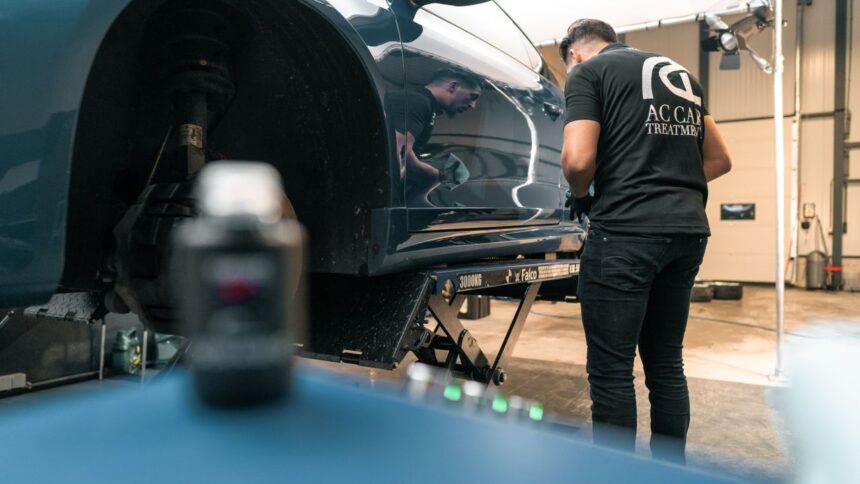
The repair works from the back side. The technician gets behind the panel, sometimes through an existing access hole, sometimes by removing an interior trim panel or a liner, and uses steel rods to apply precise pressure to the exact center of the deformation. Small, repeated pushes, working from the outside of the dent toward the middle, gradually release the stress and let the metal return toward its original geometry.
The work is read through a reflective light board. The technician is not looking at the dent directly; they are looking at how a line of light bends as it crosses the panel. A straight reflection means flat metal. A wobble means the shape is still off by a fraction of a millimeter. This is why the job takes as long as it does. The pushing is easy. Knowing exactly where to push, by how much, and when to stop is the skill.
Why No Paint Is Involved
The name describes what is missing. There is no filler, no sanding, no primer, no basecoat, no clearcoat, no color match, no blending into adjacent panels.
This is possible only because automotive paint is more flexible than most people assume. Modern finishes stretch with the metal underneath them rather than shattering, so a dent that pushed the panel inward carried the paint along without breaking the film. When the metal comes back, the paint comes back with it, unbroken the entire time.
The consequence is significant and often understated: the factory finish survives. A repainted panel is detectable forever, by a paint meter, by a careful eye in the right light, and by every dealer who appraises the car for the rest of its life. A properly repaired panel is not detectable, because nothing about the finish changed. For anyone weighing hail damage cars for sale as an investment rather than just transportation, this is a large part of why the repair economics work.
What Drives the Cost
The pricing is not mysterious, and it does not scale with how dramatic the car looks.
Dent count is the primary driver. Each dent is a discrete unit of work, so forty dents is roughly five times the job that eight dents is. Size matters too, but less than people expect: a large, shallow dent is often easier than a small, sharp one, because the sharp one has more concentrated stress in a smaller area.
Access is the second driver. A hood is open underneath and easy to reach. A roof has structural bracing, headliner, wiring, and airbag components behind it, and getting a rod to the right spot may require removing trim or working through a narrow gap. Some panels are effectively sealed and require different techniques entirely, which cost more.
Material is the third. Aluminum has less memory than steel and works harder, requiring more passes and more patience. Panels with high-strength steel resist the same way. A vehicle with aluminum body panels will quote noticeably higher than an equivalent steel car with identical damage.
The valuable part of all three factors is that they are visible in advance. A shop can look at the car and quote it accurately before you spend anything. That is unusual in damaged-vehicle work, where the estimate is usually a guess until something comes apart.
Where the Technique Fails
The limits matter more than the capabilities, because they are what separate the good listings from the bad ones.
Broken paint is the hard stop. If the hail cracked, chipped, or flaked the finish at the bottom of a dent, pushing the metal back does not repair the paint. That panel now needs conventional bodywork, refinishing, and blending, at several times the cost and with a permanently detectable repair. One panel with broken paint can change a quote more than fifty extra dents elsewhere on the car.
Creases are the second limit. A crease is a dent with a fold in it, where the metal did not just deform but doubled over on itself along a line. The stress in a crease is distributed differently and often cannot be fully released. Hail rarely produces creases on flat panels, but it can on body lines, where the panel was already bent by design.
Previous repair is the third. If a panel has filler in it from an earlier incident, the technique will not work, because the rods push metal and filler does not respond the way metal does. This is one reason to pull the history on any hail car for sale rather than assuming the storm is the whole story.
And stretched metal is the final one. Very severe impacts can stretch the panel rather than merely deforming it, and stretched metal has more surface area than it started with. Push it back and it will not lie flat, because there is now too much material for the space. This shows up as a slight oil-canning wave. It is uncommon with hail, but it is the reason enormous stones are worse than many small ones.
How to Use This When You Shop
All of this reduces to a very short inspection routine that costs nothing and eliminates most of the category’s downside.
Zoom in on the dents in the listing photos and look for broken paint. This one check is worth more than everything else combined, because it is the difference between a cheap fix and an expensive one, and between a car that will never rust from the storm and one that will.
Count roughly and note distribution. Damage confined to horizontal surfaces means a vertical storm and easier work. Damage wrapped around doors and quarter panels means wind was involved and the job is bigger.
Identify the panel material for the model. If the vehicle uses aluminum for the hood or doors, add to your estimate accordingly.
And then get a quote before you bid, not after. Send the photos to a repair shop and ask for a range. Most will give you one. That number, plugged into your ceiling, is what keeps a good deal from becoming a mediocre one at a hail damaged car auction where the excitement is running high.
The Reason the Whole Category Works
Strip everything else away and this repair technique is the load-bearing element under the entire storm car market. Without it, dents would require conventional bodywork on every panel, the repair cost would approach the discount, and there would be no gap to exploit.
With it, a car that lost a large share of its value on paper can be restored, invisibly, for a fraction of that loss, using a technique that has been refined for decades and requires no paint at all. Buyers looking at hail damage vehicles are not betting on a hopeful fix. They are relying on a mature process with known limits, all of which are visible in a photograph before a single dollar changes hands.